
Explore the functionality, types, applications, and limitations of Infrared Body Temperature Scanners, crucial tools in today’s health-conscious world.
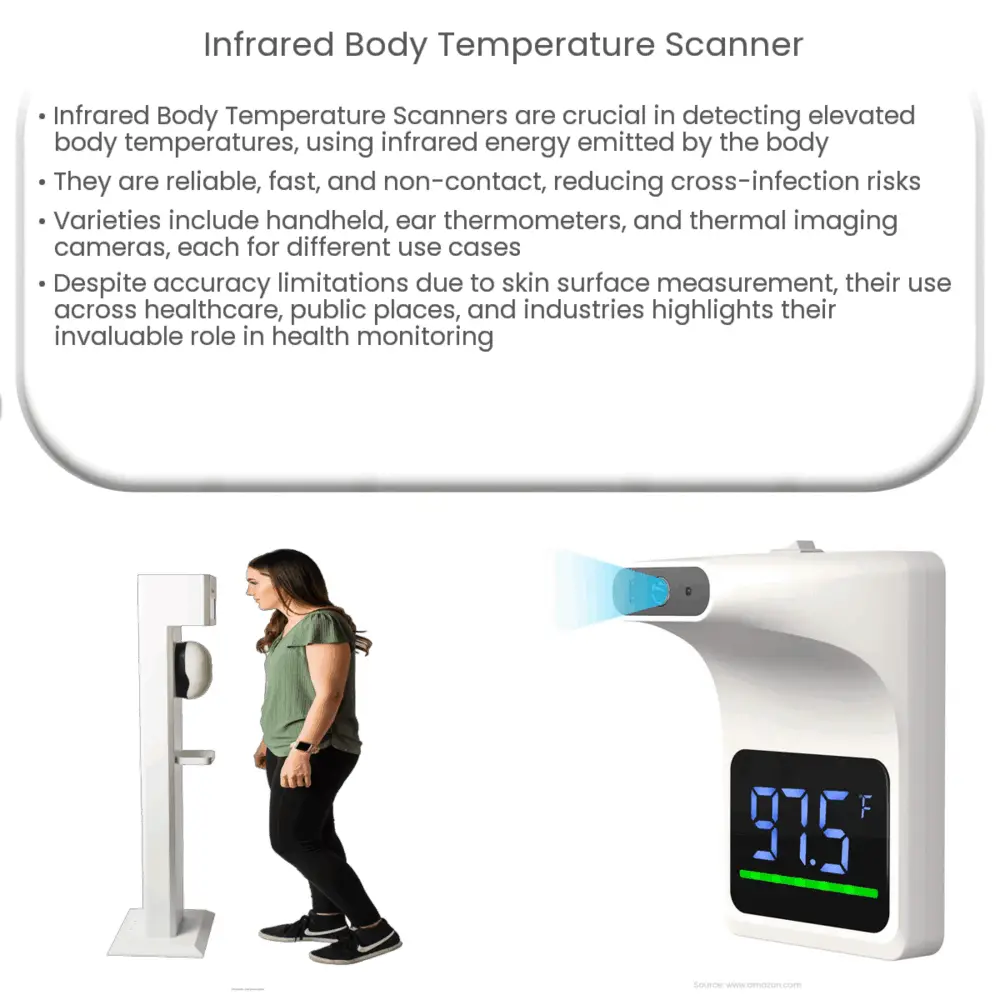
Infrared Body Temperature Scanners: An Essential Tool in a Modern Health-Conscious Society
With the rise of global health concerns in the 21st century, technology has risen to the challenge of providing innovative solutions. One such advancement is the Infrared Body Temperature Scanner, an essential tool for detecting elevated body temperatures, which could be a symptom of various health conditions.
Infrared body temperature scanners, also known as infrared thermometers, operate on the principle of infrared technology. They detect and measure the amount of infrared energy emitted by the body. This energy is converted into a temperature reading, providing a non-invasive and efficient way to measure body temperature.
Working Principle of Infrared Body Temperature Scanners
The technology behind infrared body temperature scanners is both fascinating and complex. They rely on the concept that all objects, including the human body, emit infrared energy. This energy increases with the object’s temperature, meaning that warmer objects emit more infrared energy. Infrared thermometers detect this energy, convert it into an electrical signal, and display it as a temperature reading. This operation is carried out without any physical contact, making these devices particularly advantageous in various situations.
- Accuracy: Although these devices may not offer the precision of traditional thermometers, they are reliable enough for mass temperature screenings, often providing accuracy within 0.5°C.
- Speed: These scanners can take a temperature reading in seconds, making them significantly faster than traditional thermometers.
- Non-contact: Perhaps the most significant benefit is the ability to measure temperature without physical contact, reducing the risk of cross-infection.
Types of Infrared Body Temperature Scanners
There are several types of infrared body temperature scanners available on the market, each designed for specific use cases. Here are the most common types:
- Handheld Infrared Thermometers: These are portable, easy to use, and are commonly used in many households and businesses. They are pointed at a person’s forehead to read their body temperature.
- Infrared Ear Thermometers: These thermometers take readings from the ear canal, offering a more direct and reliable body temperature reading.
- Infrared Thermal Imaging Cameras: These are often used in crowded places, like airports or malls, to scan multiple people at once for elevated temperatures.
Applications of Infrared Body Temperature Scanners
Infrared body temperature scanners have found widespread use due to their convenient and non-invasive nature. Here are a few notable applications:
- Healthcare: In healthcare settings, these devices provide a quick, efficient, and non-invasive way to monitor patients’ temperatures. This is especially important in contagious situations where contact needs to be minimized.
- Public Places: Airports, malls, schools, and workplaces use infrared scanners for mass temperature screening, helping to detect potential health risks and ensure public safety.
- Industrial Use: These scanners are used in industries to detect overheating or thermal irregularities in machines or processes, preventing potential accidents and ensuring smooth operation.
Limitations of Infrared Body Temperature Scanners
While infrared body temperature scanners provide numerous benefits, it’s important to note their limitations. These devices measure the temperature of the skin surface, not the internal body temperature. Hence, they may not accurately represent a person’s core body temperature. Additionally, various factors like perspiration, environmental temperature, and improper use can impact the accuracy of readings.
Conclusion
Infrared body temperature scanners have revolutionized the way we measure body temperature, offering a swift, non-contact method that reduces the risk of cross-infection. These tools have become invaluable, not just in the healthcare industry but also in public spaces and industrial settings. Despite their limitations, their convenience, speed, and safety make them a vital part of our modern, health-conscious society. They embody how technology can step up and offer effective solutions to global health challenges.