
Explore the functionalities, advantages, and applications of Inductive Spectrum Analyzers in RF engineering and telecommunications.
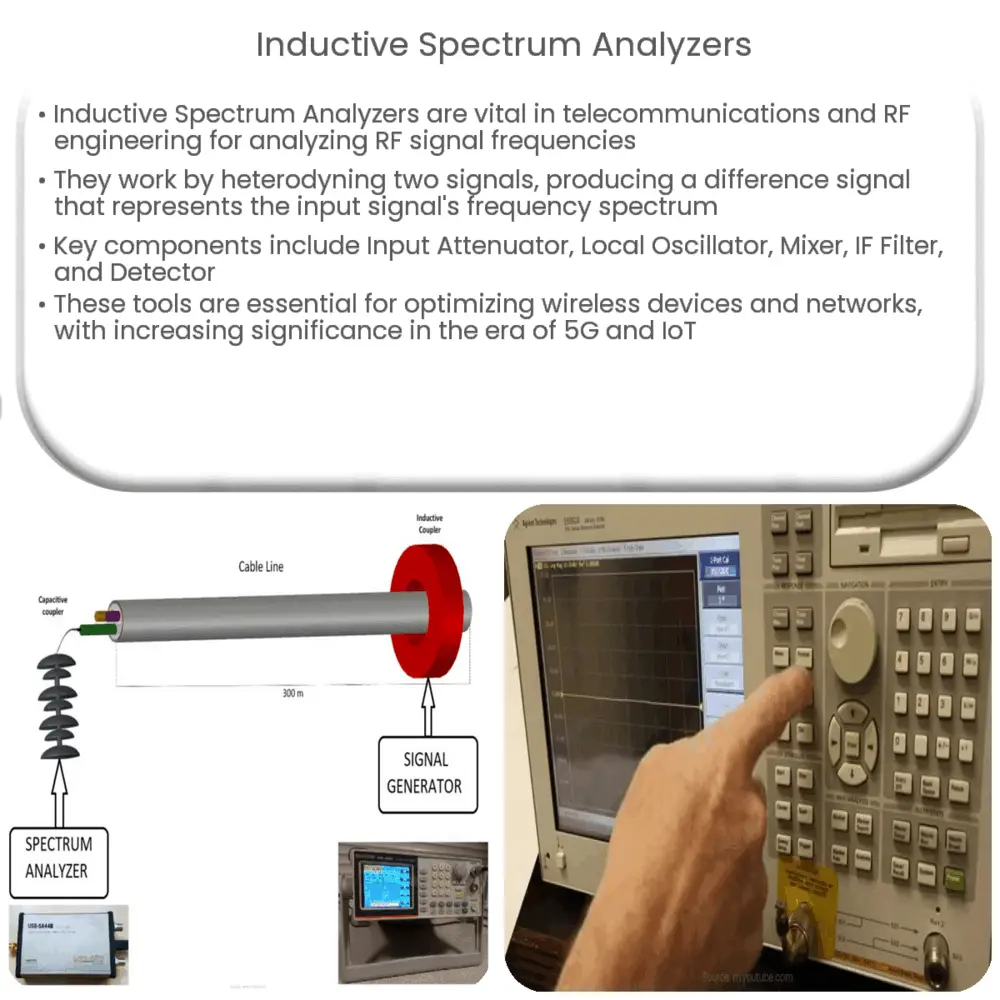
Understanding Inductive Spectrum Analyzers
Inductive Spectrum Analyzers are powerful tools extensively used in the field of telecommunications, radio frequency (RF) engineering, and electronics. They are essential for measuring, analyzing, and testing the frequency spectrum of RF signals, enabling comprehensive monitoring of signal integrity and performance.
The fundamental concept behind an Inductive Spectrum Analyzer is based on inductive coupling, which is the transfer of energy from one circuit component to another through a shared magnetic field. This phenomenon is utilized to selectively probe different frequency components of the signal in question.
How Inductive Spectrum Analyzers Work
Inductive Spectrum Analyzers operate on the principle of heterodyning or mixing two signals to produce new frequencies. A local oscillator (LO) generates a signal which is combined with the input signal, creating a difference signal. This difference signal is then processed and measured, providing a precise representation of the spectrum of frequencies present in the input signal.
Key Components of an Inductive Spectrum Analyzer
- Input Attenuator: This component controls the level of signal that enters the analyzer, preventing potential damage due to excessively strong signals.
- Local Oscillator: As previously mentioned, this generates a signal that’s combined with the input signal, resulting in a difference frequency.
- Mixer: The mixer combines the input signal with the LO signal, thereby producing the difference signal.
- Intermediate Frequency (IF) Filter: This filter removes unwanted frequency components, isolating the difference signal for further processing.
- Detector: The detector measures the amplitude of the difference signal, which corresponds to the strength of a particular frequency in the input signal.
Applications of Inductive Spectrum Analyzers
Inductive Spectrum Analyzers have a wide range of applications across various domains. These include:
- Testing and troubleshooting RF and microwave devices.
- Performing signal and network analysis in telecommunications.
- Enabling the design and development of wireless technology, including mobile communications and Wi-Fi.
These indispensable devices provide professionals with vital information regarding signal performance, facilitating the optimization of wireless networks and devices for peak efficiency.
Advantages of Inductive Spectrum Analyzers
Inductive Spectrum Analyzers provide several key advantages that underscore their significance in the technological sphere:
- High Resolution: They can dissect signals down to minute frequencies, offering high precision and accuracy in their measurements.
- Versatility: These analyzers can deal with a wide range of signals, making them ideal for use in diverse fields such as telecommunications, satellite communication, and defense electronics.
- Sensitivity: Inductive Spectrum Analyzers have a high degree of sensitivity, enabling them to detect even very weak signals which are often critical in scientific and research applications.
Modern Innovations and Future Prospects
As technology continues to evolve, so too do the capabilities of Inductive Spectrum Analyzers. Recent innovations include more compact and portable designs, software-controlled operations, and improvements in resolution bandwidth. The emergence of Software Defined Radio (SDR) technology has also led to the advent of software-based spectrum analyzers, adding a new dimension to the field.
Moreover, with the ongoing rollout of 5G technology and the Internet of Things (IoT), the demand for Inductive Spectrum Analyzers is only set to grow. These tools will play a crucial role in the development, testing, and maintenance of these future-oriented technologies.
Conclusion
In conclusion, Inductive Spectrum Analyzers are essential tools in the modern world, supporting a broad range of applications within the RF and telecommunications domains. Their ability to precisely analyze frequency spectra ensures the efficient functioning and optimization of wireless devices and networks.
With continued technological advancements and an increasing demand for wireless connectivity, Inductive Spectrum Analyzers are certain to remain a critical element in the shaping of our connected future.



