
Explore the principles, types, applications, and design considerations of Inductive Impedance Transformers in electronics and telecommunications.
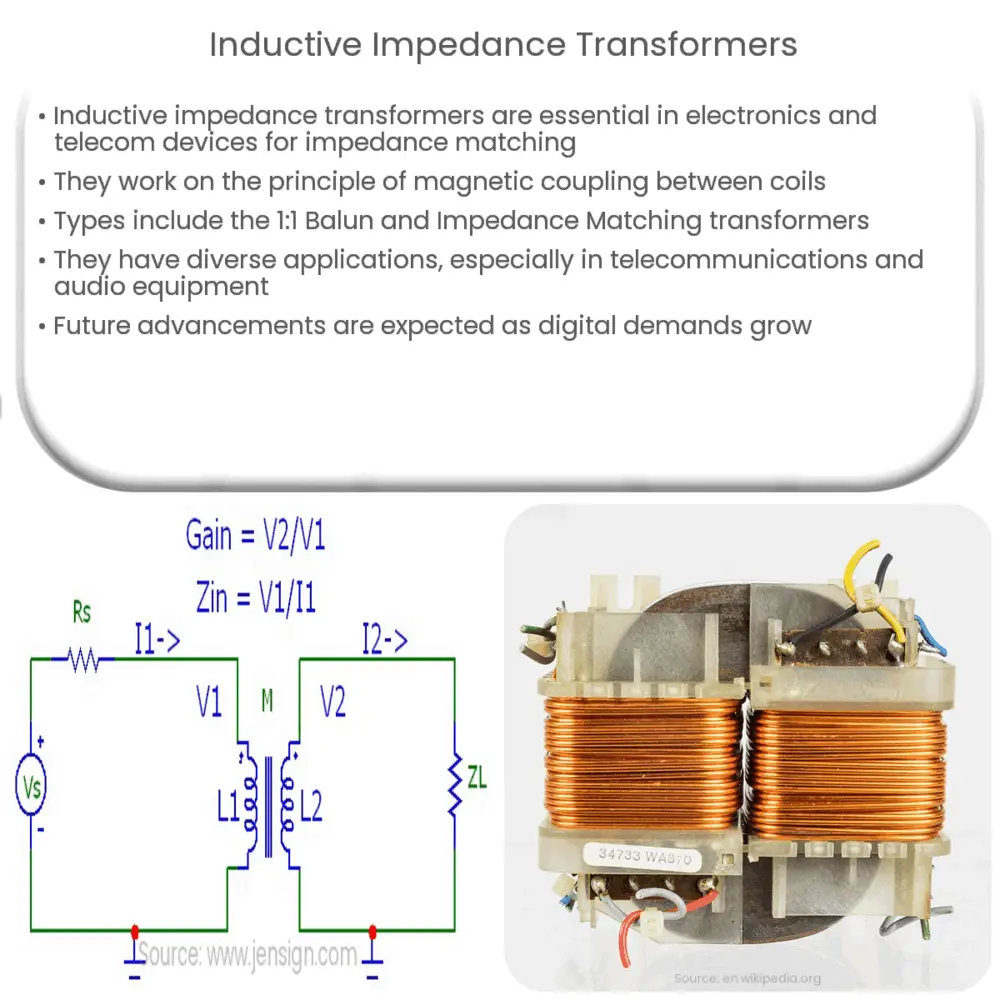
Understanding Inductive Impedance Transformers
Inductive impedance transformers, also known as radio frequency (RF) transformers or RF impedance transformers, are a key element in many electronic and telecommunication devices. They play an essential role in matching impedances between different parts of an electronic circuit to ensure maximum power transfer and minimal signal reflection.
The Principle of Operation
Inductive impedance transformers operate on the fundamental principle of magnetic coupling. The transformer comprises two or more coils, or “windings”, each with a specific number of turns. An AC current passing through the primary coil generates a magnetic field, inducing a voltage in the secondary coil. The ratio of the number of turns in the primary and secondary coils determines the impedance transformation.
Types of Inductive Impedance Transformers
- 1:1 Balun Transformer: This transformer helps convert unbalanced signals to balanced ones or vice versa. In this case, the impedance remains the same on both sides.
- Impedance Matching Transformer: This transformer adjusts the impedance from one side to the other, providing efficient power transfer from a source to its load. For instance, it can transform a 50-ohm impedance to a 75-ohm impedance.
Applications of Inductive Impedance Transformers
Inductive impedance transformers find extensive use in multiple domains. Here are some notable applications:
- Telecommunication: These transformers are critical components in the telecommunications industry, especially in antennas, to ensure efficient power transfer and mitigate signal reflection.
- Audio Equipment: Audio devices, like microphones and speakers, often utilize these transformers for impedance matching, optimizing the power transfer from the audio source to the speakers.
In conclusion, inductive impedance transformers are indispensable in a vast array of electronic and telecommunication applications due to their ability to match impedances, thereby optimizing power transfer and minimizing signal reflection.
Design and Construction of Inductive Impedance Transformers
Designing and constructing inductive impedance transformers requires careful consideration of several factors such as the impedance levels to be matched, the frequency of operation, and the power levels. The transformer’s design also depends on whether it is intended to handle balanced or unbalanced signals.
Design and Construction of Inductive Impedance Transformers (continued)
Often, the construction of an inductive impedance transformer begins with the choice of a suitable magnetic core material. This material should have a high permeability to facilitate magnetic coupling and a high saturation flux density to handle the required power levels.
The number of turns in the primary and secondary windings is another crucial design parameter. It determines the impedance transformation ratio according to the square of the turns ratio.
Challenges and Solutions
Despite the numerous advantages of inductive impedance transformers, designers and engineers may face several challenges. These include minimizing parasitic capacitance and inductance, ensuring the transformer can handle the desired power levels, and ensuring the transformer operates effectively across the desired frequency range.
Various solutions are applied to mitigate these issues. For example, winding techniques such as bifilar winding and twisted pair winding can help reduce parasitic effects. Meanwhile, using suitable core materials and optimizing the core geometry can help handle higher power levels.
Future Perspectives
As we march into an increasingly digital future, the demand for efficient and reliable telecommunication and electronic systems continues to rise. Therefore, the significance of inductive impedance transformers, with their critical role in these systems, is likely to grow further. Innovations in material science and transformer design are expected to help these devices meet the evolving requirements of the future.
Conclusion
In summary, inductive impedance transformers serve as a cornerstone in many electronic and telecommunication applications, playing a pivotal role in ensuring efficient power transfer and mitigating signal reflection. Despite certain design challenges, innovative solutions are continually being developed to enhance their performance and adaptability. The importance of these transformers is set to rise as we increasingly rely on sophisticated electronic systems in the digital age. Understanding their operation, design, and applications thus becomes indispensable for anyone involved in electronics or telecommunications.



