
Explore the working, benefits, applications, and types of Inductive Displacement Sensors, a crucial tool in numerous industries.
Introduction to Inductive Displacement Sensors
Inductive displacement sensors are a type of sensor technology that operates on the principles of inductance, which is the property of an electric conductor that produces a voltage when the current flowing through it changes. They play a pivotal role in a wide variety of industrial applications.
Operating Principle of Inductive Displacement Sensors
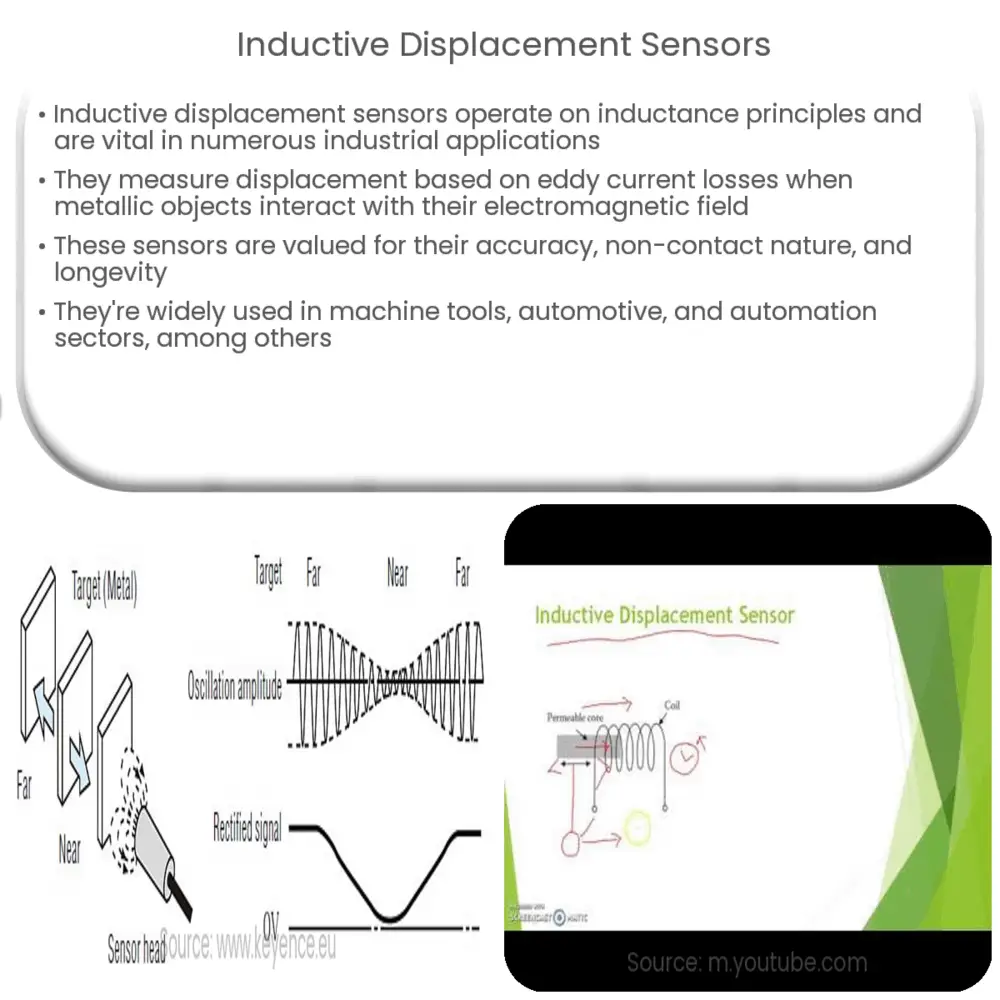
These sensors work on the principle of eddy current losses. An inductive displacement sensor generates a high-frequency electromagnetic field in its sensing face. When a metallic object comes into this field, eddy currents are induced in the object which leads to a loss in the oscillation amplitude. This loss is proportional to the distance of the object from the sensor, thus providing a measure of displacement.
Components of Inductive Displacement Sensors
- Coil: The coil, wound on a coil core, is the main component of the sensor. It generates the electromagnetic field when powered.
- Oscillator: The oscillator generates the alternating current that passes through the coil, creating the electromagnetic field.
- Demodulator: This component interprets the changes in the oscillation amplitude due to the eddy currents and converts it into an output signal.
Advantages of Inductive Displacement Sensors
Inductive displacement sensors offer a host of advantages making them ideal for many industrial settings. Their non-contact nature allows them to measure the displacement of objects without physical contact, making them wear-free and ensuring a long life. Additionally, they are known for their excellent repeatability and high precision, which makes them incredibly reliable.
Applications of Inductive Displacement Sensors
- Machine tool industry: In the machine tool industry, these sensors are used for tool positioning and detecting the end of travel of an axis.
- Automotive industry: In the automotive sector, inductive sensors are commonly used for engine management and chassis applications.
- Automation technology: They are often employed in automation technology for tasks like object detection and positioning.
The above-mentioned industries represent just a small fraction of the potential applications of inductive displacement sensors. They continue to find novel uses in a broad spectrum of other fields and sectors.
Variants of Inductive Displacement Sensors
There are several different types of inductive displacement sensors, each tailored to meet the unique requirements of different applications. Key among them are:
- Inductive Proximity Sensors: These are simple on/off devices that detect the presence or absence of an object.
- Inductive Linear Position Sensors: These sensors can measure the exact position of an object and provide a continuous output signal representing this position.
- Resolution Inductive Sensors: These sensors have an extremely high resolution and are often used in micro-positioning applications where very precise measurements are required.
Limitations and Considerations
While inductive displacement sensors offer numerous advantages, there are certain limitations to be aware of. They are designed to work primarily with metal targets, and their performance can be significantly impacted when used with non-metallic materials. Environmental factors such as temperature, humidity, and pressure may also affect the sensor’s performance. Therefore, when selecting an inductive displacement sensor, it is important to consider the specific requirements of the application and the conditions under which the sensor will be operating.
Conclusion
Inductive displacement sensors are essential tools in numerous industries due to their accuracy, reliability, and versatility. Despite their limitations, they offer a robust solution for a multitude of applications where precise and contactless displacement measurements are required. As technology continues to advance, we can expect the functionality and utility of these sensors to expand further, enabling even more innovative applications across various sectors.
Whether it’s the precision required in the machine tool industry, the demanding conditions of the automotive sector, or the intricate requirements of automation technology, inductive displacement sensors have proven their worth. Understanding their operating principles, benefits, limitations, and applications enables us to appreciate the significant role they play in modern industry and technology.



