
Explore the crucial role of ignition coils in a vehicle’s operation, their structure, types, symptoms of failure, and maintenance tips.
Understanding Ignition Coils
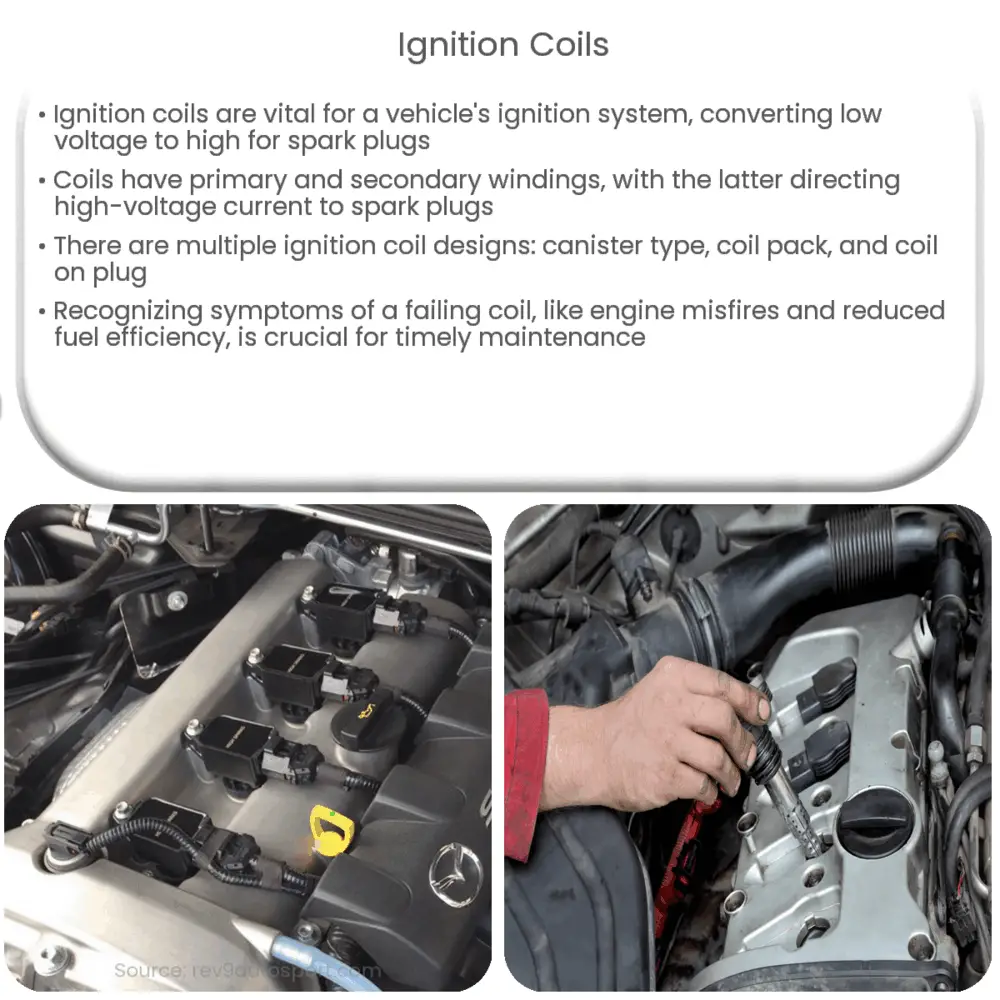
The ignition coil is a critical component of a vehicle’s ignition system, tasked with the crucial role of supplying power to the spark plugs. This high-voltage power enables the spark plugs to ignite the air/fuel mixture in the combustion chamber, allowing the engine to function and the vehicle to operate.
The Fundamental Role of Ignition Coils
The primary role of ignition coils is to convert the vehicle’s low voltage into the thousands of volts necessary to create an electric spark in the spark plugs, igniting the fuel. The ignition coil does this using the principle of electromagnetic induction.
The Structure of Ignition Coils
An ignition coil comprises two sets of windings – the primary and secondary windings. These are wrapped around an iron core. The primary winding is made up of a few hundred turns of thick wire, while the secondary winding consists of thousands of turns of thin wire.
- Primary Winding: The primary winding is connected to the ignition switch and the battery, which provides the low voltage power. The primary winding then steps this power up to a high voltage level.
- Secondary Winding: The secondary winding takes this high-voltage current and applies it to the spark plugs, igniting the air/fuel mixture within the engine.
Types of Ignition Coils
There are several types of ignition coils, including the canister type, coil pack, and coil on plug. Let’s delve a little into each:
- Canister Type: This is the earliest design, commonly found in vehicles manufactured before 1980. Canister type ignition coils are cylindrical and filled with oil for cooling purposes.
- Coil Pack: This type is a group of ignition coils combined together. Each coil within the pack serves one or two cylinders. This design has been in use since the 1980s.
- Coil On Plug: In this design, each cylinder has its own dedicated ignition coil, which directly mounts onto the spark plug. This is the most common design in modern vehicles, known for its efficiency and reliability.
The Operation of Ignition Coils
When the ignition switch is turned on, the primary winding in the ignition coil gets charged by the battery. Once the control unit interrupts this circuit, the magnetic field within the coil collapses. This sudden collapse of the magnetic field induces a high voltage across the secondary windings, which is directed to the spark plug, resulting in the ignition of the air-fuel mixture.
Symptoms of a Failing Ignition Coil
Identifying a failing ignition coil early can prevent further damage to your vehicle. Some common symptoms include:
- Engine Misfires: This can be noticed by irregular idling, engine stutter, or increased emissions.
- Reduced Fuel Efficiency: A malfunctioning ignition coil can cause your car to consume more fuel than usual.
- Poor Acceleration: Your vehicle might lack power during acceleration if the ignition coil isn’t functioning properly.
- Check Engine Light: This light can come on for many reasons, one of which might be a failing ignition coil.
Maintenance and Replacement
While ignition coils are designed for longevity, like all vehicle components, they can wear down over time and will eventually require replacement. It’s essential to get your vehicle regularly serviced and keep an eye on the symptoms mentioned above to ensure the optimal operation of your vehicle.
Conclusion
In conclusion, ignition coils play a crucial role in a vehicle’s operation by providing the necessary voltage to ignite the fuel and power the engine. Understanding the function, structure, and types of ignition coils, as well as the symptoms of a failing ignition coil, can assist vehicle owners in maintaining their vehicles’ efficiency and longevity. Regular maintenance and timely replacements can keep your ignition system working at peak performance, ensuring a smoother, safer ride.