
Hybrid capacitors merge the power density of capacitors with the energy density of batteries, offering rapid energy transfer and high storage capacity.
Understanding Hybrid Capacitors: A Leap in Energy Storage Technology
Overview of Hybrid Capacitors
Hybrid capacitors, as the name suggests, are a blend of the best features of traditional capacitors and batteries, aimed at creating a more advanced energy storage solution. They combine the power density of capacitors with the energy density of batteries, resulting in a device with the ability to charge and discharge energy rapidly while also storing a considerable amount of energy.
Capacitors and batteries, the building blocks of a hybrid capacitor, possess distinct characteristics. Capacitors are renowned for their fast charge and discharge rates and excellent cycle life, but they fall short when it comes to energy storage capacity. On the other hand, batteries offer high energy density, i.e., they can store a significant amount of energy, but they have slower charge and discharge rates and a shorter life cycle. Hybrid capacitors aim to bridge these gaps by combining these two technologies into one efficient unit.
The Working Mechanism of Hybrid Capacitors
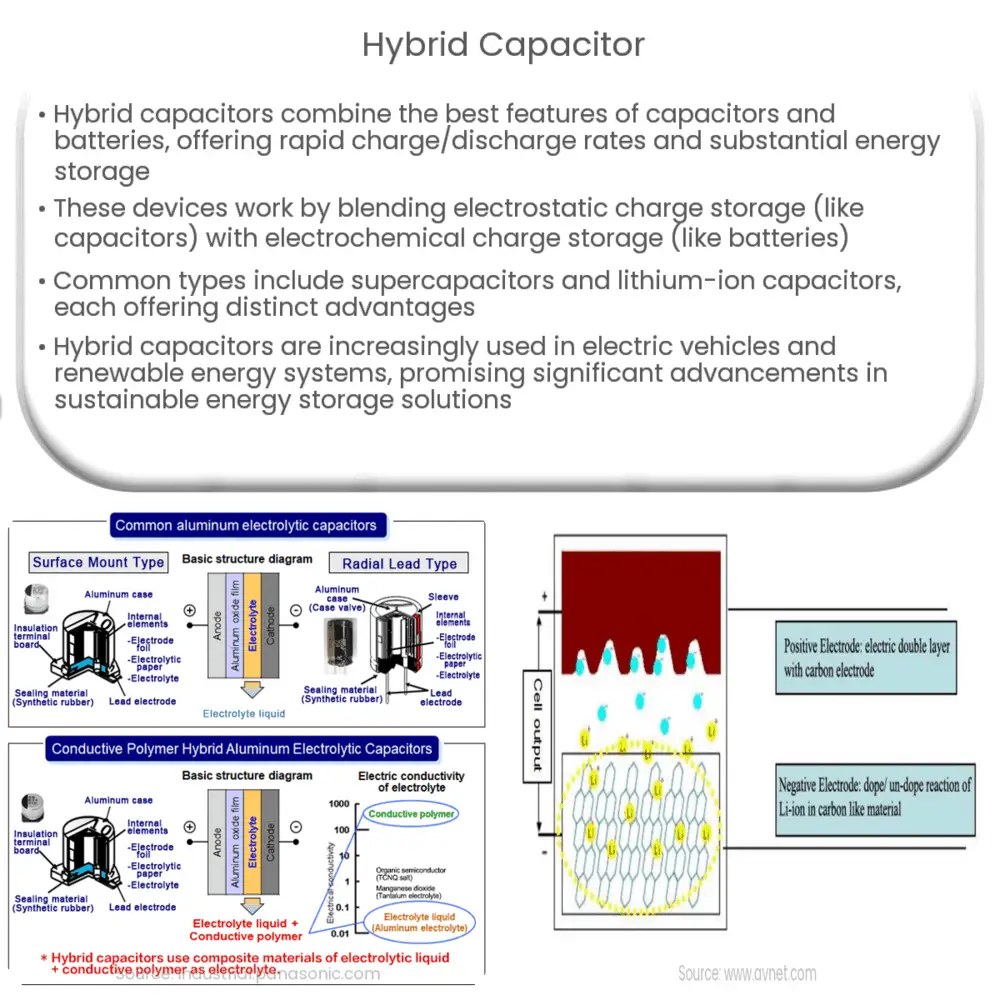
In a hybrid capacitor, one electrode operates on the principle of electrostatic charge storage (like a conventional capacitor), while the other uses electrochemical charge storage (as in a battery). This unique combination results in a device with superior performance characteristics.
The electrostatic (capacitive) electrode stores energy by separating charges, a process that involves no chemical reaction. This feature allows for rapid charge and discharge cycles with minimal wear and tear, resulting in a longer life span. The electrochemical (battery-like) electrode, on the other hand, stores energy through a chemical reaction. Although this process is slower than the charge separation in capacitors, it results in higher energy storage, compensating for the lower energy density of capacitors.
The interface between these two electrodes is where the hybrid capacitor’s true potential lies. By balancing the rapid energy transfer of the capacitive electrode with the high energy storage of the electrochemical electrode, hybrid capacitors achieve a balance of power and energy density that surpasses traditional capacitors and batteries.
Types of Hybrid Capacitors
There are several types of hybrid capacitors, each with its unique configuration and advantages. The most common types include the supercapacitor, also known as an ultracapacitor, and the lithium-ion capacitor.
Supercapacitors, also called electrochemical double-layer capacitors (EDLCs), use carbon-based electrodes and an electrolyte solution to store energy. They exhibit high power density and have a remarkable charge/discharge speed, but their energy density is relatively low.
Lithium-ion capacitors, on the other hand, combine the high energy density of lithium-ion batteries with the high power density of supercapacitors. One electrode in a lithium-ion capacitor is carbon-based (like in a supercapacitor), and the other is lithium-based (like in a lithium-ion battery). This combination results in a higher energy density compared to supercapacitors while maintaining a high power density and rapid charging capability.
Applications and Future of Hybrid Capacitors
Hybrid capacitors’ unique blend of high power and energy density has made them desirable in various applications. They are widely used in electric vehicles and hybrid electric vehicles, where they contribute to enhanced performance and efficiency. Their rapid charge/discharge capability makes them ideal for regenerative braking systems, where they quickly capture and store energy during braking for later use.
In renewable energy systems, hybrid capacitors can store energy generated from solar panels or wind turbines, providing a stable power supply when sunlight or wind is not available. They are also being explored for use in grid energy storage due to their long lifespan and high cycling stability.
The future of hybrid capacitors looks promising. With continued research and development, improvements in energy and power density, efficiency, and cost-effectiveness are expected. Hybrid capacitors could play a crucial role in our transition towards more sustainable energy systems, offering a high-performing, reliable, and eco-friendly solution for energy storage.