Resistance
Resistance is the property of a material or component that opposes the flow of electric current through it. It is measured in Ohms and denoted by the symbol “Ω”.
Resistance arises due to the interactions between electrons and the atoms or molecules that make up the material. When an electric current flows through a material, the electrons collide with these atoms or molecules, causing the electrons to lose energy and reducing the flow of current.
The resistance of a material depends on several factors, including its length, cross-sectional area, and the material’s resistivity, which is a measure of how strongly the material opposes the flow of current. Some materials, such as metals, have low resistance and are good conductors of electricity, while other materials, such as rubber or glass, have high resistance and are insulators.
How to measure resistance
Resistance can be measured using a device called a multimeter, which is a tool used to measure electrical properties such as voltage, current, and resistance. Here are the steps to measure resistance using a multimeter:
- Turn off the power source: If the circuit being measured is powered, turn off the power source and disconnect any batteries.
- Set the multimeter to the resistance setting: Set the dial or switch on the multimeter to the resistance setting, usually denoted by the Greek letter omega (Ω).
- Connect the test leads: Connect the red test lead to the positive (or resistance) terminal on the multimeter and the black test lead to the negative (or common) terminal on the multimeter.
- Touch the test leads to the material being measured: Touch the two test leads together to verify that the multimeter is functioning correctly. Then, touch the test leads to the material being measured, making sure that they are in good contact with the material.
- Read the resistance: The multimeter will display the resistance measurement on its screen in Ohms (Ω).
It is important to note that when measuring resistance, the material being measured must be disconnected from any power source or other electrical components, and the probes of the multimeter should not touch each other while measuring resistance. Additionally, the multimeter should be set to the appropriate range for the resistance being measured to obtain an accurate measurement.
Ammeter–voltmeter method for measuring resistance
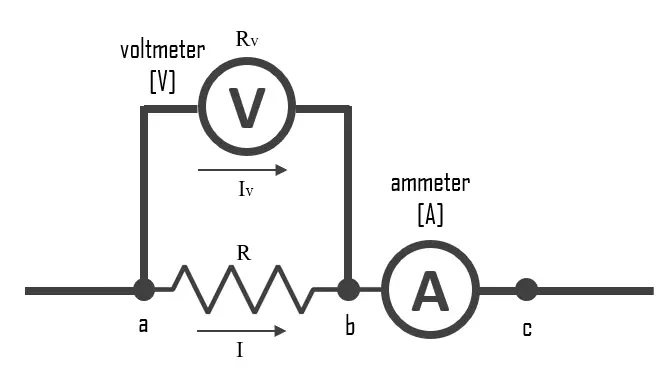
The ammeter-voltmeter method is a technique used to measure the resistance of an electrical component. It involves using an ammeter and a voltmeter in a circuit with the component whose resistance is to be measured. Here are the steps to follow:
- Disconnect the power source from the circuit.
- Connect the ammeter in series with the component whose resistance is to be measured.
- Connect the voltmeter in parallel with the component.
- Reconnect the power source to the circuit.
- Read the current on the ammeter and the voltage on the voltmeter.
- Use Ohm’s Law (R = V/I) to calculate the resistance of the component, where R is the resistance, V is the voltage across the component, and I is the current through the component.