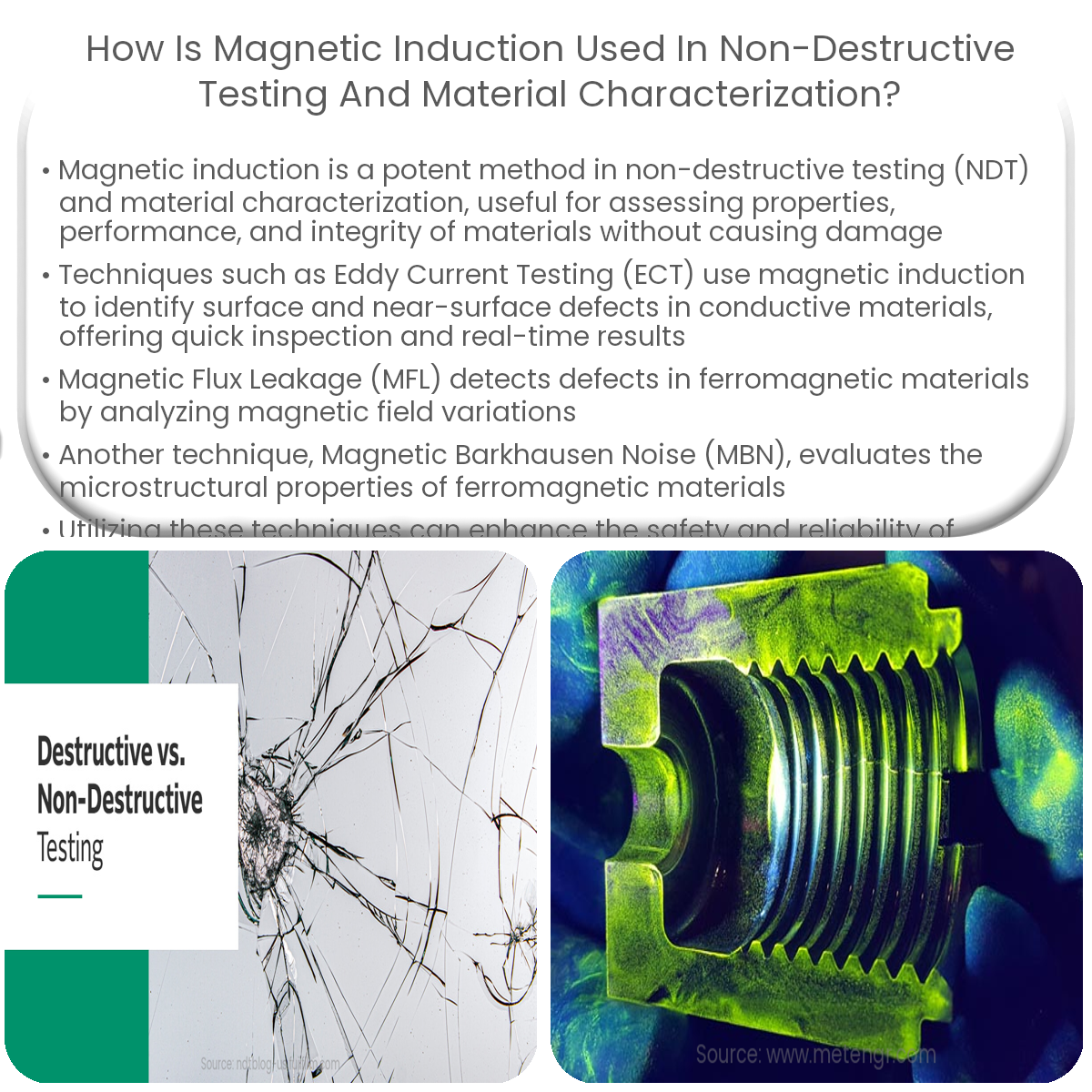
Magnetic induction is used in Eddy Current Testing, Magnetic Flux Leakage, and Magnetic Barkhausen Noise for non-destructive testing and characterization.
Magnetic Induction in Non-Destructive Testing and Material Characterization
Magnetic induction is a versatile technique used in non-destructive testing (NDT) and material characterization to evaluate the properties, performance, and integrity of materials without causing damage. This article highlights some of the most common applications of magnetic induction in NDT and material characterization.
Eddy Current Testing (ECT)
Eddy Current Testing is a widely used NDT technique that employs magnetic induction to detect surface and near-surface defects in conductive materials. ECT involves passing an alternating current through a coil, generating a magnetic field that induces eddy currents in the test material. Any discontinuities or defects in the material disrupt the eddy currents, altering the coil’s impedance and revealing the presence of defects.
- Advantages: Rapid inspection, high sensitivity, and real-time results.
- Applications: Detection of cracks, corrosion, and material thinning in metal components, such as pipelines, aircraft structures, and heat exchangers.
Magnetic Flux Leakage (MFL)
Magnetic Flux Leakage is an NDT technique used to identify defects in ferromagnetic materials by analyzing changes in the magnetic field. MFL involves magnetizing the material and measuring the magnetic field variations caused by defects, such as corrosion or cracks, which alter the material’s permeability and magnetic properties.
- Advantages: Fast inspection, reliable detection of defects, and compatibility with automated systems.
- Applications: Inspection of pipelines, storage tanks, and other ferromagnetic structures for corrosion and material loss.
Magnetic Barkhausen Noise (MBN)
Magnetic Barkhausen Noise is a material characterization technique that evaluates the microstructural properties of ferromagnetic materials. MBN measures the noise generated when a magnetic field is applied to the material, causing the domain walls to move. This noise is influenced by the material’s microstructure, stress, and defects, providing valuable insights into its properties and performance.
- Advantages: Non-destructive evaluation of microstructure, stress, and material properties.
- Applications: Assessment of heat treatment, residual stress, and material degradation in ferromagnetic materials.
Conclusion
Magnetic induction is a powerful tool for non-destructive testing and material characterization, enabling rapid and reliable evaluation of material properties, performance, and integrity. By leveraging the capabilities of magnetic induction techniques, industries can ensure the safety and reliability of their products and infrastructure while minimizing downtime and maintenance costs.