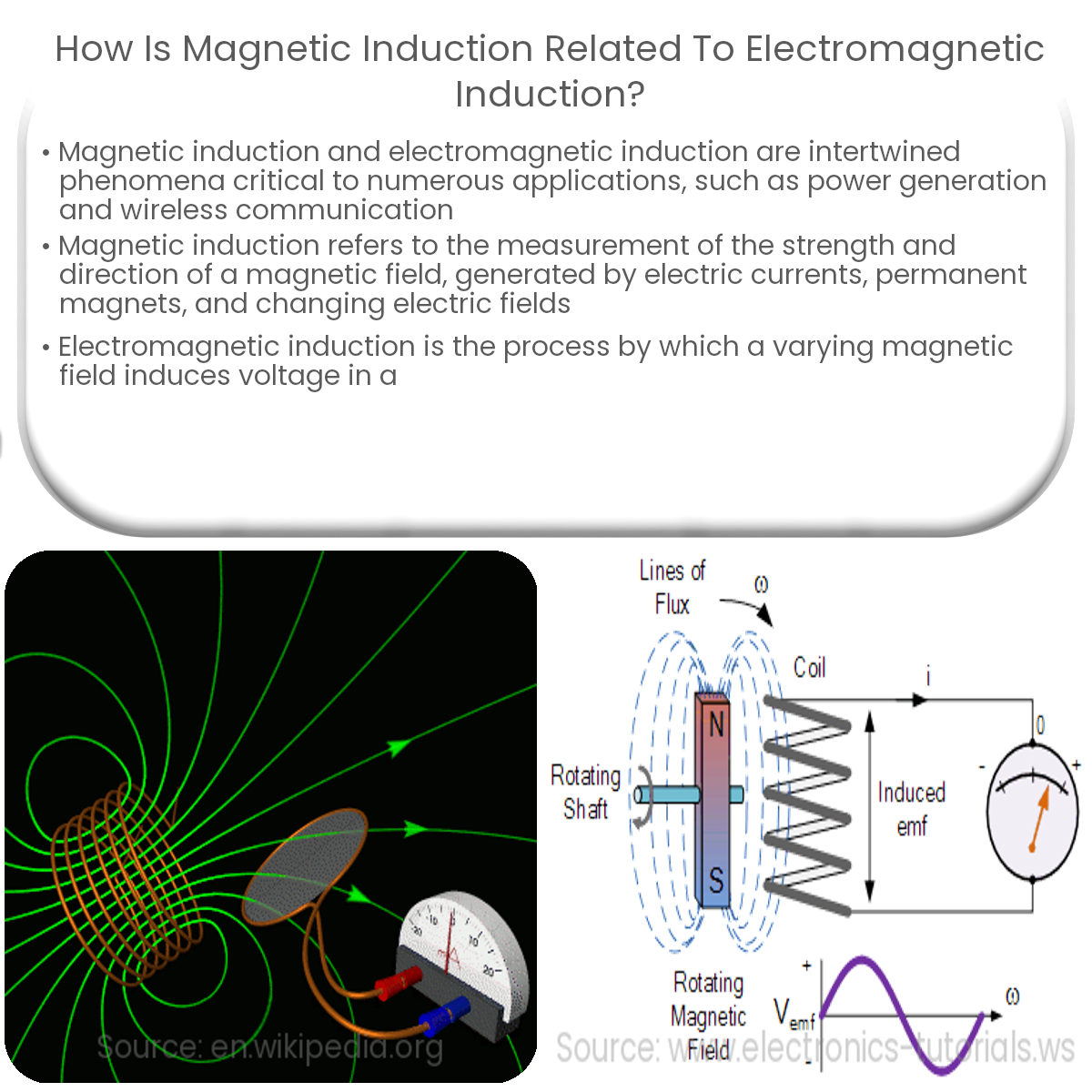
Magnetic induction creates magnetic fields, while electromagnetic induction occurs when a changing magnetic field induces a voltage in a conductor.
Magnetic Induction and Electromagnetic Induction: The Connection
Magnetic induction and electromagnetic induction are interrelated phenomena that play a vital role in many applications, such as power generation, wireless communication, and sensing. Understanding the connection between these two concepts is essential to grasp their underlying principles and applications.
Magnetic Induction
Magnetic induction, also known as magnetic flux density or simply magnetic field, is a measure of the strength and direction of a magnetic field at a particular point in space. It is represented by the symbol B and has the unit of Tesla (T). Magnetic fields are generated by electric currents, permanent magnets, and changing electric fields.
Electromagnetic Induction
Electromagnetic induction, on the other hand, is a phenomenon in which a changing magnetic field induces an electromotive force (EMF) or voltage in a conductor. This principle, discovered by Michael Faraday in 1831, is the basis for the operation of generators, transformers, and induction motors. Faraday’s law of electromagnetic induction states that the induced EMF in a loop of wire is proportional to the rate of change of magnetic flux through the loop.
The Relationship
The link between magnetic induction and electromagnetic induction lies in their mutual dependence. A changing magnetic field, characterized by magnetic induction, is the primary requirement for electromagnetic induction to occur. In other words, a constant magnetic field will not induce an EMF in a conductor; it must be changing over time.
When a conductor is placed within a changing magnetic field, the magnetic field’s interaction with the conductor’s electrons generates an electric current. This current, in turn, creates its own magnetic field, which opposes the original changing magnetic field, as described by Lenz’s law. This opposition ensures that the induced current always flows in a direction that opposes the change in the magnetic field, thus maintaining energy conservation.
Applications
The connection between magnetic induction and electromagnetic induction is the foundation for numerous practical applications, including:
- Generators: Rotating a coil of wire in a magnetic field induces a current, converting mechanical energy into electrical energy.
- Transformers: A changing current in a primary coil induces a current in a secondary coil, allowing for voltage regulation and efficient power transmission.
- Induction motors: Rotating magnetic fields induce currents in the motor’s rotor, creating torque and enabling motion.
- Wireless charging: A varying magnetic field in a transmitter coil induces a current in a receiver coil, allowing for wireless power transfer.
In summary, magnetic induction and electromagnetic induction are closely related concepts that drive many important technologies in modern society. Understanding their connection helps in designing and optimizing devices based on these principles.