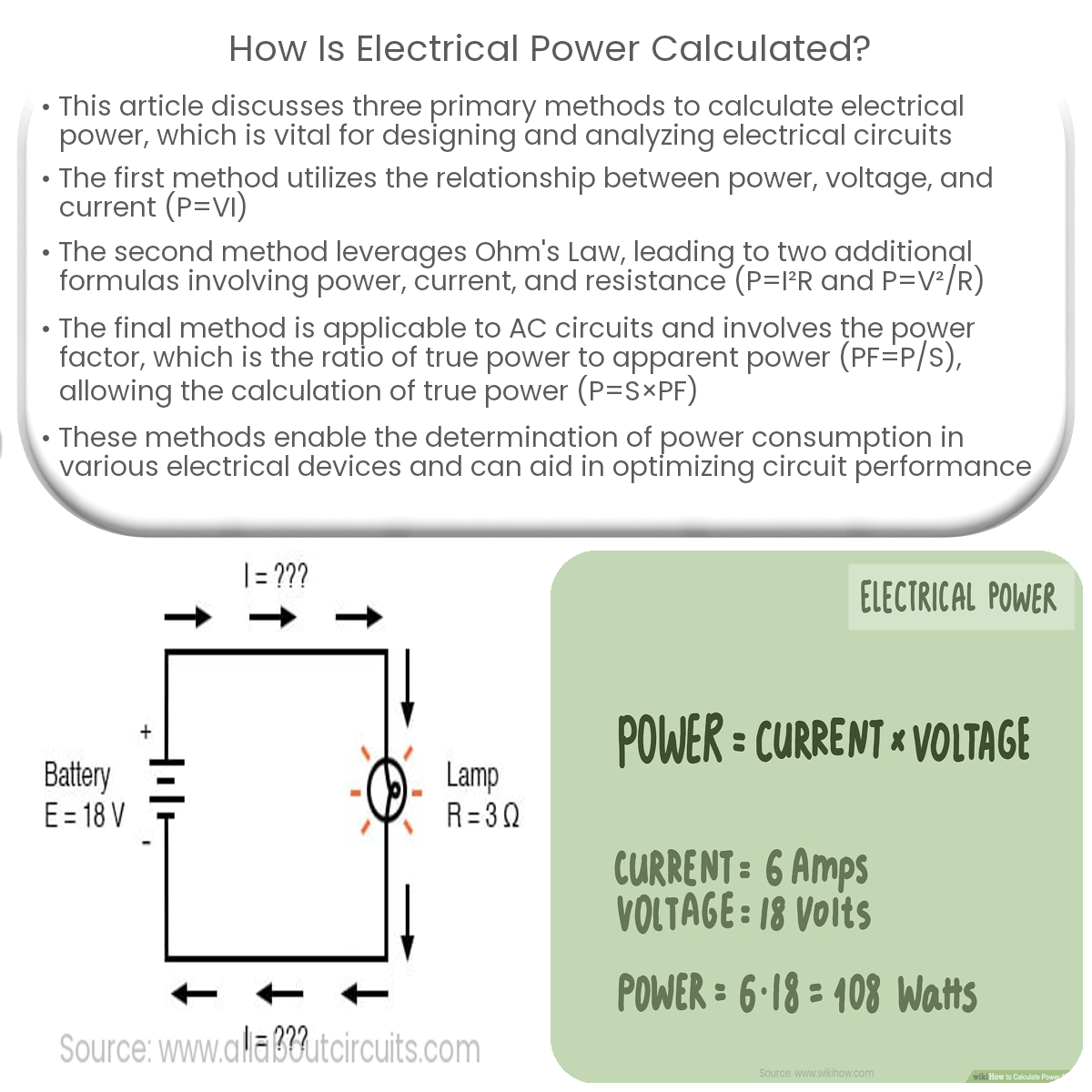
Electrical power is calculated using formulas like P=VI, P=I²R, P=V²/R, and for AC circuits, P=S×PF, where P is power, V is voltage, I is current, R is resistance, S is apparent power, and PF is power factor.
Calculating Electrical Power
Electrical power is the rate at which electrical energy is transferred or consumed in an electrical circuit. It is typically measured in Watts (W) and can be calculated using various formulas, depending on the available parameters. In this article, we will discuss three primary methods to calculate electrical power.
1. Power, Voltage, and Current Relationship
The most common formula to calculate electrical power is derived from the relationship between power, voltage (V), and current (I). This formula is:
P = VI
Where P represents power, V represents voltage, and I represents current. This formula can be used to calculate the power consumption of a device when both the voltage across it and the current flowing through it are known.
2. Power and Resistance
Another way to calculate electrical power involves the use of Ohm’s Law, which states that the voltage across a resistor is directly proportional to the current flowing through it. Ohm’s Law is given by:
V = IR
Where R represents resistance. By substituting Ohm’s Law into the power formula (P = VI), we can obtain two additional formulas:
- P = I2R (Power calculated using current and resistance)
- P = V2/R (Power calculated using voltage and resistance)
These formulas are particularly useful when only two of the three parameters (voltage, current, or resistance) are known.
3. Power Factor and Apparent Power
In alternating current (AC) circuits, the power factor (PF) plays a critical role in calculating electrical power. The power factor is the ratio of the true power (P) to the apparent power (S), and it is a dimensionless value ranging between -1 and 1:
PF = P / S
Apparent power, measured in Volt-Amperes (VA), is the product of the root-mean-square (RMS) voltage and current. The true power, in Watts, represents the actual power consumed by the load. In AC circuits, the power factor can be used to calculate the true power when the apparent power and power factor are known:
P = S × PF
This formula is essential for calculating power in AC circuits with inductive or capacitive loads, where the power factor differs from 1.
In conclusion, understanding how to calculate electrical power is vital for designing and analyzing electrical circuits. By using the appropriate formulas, you can determine the power consumption of various electrical devices and optimize circuit performance.