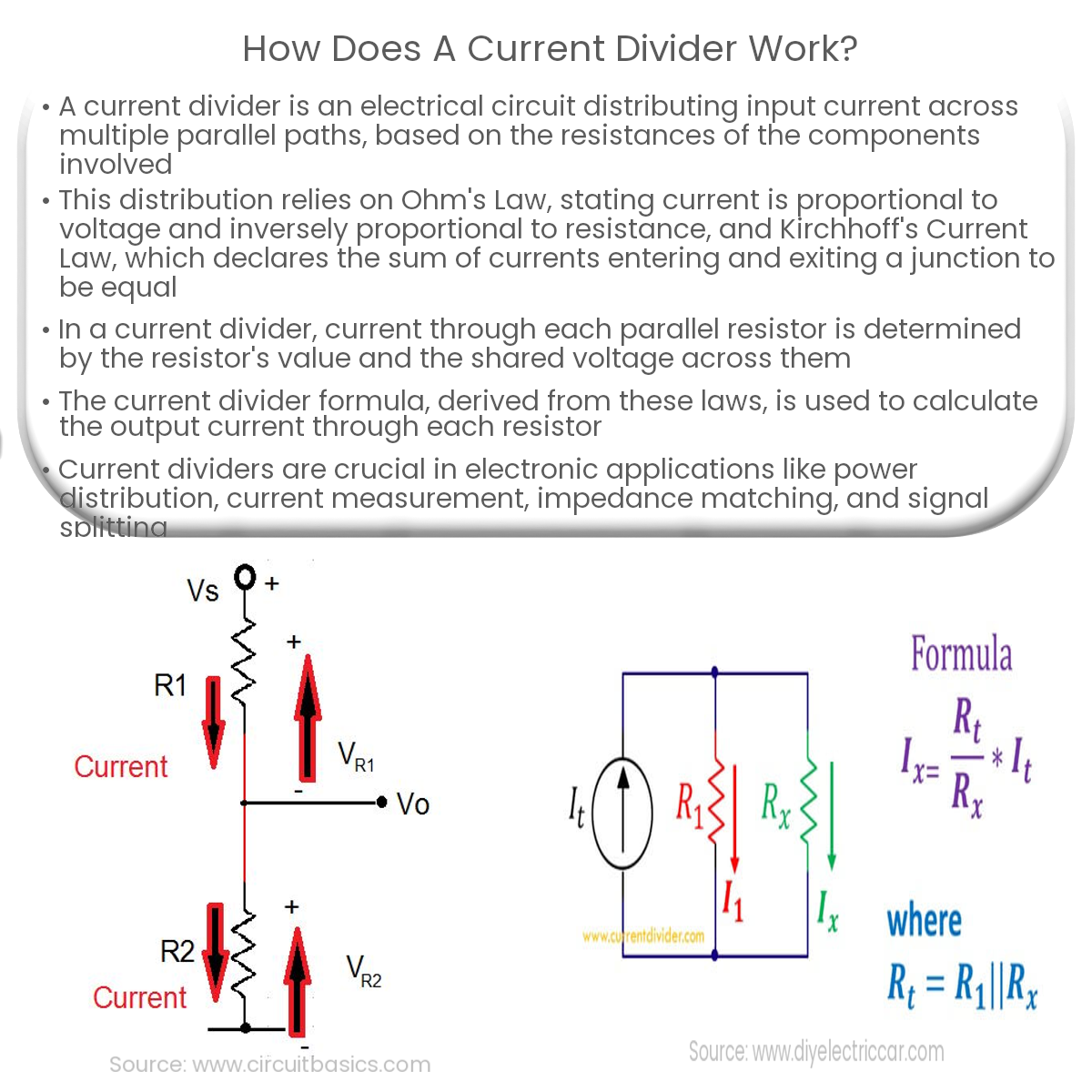
A current divider works by distributing input current among parallel paths in proportion to the resistances or impedances of the connected components.
Understanding Current Dividers
A current divider is an electrical circuit designed to distribute an input current among multiple parallel paths in proportion to the resistances or impedances of the connected components. The primary principle behind the functioning of a current divider is based on Ohm’s Law and Kirchhoff’s Current Law.
Ohm’s Law
Ohm’s Law states that the current flowing through a resistor is directly proportional to the voltage across it and inversely proportional to its resistance:
I = V / R
Kirchhoff’s Current Law
Kirchhoff’s Current Law (KCL) states that the sum of currents entering a junction equals the sum of currents leaving the junction:
Iin = I1 + I2 + … + In
Working of a Current Divider
In a current divider, two or more resistors are connected in parallel, with the input current (Iin) applied at the junction of these parallel elements. The output currents (Iout) flow through each resistor and are measured across them. The sum of the output currents is equal to the input current, as stated by KCL.
Since the resistors are connected in parallel, the voltage across each resistor is the same. However, the current flowing through each resistor varies based on the resistor’s value. This is where Ohm’s Law comes into play. The current through each resistor is determined by the voltage across it and its resistance. Therefore, the current in each parallel path depends on the resistance of that path.
Current Divider Formula
For a current divider with two resistors, R1 and R2, the current divider formula can be derived using Ohm’s Law and KCL:
I2 = Iin * (R1 / (R1 + R2))
Similarly, the output current I1 can be calculated as follows:
I1 = Iin * (R2 / (R1 + R2))
Applications of Current Dividers
Current dividers are widely used in various electronic circuits and applications, including:
- Power distribution in parallel loads
- Current measurement in ammeters
- Impedance matching in communication systems
- Signal splitting in audio systems
Understanding the working principle and applications of current dividers is essential for designing and analyzing electronic circuits.