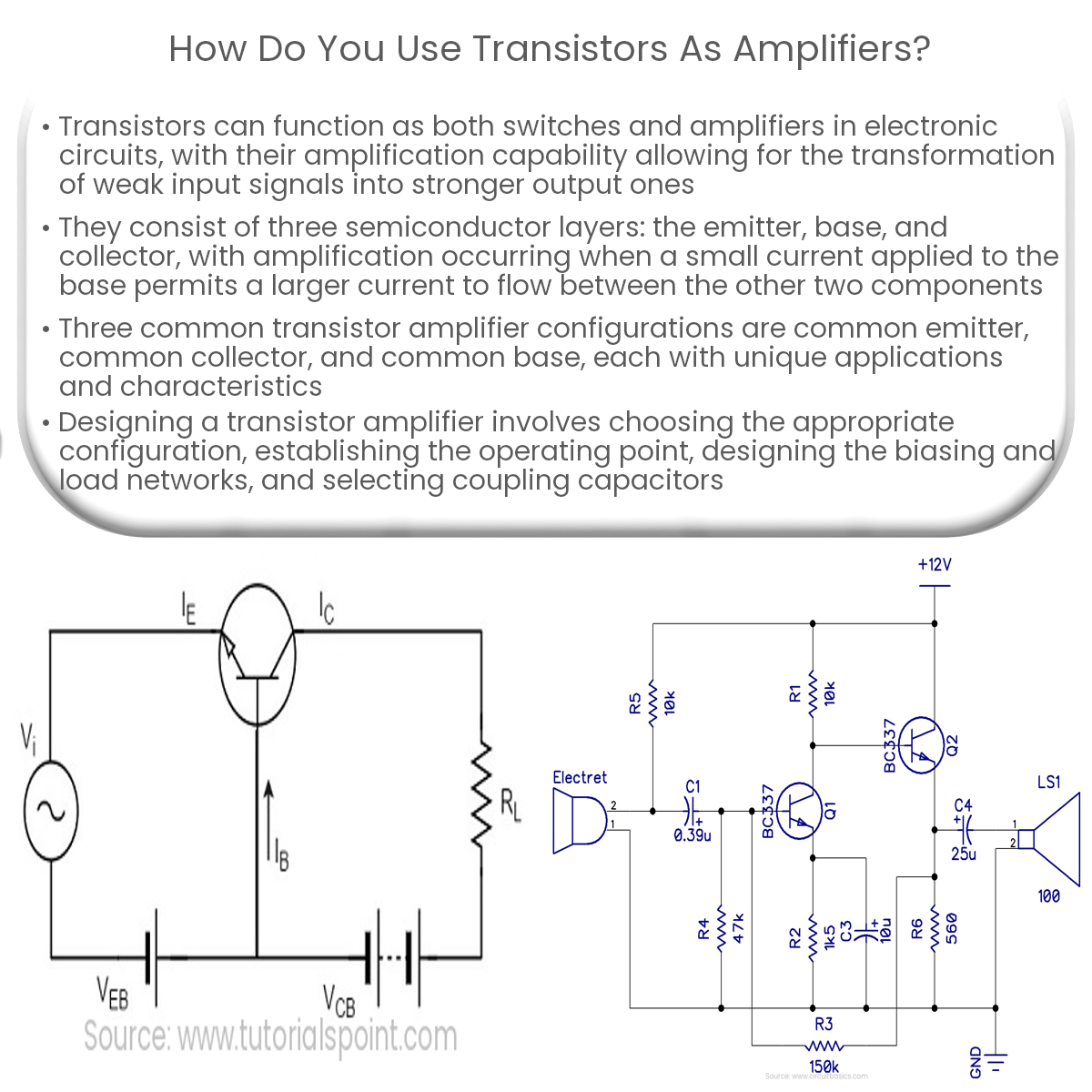
Transistors as amplifiers work by controlling the current flow between emitter and collector, amplifying weak input signals into stronger output signals.
Using Transistors as Amplifiers
Transistors are versatile electronic components, capable of acting as both switches and amplifiers. This article focuses on how transistors function as amplifiers in electronic circuits, amplifying weak input signals into stronger output signals.
Understanding Transistor Operation
Transistors consist of three layers of semiconductor material called the emitter, base, and collector. The current flowing between the emitter and the collector is controlled by the base current. When a small current is applied to the base, it allows a much larger current to flow between the emitter and collector, resulting in amplification.
Common Amplifier Configurations
There are three common transistor amplifier configurations: common emitter (CE), common collector (CC), and common base (CB). Each has its specific application and characteristics.
- Common Emitter (CE): This is the most widely used configuration, providing voltage and power amplification. It offers a medium input impedance, high output impedance, and an inverted output signal.
- Common Collector (CC): Also known as an emitter follower, this configuration provides voltage amplification without phase inversion. It has high input impedance, low output impedance, and a unity voltage gain.
- Common Base (CB): This configuration offers high voltage and power gain, with low input impedance and high output impedance. The output signal is in phase with the input signal.
Designing a Transistor Amplifier
To design a transistor amplifier, follow these steps:
- Choose the amplifier configuration: Select the appropriate configuration based on your application requirements and desired input/output characteristics.
- Calculate the operating point: Establish the DC operating point or Q-point, which determines the transistor’s biasing for linear operation and optimal amplification.
- Design the biasing network: Create a network of resistors to provide the appropriate base current and set the transistor’s Q-point.
- Select the coupling capacitors: Use coupling capacitors to block DC components and allow only AC signals to pass between stages or to the output.
- Design the load network: Determine the appropriate load impedance to ensure maximum power transfer and to set the desired voltage gain.
By following these steps and understanding the various transistor amplifier configurations, you can effectively use transistors as amplifiers in electronic circuits.