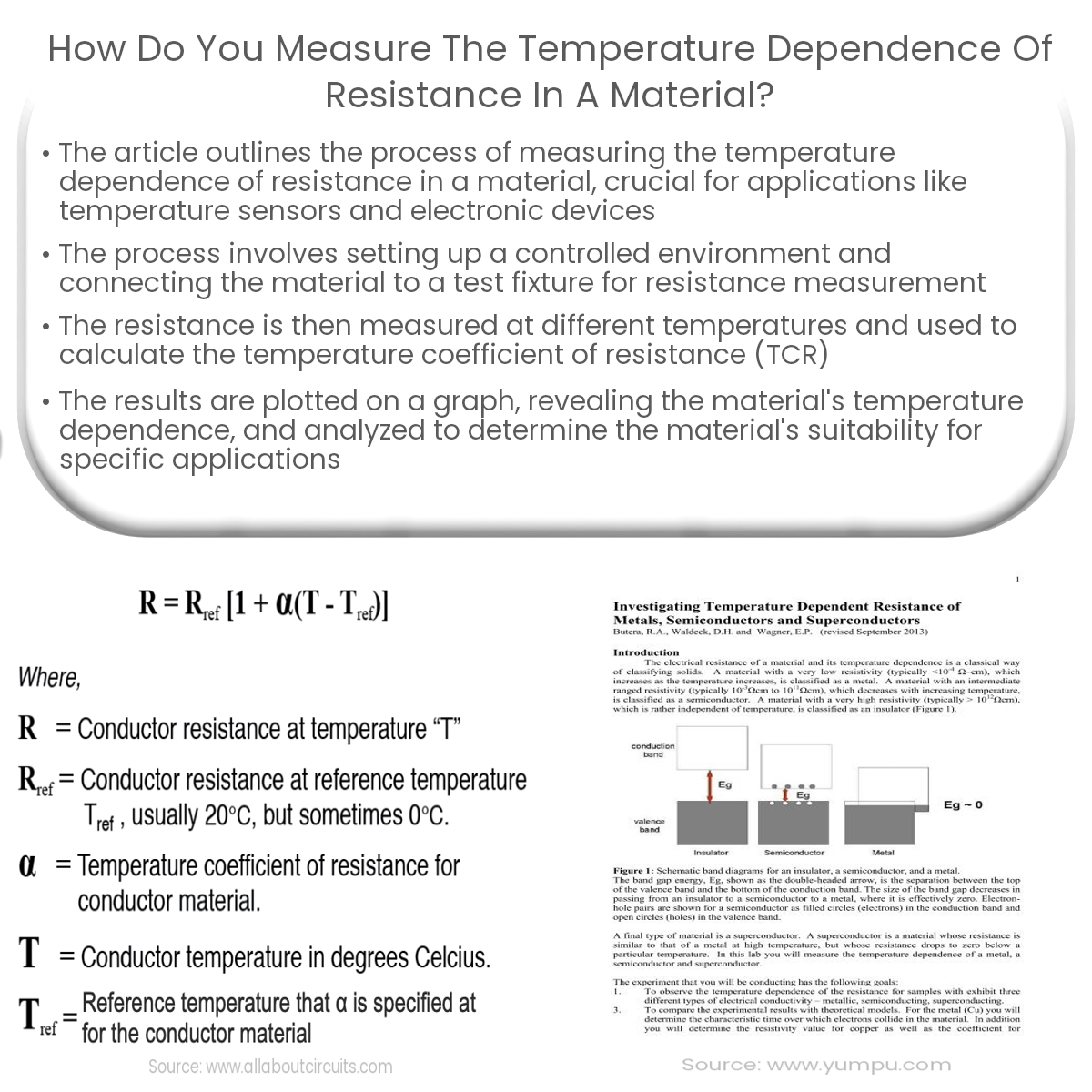
To measure temperature dependence of resistance, create a controlled environment, measure resistance at various temperatures, calculate TCR, and analyze.
Measuring Temperature Dependence of Resistance in a Material
Temperature dependence of resistance is an essential property of materials used in various applications, including temperature sensors, heating elements, and electronic devices. To measure the temperature dependence of resistance in a material, follow the steps below:
1. Prepare the Test Setup
Set up a controlled environment, such as an insulated chamber or an oven, to maintain a constant temperature. Ensure that the test equipment, including a temperature sensor, a multimeter, and a stable voltage source, are in place.
2. Attach the Material to a Test Fixture
Connect the material to a test fixture, such as a four-point probe or a two-point probe, to measure its resistance. The four-point probe method is more accurate, as it eliminates contact resistance.
3. Measure Resistance at Different Temperatures
Adjust the temperature in the controlled environment and allow the material to reach thermal equilibrium. Record the temperature using a temperature sensor, and measure the material’s resistance with a multimeter. Repeat this process for various temperature points, covering the entire range of interest.
4. Calculate Temperature Coefficient of Resistance
Use the measured resistance values to calculate the temperature coefficient of resistance (TCR) for the material. TCR is a measure of the relative change in resistance per degree Celsius and is given by the formula:
TCR = (R2 – R1) / (R1 * (T2 – T1))
Where R1 and R2 are the resistance values at temperatures T1 and T2, respectively.
5. Plot Resistance vs. Temperature
Plot the measured resistance values against the corresponding temperature points on a graph. The resulting curve will illustrate the temperature dependence of resistance in the material. If the curve is linear, the material exhibits a predictable temperature dependence. If it is non-linear, the relationship between resistance and temperature is more complex.
6. Analyze the Results
Analyze the data to determine if the material’s temperature dependence is suitable for the intended application. Materials with a high TCR are suitable for temperature sensors, while those with a low TCR are ideal for applications requiring stable resistance over a wide temperature range.