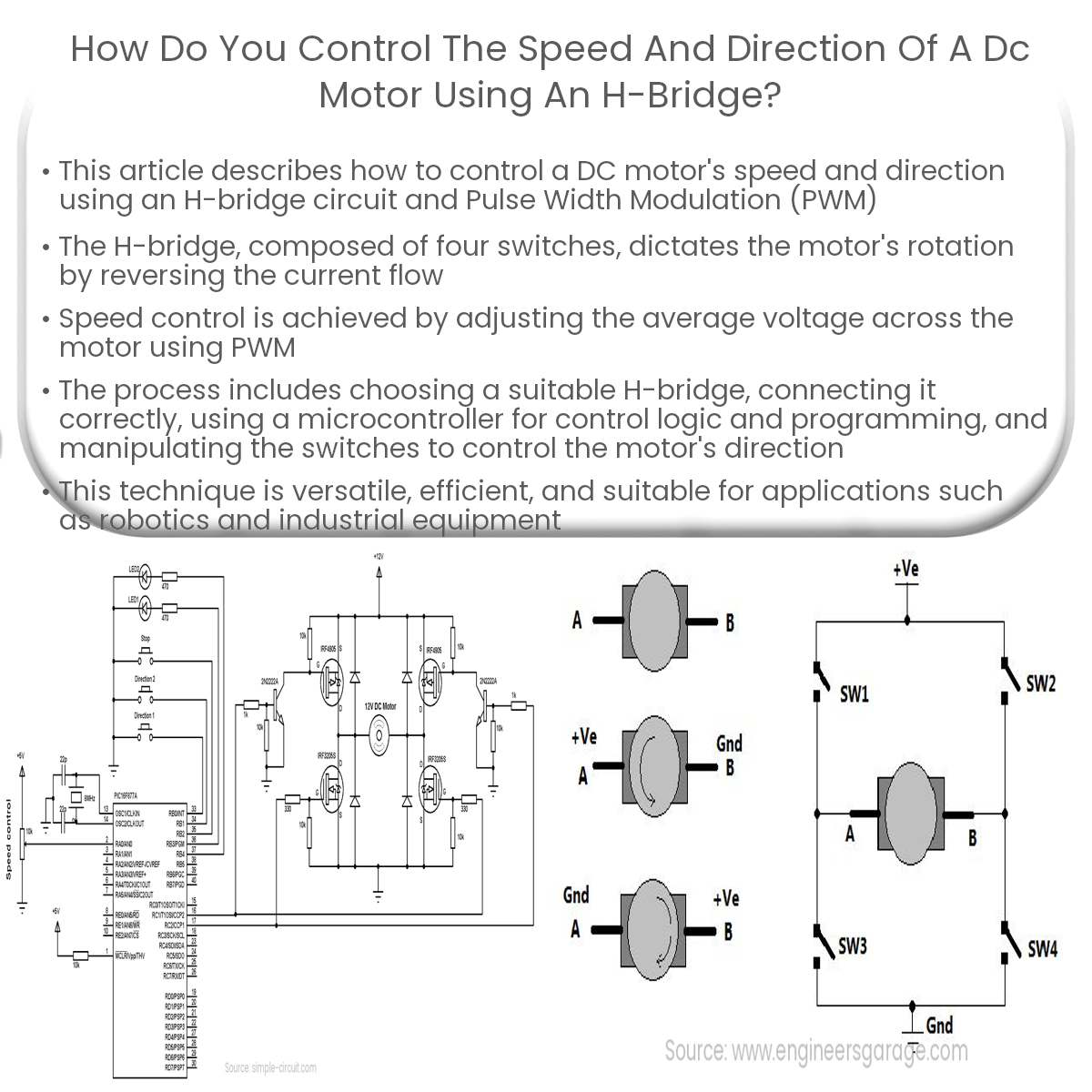
To control a DC motor’s speed and direction using an H-bridge, apply PWM for speed control and manipulate the switches to change direction.
Controlling Speed and Direction of a DC Motor Using an H-bridge
In this article, we will explore how to control the speed and direction of a DC motor using an H-bridge. An H-bridge is an electronic circuit that allows a voltage to be applied across a load in either direction, enabling the control of DC motors.
Understanding H-bridge
The H-bridge consists of four switches, typically arranged in an “H” configuration. When two diagonally opposite switches are closed, and the other two are open, a current flows in one direction through the motor, causing it to rotate in one direction. Reversing the closed and open switches reverses the current flow, and the motor rotates in the opposite direction.
Controlling Speed
To control the speed of the DC motor, we can modulate the voltage applied across the motor using a technique called Pulse Width Modulation (PWM). PWM involves switching the voltage on and off rapidly, with varying durations of the “on” time. The average voltage across the motor is proportional to the duty cycle of the PWM signal, which determines the motor’s speed.
Procedure
- Choose a suitable H-bridge: Select an H-bridge based on the voltage and current rating of your DC motor.
- Connect the H-bridge: Connect the motor terminals to the H-bridge’s output, and connect the H-bridge’s input to the appropriate power supply.
- Control logic: Use a microcontroller to generate the control signals for the H-bridge switches and the PWM signal for speed control. Connect the microcontroller’s outputs to the H-bridge’s control inputs.
- Programming: Write a program to control the motor’s direction and speed using the microcontroller.
Controlling Direction
The direction of the motor can be controlled by manipulating the switches in the H-bridge. For example, to rotate the motor in a clockwise direction, close switches S1 and S4 while keeping switches S2 and S3 open. To rotate the motor counter-clockwise, close switches S2 and S3 while keeping switches S1 and S4 open.
Conclusion
Controlling a DC motor’s speed and direction using an H-bridge is a versatile and efficient method. By combining an H-bridge with a microcontroller and PWM, you can create a precise and responsive control system for various applications, including robotics, industrial equipment, and more.