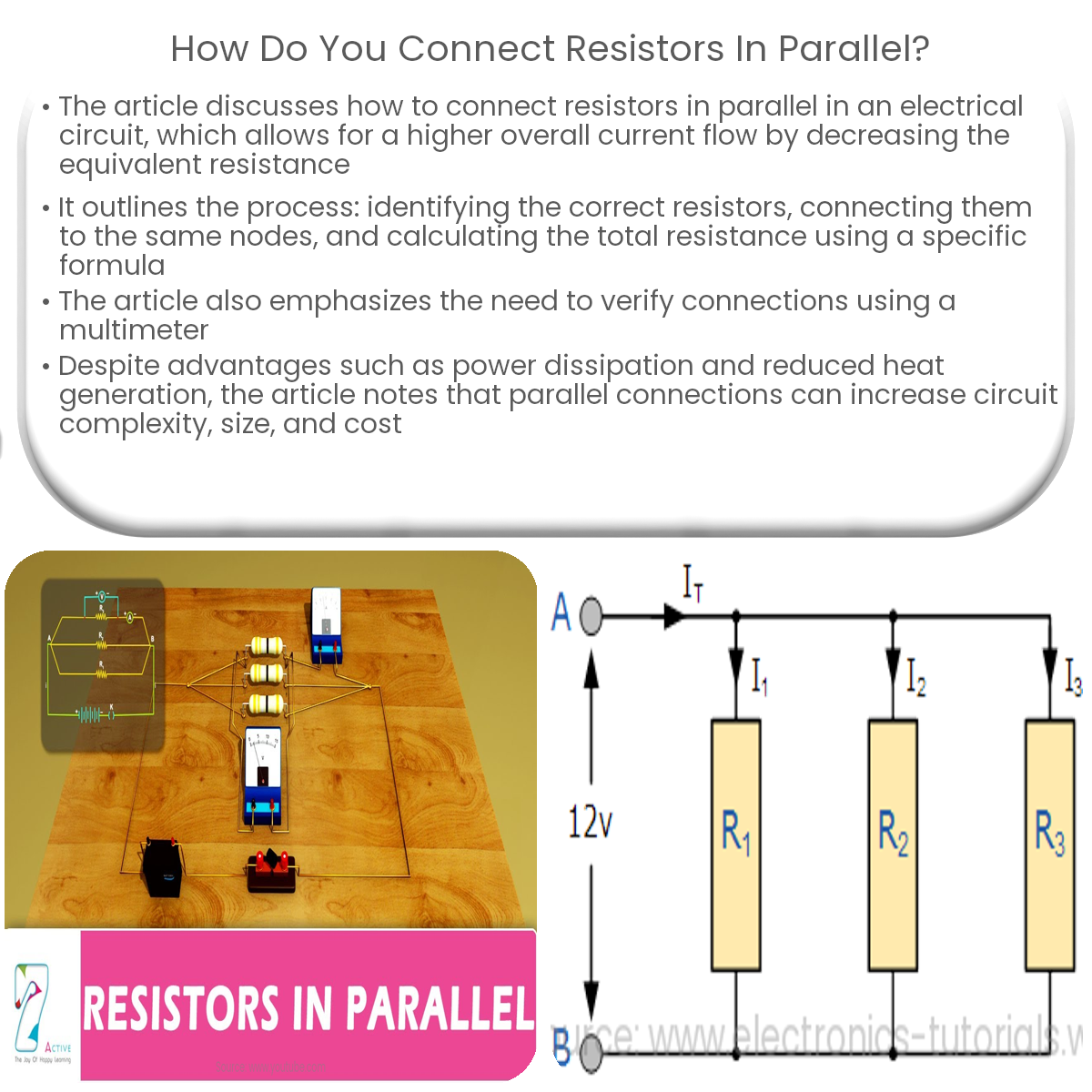
To connect resistors in parallel, connect their leads to the same nodes in the circuit, so they share the same voltage and their currents add up.
Connecting Resistors in Parallel
In this article, we’ll discuss how to connect resistors in parallel and the implications of doing so in an electrical circuit. Connecting resistors in parallel is a common method for decreasing the equivalent resistance in a circuit, allowing for a higher overall current flow.
Step 1: Identify the Resistors to be Connected
First, identify the resistors you want to connect in parallel. These may be discrete components or parts of an integrated circuit. Ensure they have the correct resistance values for your desired application.
Step 2: Connect the Resistors
To connect resistors in parallel, you need to attach their leads to the same nodes in the circuit. The first lead of each resistor should be connected to one node, and the second lead should be connected to another node. This way, all the resistors share the same voltage across them, and their currents add up.
Step 3: Calculate the Total Resistance
When resistors are connected in parallel, the total or equivalent resistance (Req) is found using the following formula:
1/Req = 1/R1 + 1/R2 + … + 1/Rn
Where R1, R2, …, Rn are the resistance values of the individual resistors connected in parallel. The reciprocal of the sum of their reciprocals gives the total resistance of the parallel configuration.
Step 4: Verify the Connections
After connecting the resistors in parallel and calculating the total resistance, it’s essential to verify the connections to ensure proper functioning. Use a multimeter to measure the resistance across the parallel resistor network and compare it to the calculated value. This will help confirm if the connections are correct.
Advantages and Disadvantages of Parallel Connections
There are several advantages of connecting resistors in parallel, including the ability to divide current among multiple paths, leading to a lower equivalent resistance. This can help distribute power dissipation and reduce the overall heat generated in a circuit.
However, there are also disadvantages. For example, connecting resistors in parallel can increase the complexity of a circuit, making it harder to analyze and troubleshoot. Additionally, it may require more components and increase the circuit’s size and cost.
In conclusion, connecting resistors in parallel is a fundamental technique used in electronic circuit design. By following the steps outlined above, you can successfully connect resistors in parallel and calculate the total resistance of the parallel network.