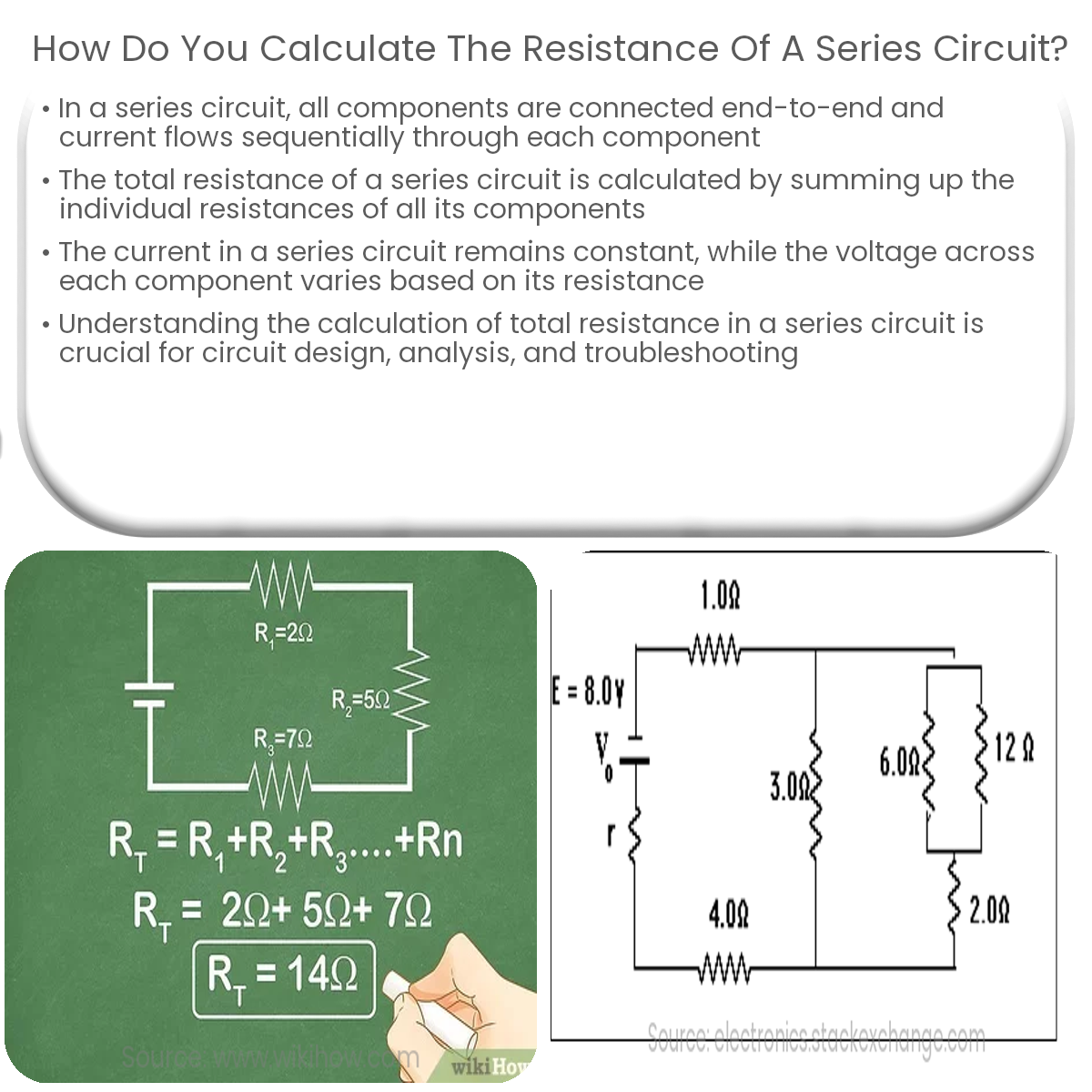
To calculate the resistance of a series circuit, simply add the individual resistances of all components in the circuit: R_T = R_1 + R_2 + … + R_n.
Calculating Resistance in a Series Circuit
A series circuit is a type of electrical circuit where all the components are connected end-to-end, so there is only one path for the current to flow. To calculate the total resistance of a series circuit, you need to consider the individual resistances of the components.
Understanding Series Circuits
In a series circuit, the current flows through each component sequentially. The current remains constant throughout the circuit, but the voltage across each component can vary depending on the individual resistances.
The total resistance of a series circuit is the sum of the individual resistances of all the components in the circuit. This is because the current must pass through each component, and the resistance of each component adds to the overall resistance of the circuit.
Calculating Total Resistance
To calculate the total resistance (RT) of a series circuit, use the following formula:
RT = R1 + R2 + R3 + … + Rn
Where R1, R2, R3, …, Rn are the individual resistances of the components in the circuit.
For example, if you have a series circuit with three resistors (R1 = 5 Ω, R2 = 10 Ω, and R3 = 20 Ω), the total resistance can be calculated as:
RT = 5 Ω + 10 Ω + 20 Ω = 35 Ω
Important Points to Remember
- The total resistance of a series circuit is always greater than the resistance of any single component in the circuit.
- The current in a series circuit remains constant, while the voltage drop across each component is proportional to its resistance.
- When calculating total resistance in a series circuit, make sure to consider all the individual resistances of the components in the circuit.
Understanding how to calculate the total resistance of a series circuit is essential for designing and analyzing electrical circuits, as it allows you to predict the current flow and voltage drops across each component. This knowledge is vital for troubleshooting and optimizing circuit performance.