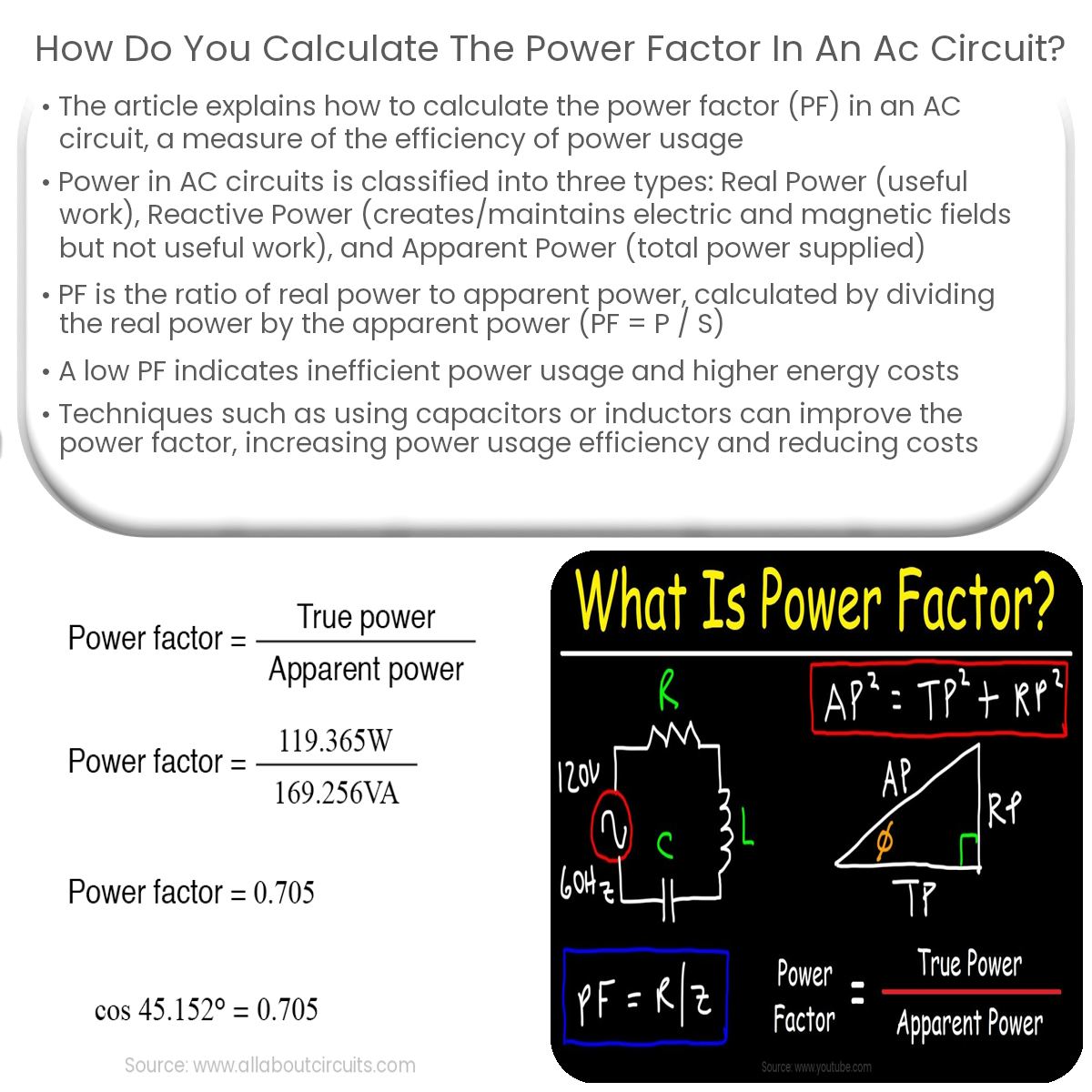
To calculate the power factor in an AC circuit, divide the real power (P) by the apparent power (S). It is represented as PF = P / S.
Calculating the Power Factor in an AC Circuit
Power factor (PF) is a crucial concept in understanding the efficiency of power usage in an alternating current (AC) circuit. It measures the proportion of real power, which does the useful work, to apparent power, which is the total power supplied to the circuit. This article will explain how to calculate the power factor in an AC circuit.
Power Types in AC Circuits
Before diving into the calculations, it is essential to understand the three types of power in AC circuits:
- Real Power (P): Measured in watts (W), it is the power used to perform useful work, such as turning a motor or lighting a bulb.
- Reactive Power (Q): Measured in volt-amperes reactive (VAR), it is the power used to create and maintain electric and magnetic fields in inductive or capacitive loads. It does not contribute to useful work.
- Apparent Power (S): Measured in volt-amperes (VA), it is the total power supplied to the circuit, which is the vector sum of real and reactive power.
Calculating Power Factor
The power factor is defined as the ratio of real power to apparent power:
PF = P / S
To calculate the power factor, follow these steps:
- Measure or calculate the real power (P) in watts. Real power can be found using the formula P = VIcosθ, where V is the voltage, I is the current, and θ is the phase angle between voltage and current.
- Measure or calculate the apparent power (S) in volt-amperes. Apparent power can be found using the formula S = VI, where V is the voltage and I is the current.
- Divide the real power (P) by the apparent power (S) to find the power factor: PF = P / S.
Power factor values range between -1 and 1. A power factor of 1 (or -1) signifies that all the power supplied to the circuit is being used to perform useful work, whereas a power factor of 0 indicates that no real power is being used. A low power factor suggests that the circuit has a significant reactive power component, which can lead to inefficient power usage and higher energy costs.
Improving Power Factor
Improving the power factor can increase the efficiency of power usage and reduce energy costs. One common method to achieve this is by using capacitors or inductors in parallel with the load to compensate for the reactive power component. By carefully selecting and placing these components, the power factor can be adjusted closer to 1, resulting in more efficient power usage.