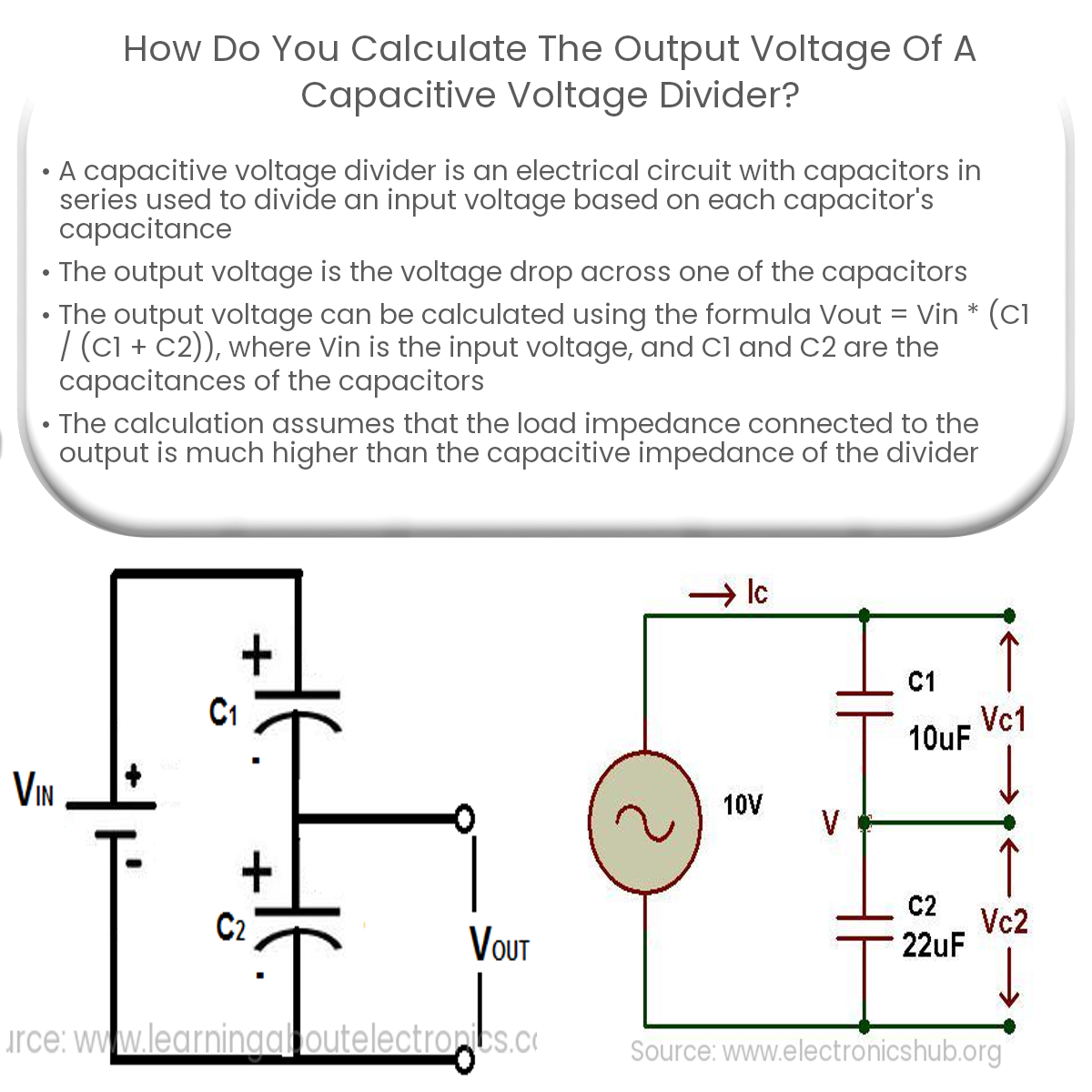
To calculate the output voltage of a capacitive voltage divider, use the formula: Vout = Vin * (C1 / (C1 + C2)), where Vin is input voltage, and C1 and C2 are capacitances.
Calculating the Output Voltage of a Capacitive Voltage Divider
A capacitive voltage divider is a type of electrical circuit that consists of capacitors connected in series, which are used to divide an input voltage into smaller portions based on the capacitance values of each capacitor. To calculate the output voltage of a capacitive voltage divider, it’s essential to understand the fundamental principles behind it.
Understanding Capacitive Voltage Dividers
In a capacitive voltage divider, capacitors are connected in series, and the voltage drop across each capacitor is proportional to its capacitance. The total voltage across the capacitors is equal to the input voltage. The output voltage is the voltage drop across one of the capacitors in the divider.
Capacitive Voltage Divider Formula
To calculate the output voltage of a capacitive voltage divider, you can use the following formula:
Vout = Vin * (C1 / (C1 + C2))
Where:
- Vout is the output voltage across one of the capacitors
- Vin is the input voltage applied to the capacitive voltage divider
- C1 is the capacitance of the first capacitor
- C2 is the capacitance of the second capacitor
Steps to Calculate the Output Voltage
- Identify the input voltage (Vin) and the capacitance values of the capacitors (C1 and C2).
- Calculate the sum of the capacitance values of both capacitors (C1 + C2).
- Divide the capacitance of the first capacitor (C1) by the sum of the capacitance values (C1 + C2).
- Multiply the result obtained in step 3 by the input voltage (Vin) to get the output voltage (Vout).
By following these steps, you can calculate the output voltage of a capacitive voltage divider. Keep in mind that this calculation is based on the assumption that the load impedance connected to the output is much higher than the capacitive impedance of the divider, ensuring that the load does not significantly affect the division ratio.