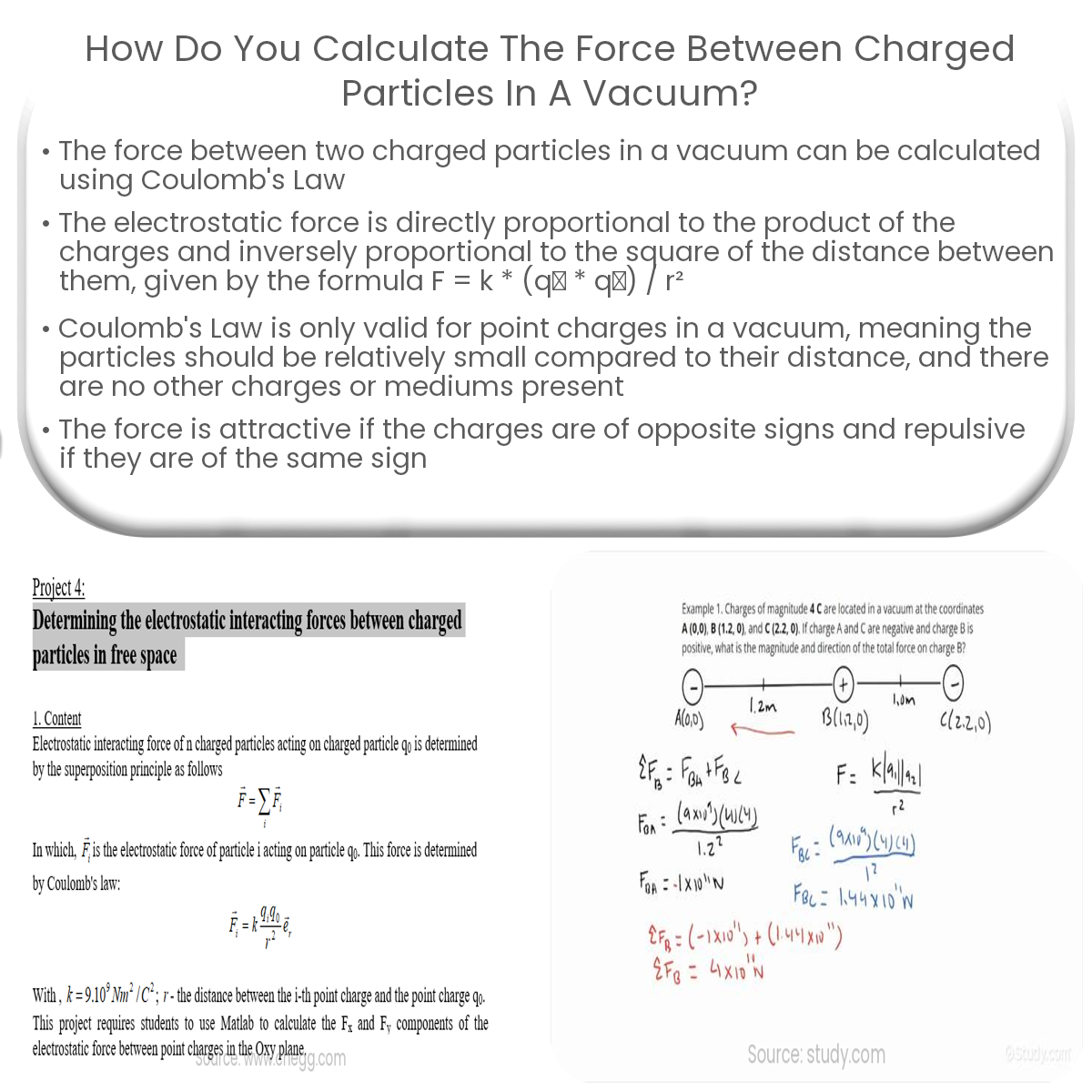
Use Coulomb’s Law, F = k*(q1*q2)/r², where F is the force, k is Coulomb’s constant, q1 and q2 are the charges, and r is the distance between them.
Calculating the Force Between Charged Particles in a Vacuum
To calculate the force between two charged particles in a vacuum, you can use Coulomb’s Law. This law states that the electrostatic force (F) between two point charges is directly proportional to the product of the magnitudes of their charges (q₁ and q₂) and inversely proportional to the square of the distance (r) between them.
The mathematical formula for Coulomb’s Law is:
F = k * (q₁ * q₂) / r²
Where:
- F is the electrostatic force between the charges,
- k is Coulomb’s constant, approximately 8.99 x 10⁹ N m²/C²,
- q₁ and q₂ are the magnitudes of the charges in coulombs (C), and
- r is the distance between the charges in meters (m).
The force acts along the line connecting the two charges and is attractive if the charges have opposite signs (positive and negative) and repulsive if they have the same sign (both positive or both negative).
To calculate the force between charged particles in a vacuum, follow these steps:
- Identify the charges of the particles (q₁ and q₂) and the distance between them (r).
- Substitute the values of q₁, q₂, and r into the Coulomb’s Law formula.
- Calculate the force (F) using the values you’ve substituted.
- Determine the direction of the force based on the signs of the charges (attractive or repulsive).
Keep in mind that Coulomb’s Law is valid for point charges, meaning the charged particles should be relatively small compared to the distance between them. The vacuum condition ensures that the presence of other charges or medium doesn’t affect the force between the two particles.
In summary, the force between charged particles in a vacuum can be calculated using Coulomb’s Law. This law takes into account the magnitudes of the charges, the distance between them, and Coulomb’s constant to determine the electrostatic force acting on the particles.