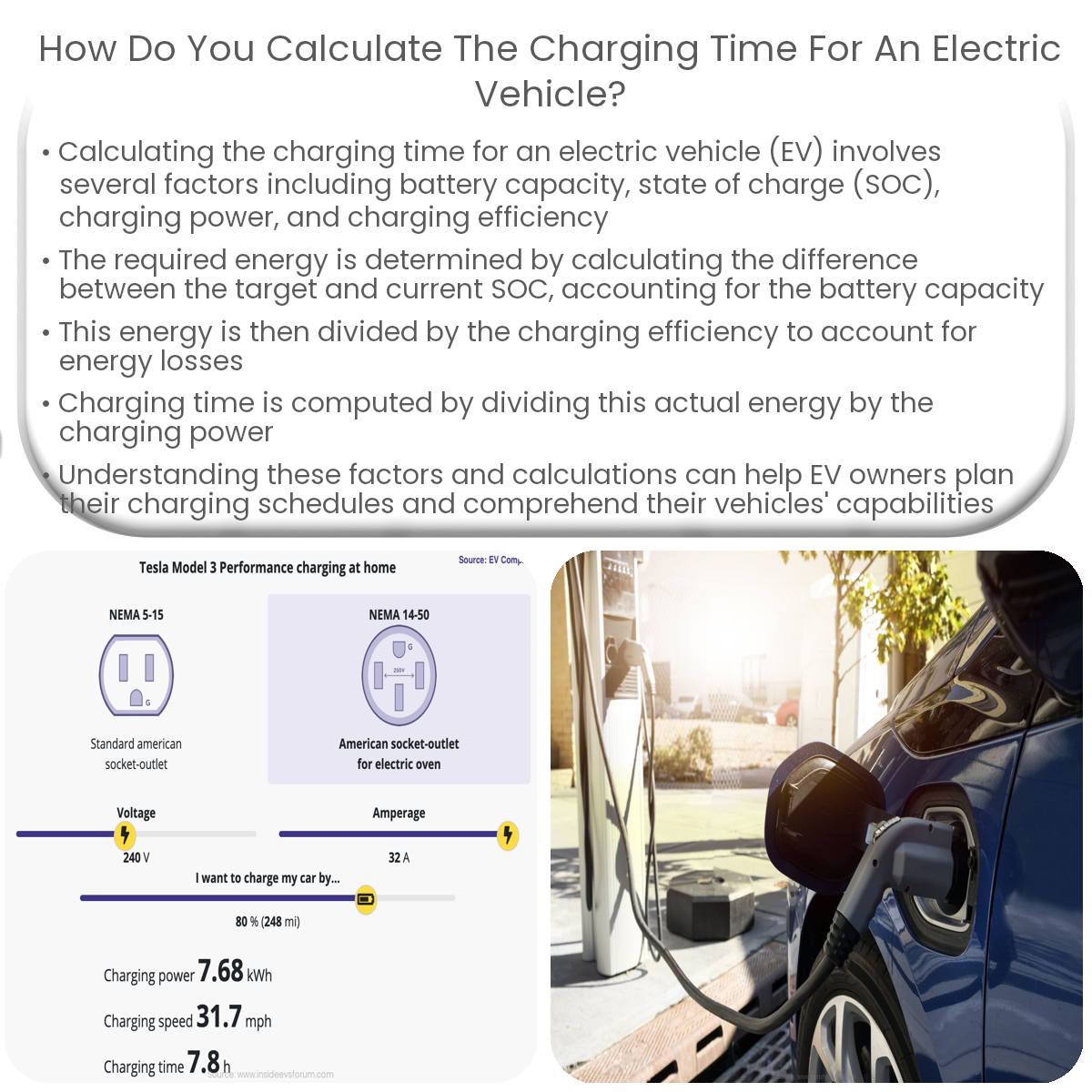
Calculate EV charging time by finding the required energy, accounting for charging efficiency, dividing by charging power, and converting to minutes.
Calculating Charging Time for an Electric Vehicle
Understanding how to calculate the charging time for an electric vehicle (EV) is crucial for EV owners and potential buyers. This article will guide you through the factors that influence charging time and the steps to calculate it.
Factors Influencing Charging Time
The charging time for an EV depends on several factors:
- Battery capacity: Measured in kilowatt-hours (kWh), the battery capacity determines the amount of energy the battery can store.
- State of charge (SOC): The SOC indicates the current battery charge level as a percentage of its capacity.
- Charging power: The charging power, measured in kilowatts (kW), determines the rate at which the EV charger can deliver energy to the battery.
- Charging efficiency: Charging efficiency accounts for energy losses during the charging process, which typically range from 85% to 95%.
Steps to Calculate Charging Time
Follow these steps to calculate the charging time for an EV:
- Determine the required energy: Calculate the energy needed to reach the desired SOC by subtracting the current energy level from the target energy level. Use the formula: Required Energy (kWh) = Battery Capacity (kWh) x (Target SOC (%) – Current SOC (%)) / 100.
- Account for charging efficiency: Divide the required energy by the charging efficiency to determine the actual energy needed. Use the formula: Actual Energy (kWh) = Required Energy (kWh) / Charging Efficiency (%).
- Calculate charging time: Divide the actual energy by the charging power to obtain the charging time in hours. Use the formula: Charging Time (hours) = Actual Energy (kWh) / Charging Power (kW).
- Convert to minutes: Multiply the charging time in hours by 60 to obtain the charging time in minutes.
Example Calculation
Consider an EV with a 60 kWh battery capacity, a current SOC of 20%, and a target SOC of 80%. Using a Level 2 charger with a 10 kW charging power and 90% efficiency:
- Required Energy = 60 kWh x (80% – 20%) / 100 = 36 kWh
- Actual Energy = 36 kWh / 0.9 = 40 kWh
- Charging Time (hours) = 40 kWh / 10 kW = 4 hours
- Charging Time (minutes) = 4 hours x 60 = 240 minutes
In this example, it would take 4 hours (240 minutes) to charge the EV from 20% to 80% using a Level 2 charger.
Conclusion
Calculating the charging time for an electric vehicle helps EV owners plan their charging schedules and better understand their vehicles’ capabilities. By considering factors such as battery capacity, SOC, charging power, and efficiency, EV owners can make informed decisions about their charging needs.