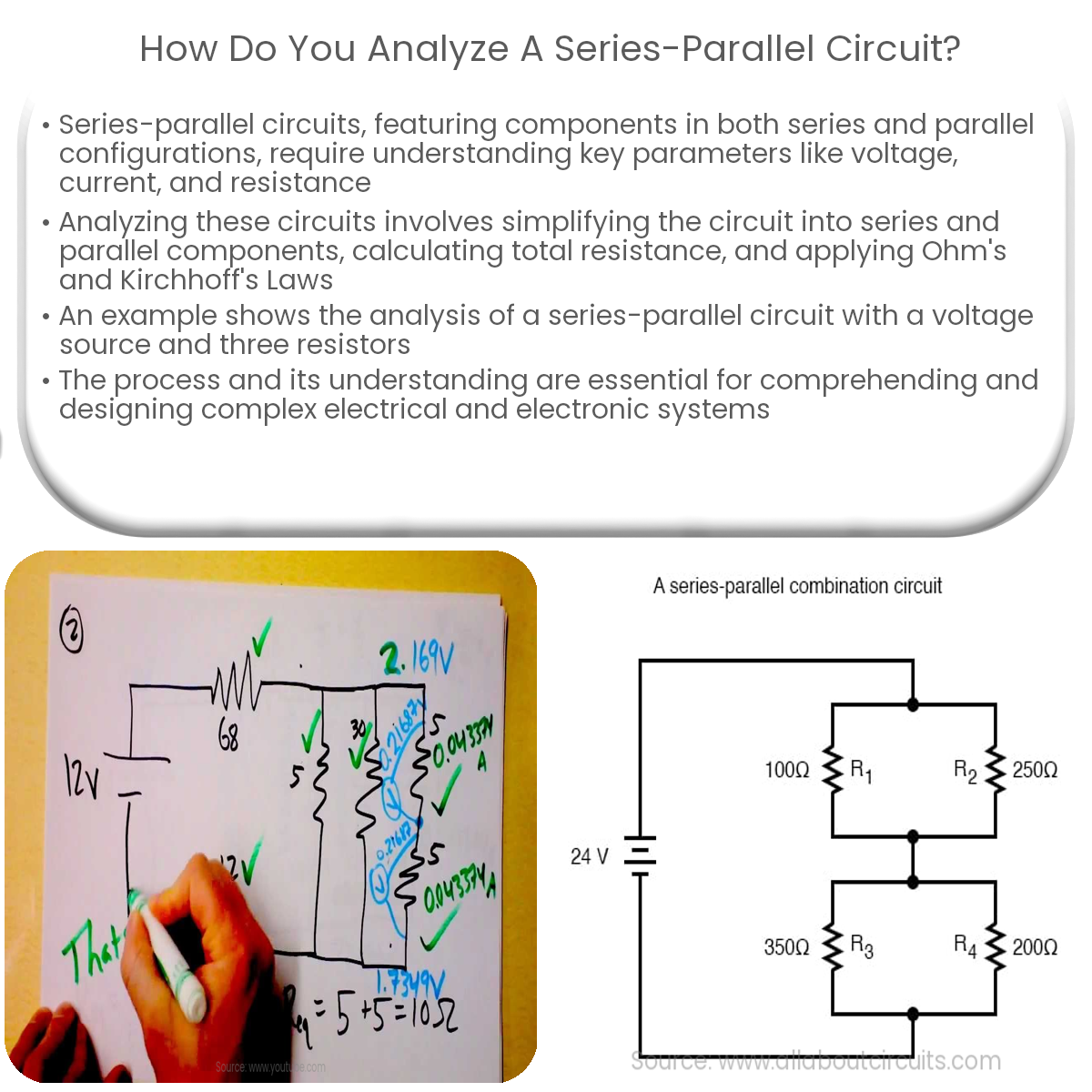
Series-parallel circuits combine elements of both series and parallel circuits, featuring components connected in a combination of these configurations.
Analyzing a Series-Parallel Circuit
Series-parallel circuits combine elements of both series and parallel circuits, featuring components connected in a combination of these configurations. This article will discuss how to analyze a series-parallel circuit, focusing on essential parameters such as voltage, current, and resistance.
Basic Components and Parameters
Before analyzing a series-parallel circuit, it is essential to understand the fundamental components and parameters involved:
- Voltage (V): The electric potential difference between two points in a circuit, measured in volts (V).
- Current (I): The flow of electric charge through a circuit, measured in amperes (A).
- Resistance (R): The opposition to the flow of electric current, measured in ohms (Ω).
Step-by-Step Analysis
Series-parallel circuit analysis involves several steps, including simplifying the circuit, calculating total resistance, and applying Ohm’s and Kirchhoff’s Laws:
- Simplify the circuit: Break down the circuit into simpler series and parallel components, and analyze them separately.
- Calculate total resistance: Use the appropriate formulas for series and parallel resistances to determine the total resistance in the circuit.
- Apply Ohm’s Law: Use Ohm’s Law (I = V / R) to calculate current, voltage, and resistance values in the simplified components.
- Apply Kirchhoff’s Laws: Use Kirchhoff’s Voltage Law (KVL) for series sections and Kirchhoff’s Current Law (KCL) for parallel sections to determine current and voltage distributions.
- Reassemble the circuit: Combine the results from the simplified components to analyze the original series-parallel circuit.
Example
Consider a series-parallel circuit with a voltage source (VT) and three resistors: R1 in series with a parallel combination of R2 and R3. To analyze this circuit:
- Identify the series and parallel sections of the circuit. In this case, R1 is in series with the parallel combination of R2 and R3.
- Calculate the total resistance of the parallel combination of R2 and R3, and then find the total resistance by adding R1.
- Apply Ohm’s Law to find the total current (IT) in the circuit and the voltage drop across R1.
- Apply KVL to find the voltage across the parallel combination of R2 and R3, and then apply Ohm’s Law to find the currents through each resistor.
- Combine the results to analyze the original series-parallel circuit.
Conclusion
Analyzing series-parallel circuits involves simplifying the circuit into its series and parallel components, calculating total resistance, and applying Ohm’s and Kirchhoff’s Laws. By breaking down the circuit and methodically analyzing each section, we can determine the current and voltage distributions throughout the series-parallel circuit. This skill is essential for understanding, troubleshooting, and designing complex electrical and electronic systems.