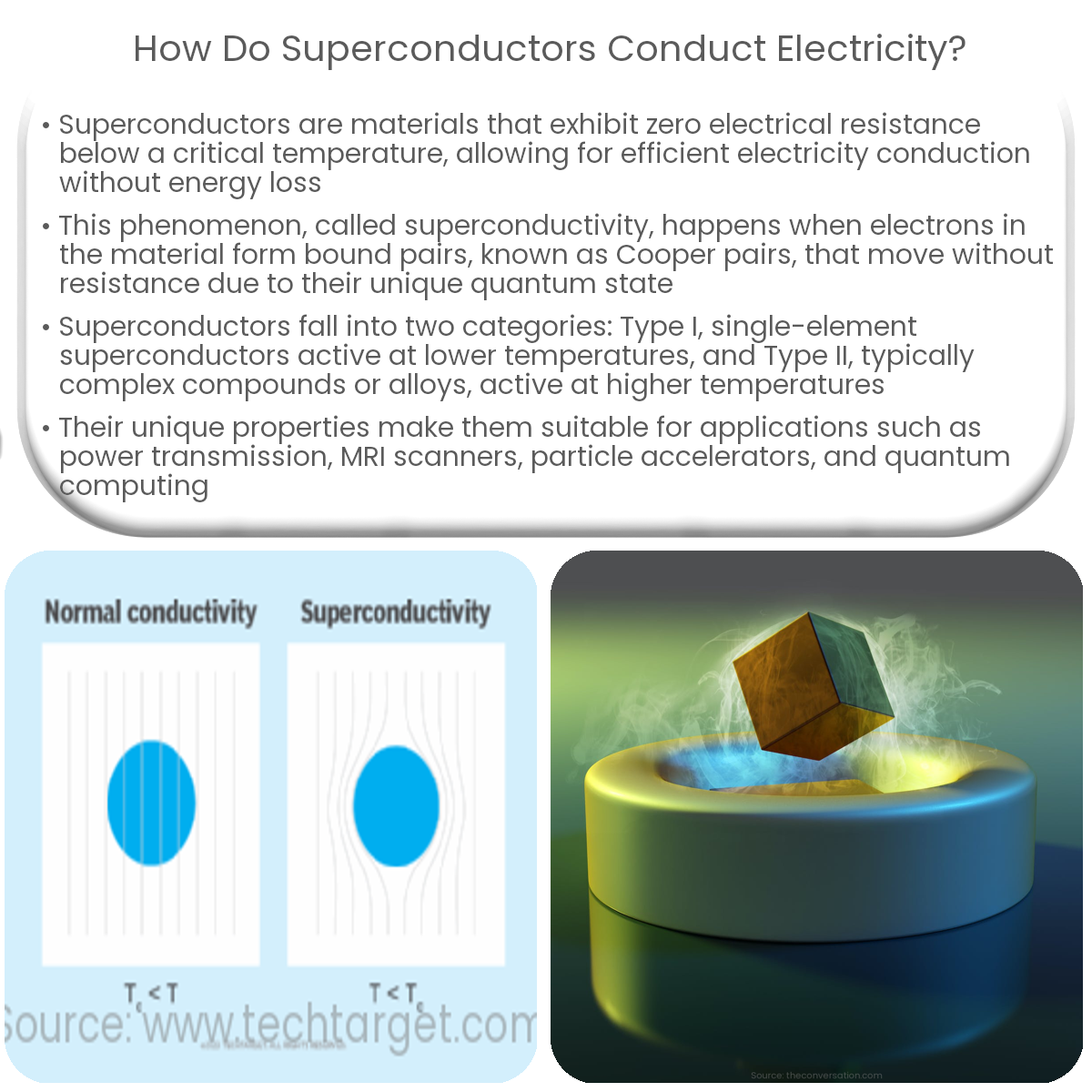
Superconductors conduct electricity without resistance by forming Cooper pairs, which move freely through the material, avoiding energy loss as heat.
Superconductors: A Unique Class of Conductive Materials
Superconductors are materials that exhibit the remarkable property of zero electrical resistance when cooled below a certain critical temperature. Unlike conventional conductors, superconductors allow the flow of electrical current without any energy loss in the form of heat, making them incredibly efficient in conducting electricity.
The Phenomenon of Superconductivity
Superconductivity occurs when the material undergoes a phase transition at its critical temperature. In this state, the material’s electrons form Cooper pairs, which are bound electron pairs that move in a correlated manner. The formation of Cooper pairs is facilitated by interactions between the electrons and the lattice structure of the material, known as the electron-phonon interaction.
Cooper pairs can move through the superconductor without encountering resistance because they occupy a unique quantum state that is distinct from the states occupied by individual electrons in a normal conductor. As a result, these pairs are not scattered by impurities or defects in the material, allowing them to move freely and maintain the flow of electrical current without any energy loss.
Types of Superconductors
Superconductors can be broadly classified into two categories:
- Type I Superconductors: These are elemental superconductors, composed of a single element, that exhibit superconductivity at relatively low temperatures, typically below 30 K (-243.15°C). Examples include mercury, lead, and aluminum.
- Type II Superconductors: These are usually composed of complex compounds or alloys and exhibit superconductivity at higher critical temperatures than Type I superconductors. Some high-temperature superconductors (HTS) can even achieve superconductivity at temperatures above the boiling point of liquid nitrogen (77 K, -196°C), making them more practical for various applications.
Applications of Superconductors
Superconductors have a wide range of potential applications due to their unique properties. Some examples include:
- Power transmission: Superconducting cables can transmit electrical power over long distances with minimal energy loss, significantly improving the efficiency of power distribution systems.
- Magnetic resonance imaging (MRI): Superconducting magnets are used to generate strong, uniform magnetic fields required for MRI scanners in medical diagnostics.
- Particle accelerators: Superconducting magnets enable the generation of extremely high magnetic fields necessary for accelerating particles in research facilities.
- Quantum computing: Superconducting circuits are being explored as a potential platform for building scalable quantum computers due to their low energy dissipation and fast operation speeds.