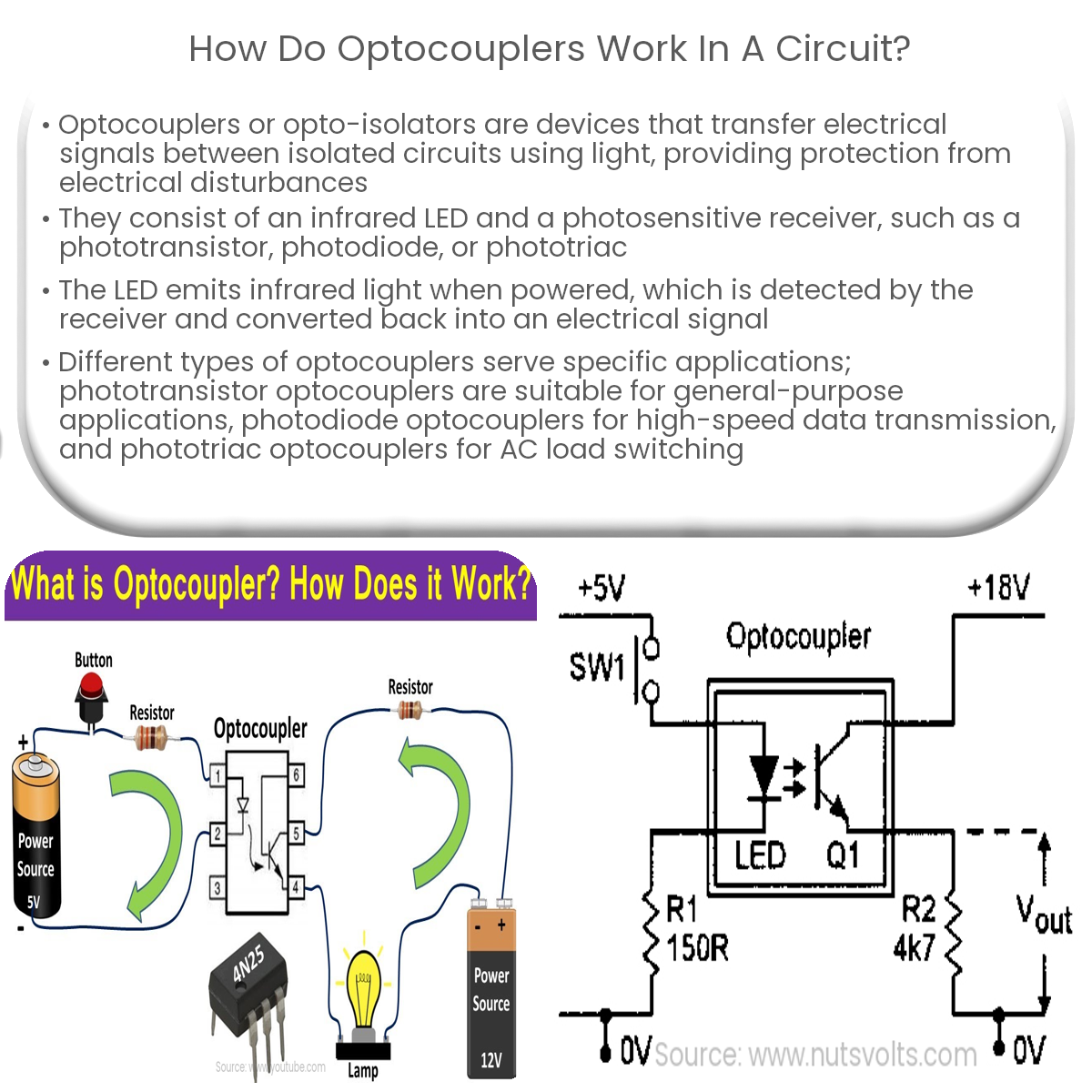
Optocouplers work by transferring electrical signals between isolated circuits using light, providing protection against noise, voltage spikes, and ground loops.
Understanding Optocouplers
An optocoupler, also known as an opto-isolator, is a device that enables the transfer of electrical signals between two isolated circuits using light. This allows for communication between the circuits without direct electrical connection, providing isolation and protection against noise, voltage spikes, and ground loops.
Optocoupler Components
Optocouplers consist of two main components: an infrared LED (light-emitting diode) and a photosensitive receiver, typically a phototransistor, photodiode, or phototriac. These components are housed within a single package, ensuring that the light generated by the LED is focused directly onto the photosensitive receiver.
How Optocouplers Work
- When an electrical current flows through the input circuit, it powers the LED, causing it to emit infrared light.
- The emitted light travels across a small gap within the optocoupler package and strikes the photosensitive receiver.
- The receiver detects the light and converts it back into an electrical signal, which is then sent to the output circuit.
By using light as a medium to transfer the signal, optocouplers effectively isolate the input and output circuits, preventing electrical disturbances from affecting signal integrity or causing damage to sensitive components.
Types of Optocouplers
There are several types of optocouplers, each with unique characteristics that make them suitable for specific applications:
- Phototransistor Optocouplers: These optocouplers use a phototransistor as the photosensitive receiver, providing a high current transfer ratio and fast response times. They are ideal for general-purpose applications, such as digital signal transmission and power supply regulation.
- Photodiode Optocouplers: With a photodiode receiver, these optocouplers offer lower current transfer ratios than phototransistor optocouplers but provide faster response times, making them suitable for high-speed data transmission and analog signal isolation.
- Phototriac Optocouplers: These optocouplers use a phototriac as the receiver, allowing them to switch AC loads directly without additional components. They are commonly used in solid-state relays and motor control applications.
Understanding the specific requirements of your circuit will help you choose the right type of optocoupler for optimal performance and protection.