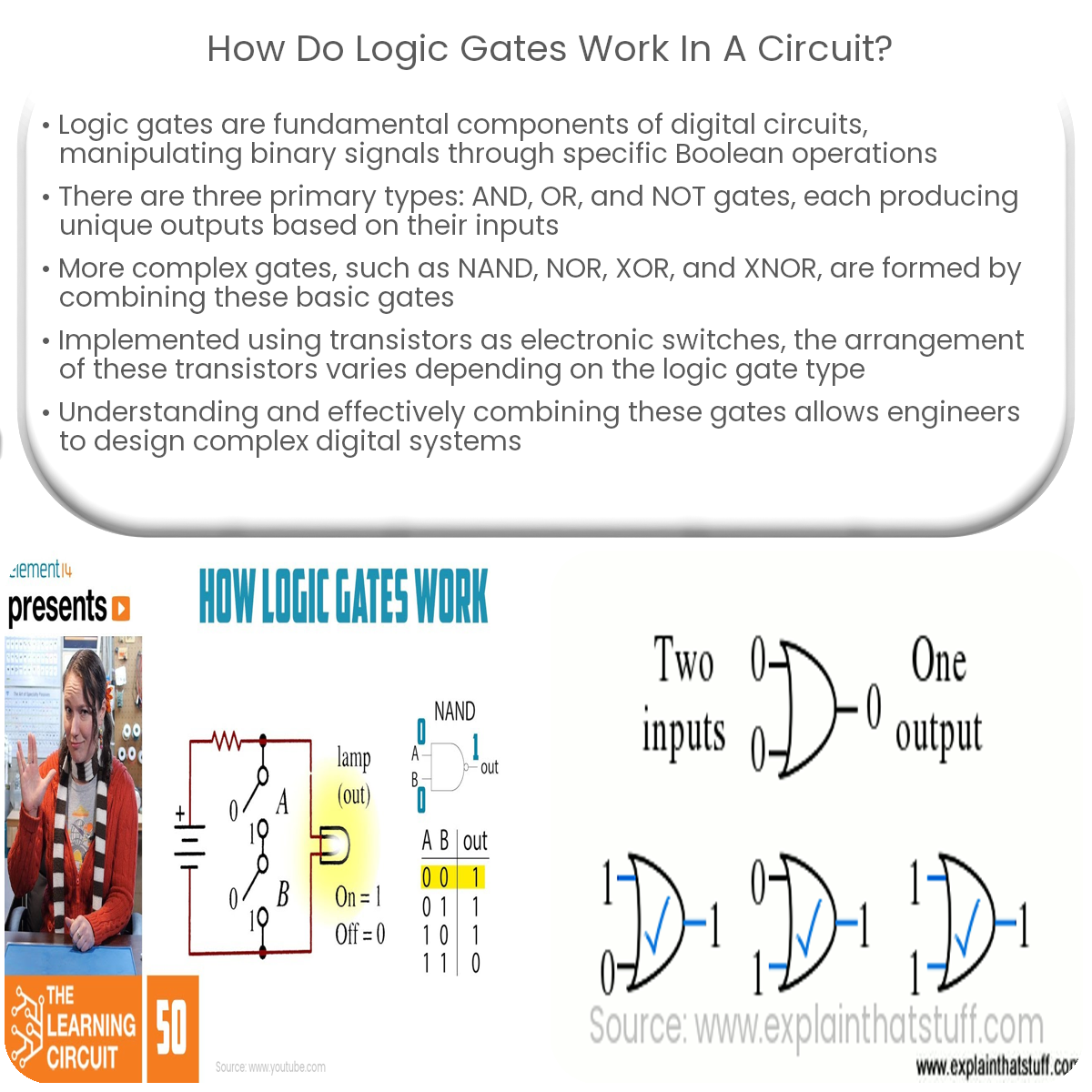
Logic gates process binary signals in digital circuits, performing Boolean operations based on their function. They can be combined for complex tasks.
How Do Logic Gates Work in a Circuit?
Logic gates are the building blocks of digital circuits, responsible for processing and manipulating binary signals. They are designed to perform specific Boolean operations on one or more input signals, producing an output based on the logic function they represent. This article will discuss how logic gates operate in a circuit and the types of logic gates commonly used.
Basic Logic Gates
There are three primary logic gates:
- AND Gate
- OR Gate
- NOT Gate (Inverter)
AND Gate: An AND gate has two or more inputs and produces an output of 1 (true) only if all its inputs are 1 (true).
OR Gate: An OR gate has two or more inputs and produces an output of 1 (true) if at least one of its inputs is 1 (true).
NOT Gate: A NOT gate, also known as an inverter, has one input and inverts the input signal. If the input is 1 (true), the output will be 0 (false), and vice versa.
Combining Logic Gates
By combining these basic gates, more complex gates can be formed, such as:
- NAND (NOT AND) Gate
- NOR (NOT OR) Gate
- XOR (Exclusive OR) Gate
- XNOR (Exclusive NOR) Gate
These complex gates perform specific Boolean functions by combining the outputs of the basic gates in unique ways.
How Logic Gates Operate in a Circuit
Logic gates are typically implemented using transistors, which serve as electronic switches. Depending on the type of logic gate, the configuration of the transistors will differ to produce the desired output.
For example, in an AND gate, the transistors are arranged in series, meaning the output will only be high (1) when both input signals are high (1), activating both transistors. Conversely, in an OR gate, the transistors are arranged in parallel, so the output will be high (1) when either input signal is high (1), activating at least one transistor.
Logic gates can be interconnected to create more complex digital circuits, such as adders, multiplexers, and flip-flops. These circuits perform various tasks, including arithmetic operations, data storage, and signal processing, in computers and other digital systems.
Conclusion
Logic gates play a crucial role in the functioning of digital circuits, enabling them to perform Boolean operations on input signals. By understanding how these gates work and how they can be combined, engineers and designers can create intricate digital systems to meet a wide range of applications.