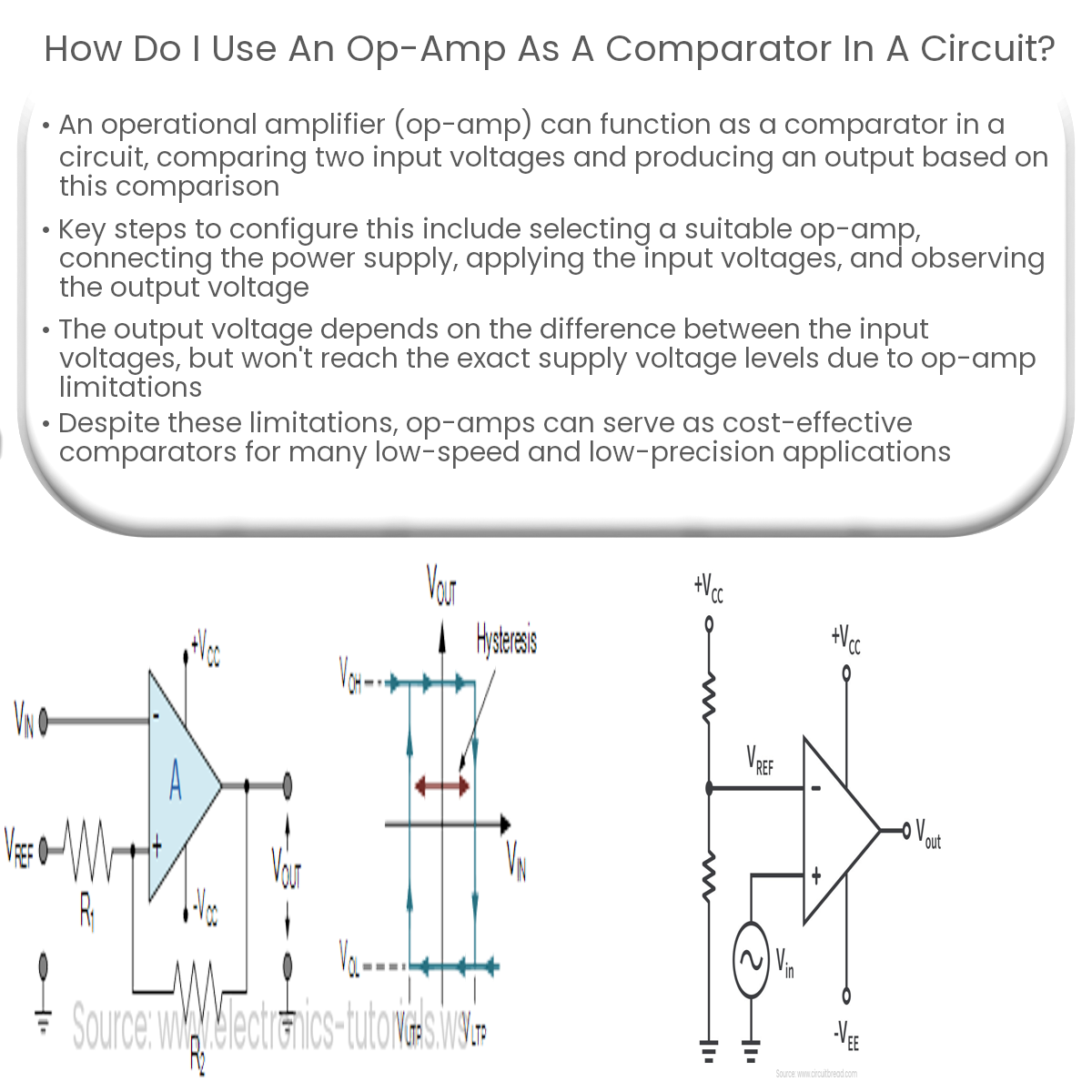
To use an op-amp as a comparator, apply two input voltages to the inverting and non-inverting inputs, and observe the output based on their difference.
Using an Op-Amp as a Comparator
An operational amplifier (op-amp) can be used as a comparator in a circuit by applying two input voltages and observing the output voltage. In this configuration, the op-amp compares the input voltages and generates an output based on the comparison. This article will guide you through the process of using an op-amp as a comparator in a circuit.
Comparator Circuit Configuration
To use an op-amp as a comparator, follow these steps:
- Choose an op-amp: Select an op-amp suitable for your application. Keep in mind the supply voltage range and frequency response.
- Power supply connections: Connect the positive and negative power supply rails to the op-amp’s V+ and V– pins, respectively.
- Connect the input voltages: Apply the two input voltages to the op-amp’s inverting (-) and non-inverting (+) input terminals. These voltages can come from various sources like sensors, potentiometers, or other circuits.
- Observe the output voltage: Connect the output pin of the op-amp to the desired output device, such as an LED or a microcontroller. The output voltage will be high or low depending on the comparison between the input voltages.
Understanding Comparator Operation
When using an op-amp as a comparator, the output voltage depends on the difference between the input voltages:
- If the non-inverting input voltage (V+) is greater than the inverting input voltage (V–), the output voltage will be close to the positive supply voltage (VCC).
- If the non-inverting input voltage (V+) is less than the inverting input voltage (V–), the output voltage will be close to the negative supply voltage (VEE).
Note that the output voltage will not reach the exact supply voltage levels due to the limitations of the op-amp.
Comparator Limitations and Considerations
While using an op-amp as a comparator can be a simple and cost-effective solution, it may not always be the best choice for all applications. Dedicated comparator ICs offer faster response times, better noise immunity, and lower power consumption. However, for many low-speed and low-precision applications, an op-amp can serve as a suitable comparator.
When using an op-amp as a comparator, it is essential to ensure that the input voltages stay within the op-amp’s common-mode input voltage range and that the output voltage does not exceed the op-amp’s maximum output voltage rating.