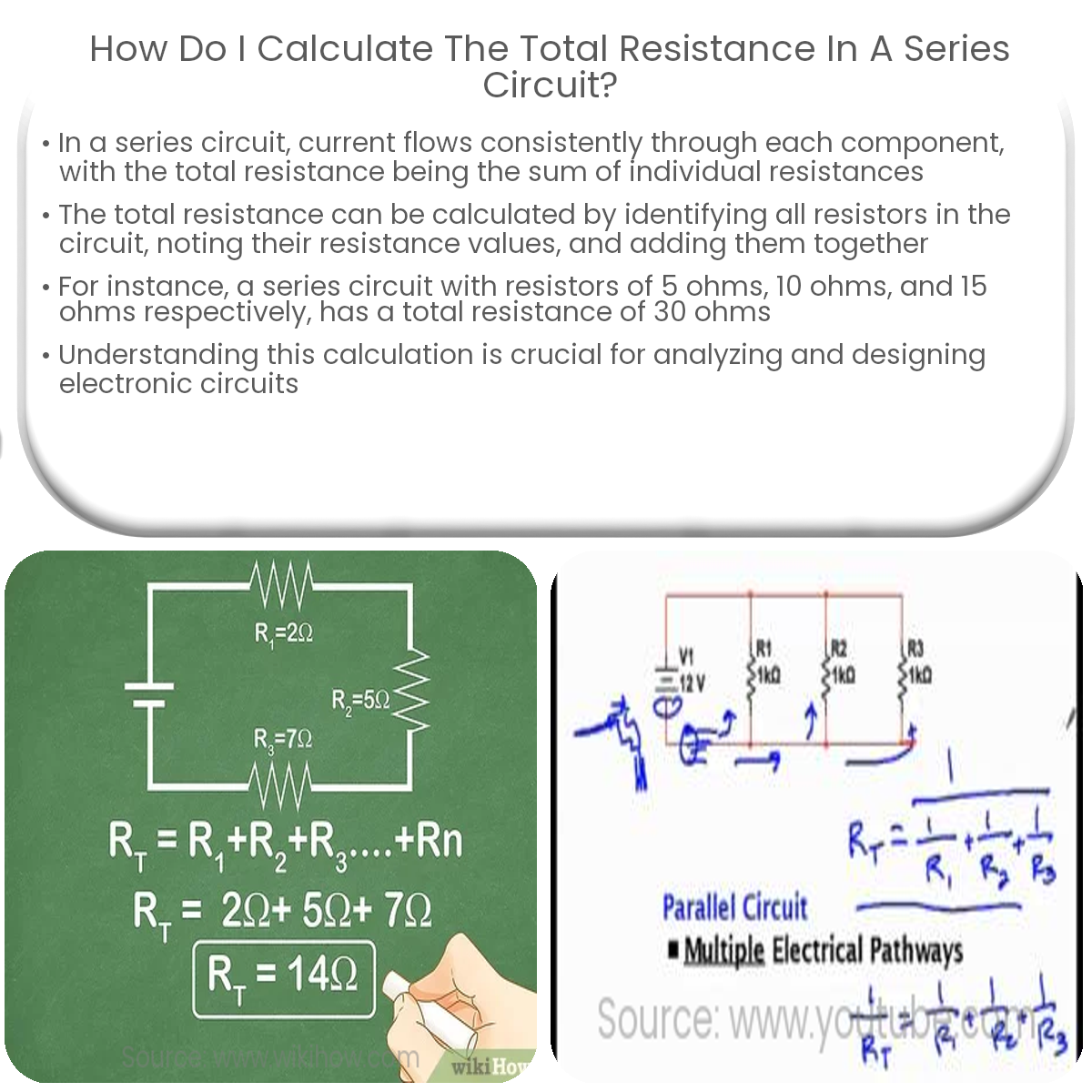
To calculate total resistance in a series circuit, simply add the individual resistance values of all resistors connected in series (R₁ + R₂ + … + Rₙ).
Introduction to Series Circuits
In a series circuit, components are connected end-to-end so that the current flows through each component in turn. One key characteristic of series circuits is that the current remains the same through all components. This article will explain how to calculate the total resistance in a series circuit.
Total Resistance in Series Circuits
The total resistance (RT) in a series circuit is simply the sum of the individual resistances of all the resistors connected in series. This is due to the fact that the current flows through each resistor, and the voltage drop across each resistor is proportional to its resistance, according to Ohm’s Law (V = I × R). The total voltage drop across the entire circuit is equal to the sum of the voltage drops across each resistor.
Calculating Total Resistance
To calculate the total resistance in a series circuit, follow these steps:
- Identify all the resistors connected in series within the circuit. This can be done by tracing the current path and locating each resistor along the way.
- Write down the resistance values of each resistor. These values are typically labeled on the resistors themselves or provided in a circuit schematic.
- Add the resistance values of each resistor to find the total resistance of the series circuit. The formula for calculating the total resistance is RT = R1 + R2 + R3 + … + Rn, where R1, R2, R3, …, Rn represent the individual resistance values, and n is the total number of resistors.
Example Calculation
Consider a series circuit with three resistors connected in series: R1 = 5 ohms, R2 = 10 ohms, and R3 = 15 ohms. To calculate the total resistance, simply add the resistance values of all three resistors:
RT = R1 + R2 + R3 = 5 ohms + 10 ohms + 15 ohms = 30 ohms
Thus, the total resistance of this series circuit is 30 ohms.
Conclusion
Calculating the total resistance in a series circuit is a straightforward process that involves adding the individual resistance values of all the resistors connected in series. Understanding how to calculate total resistance is essential for analyzing and designing electronic circuits.