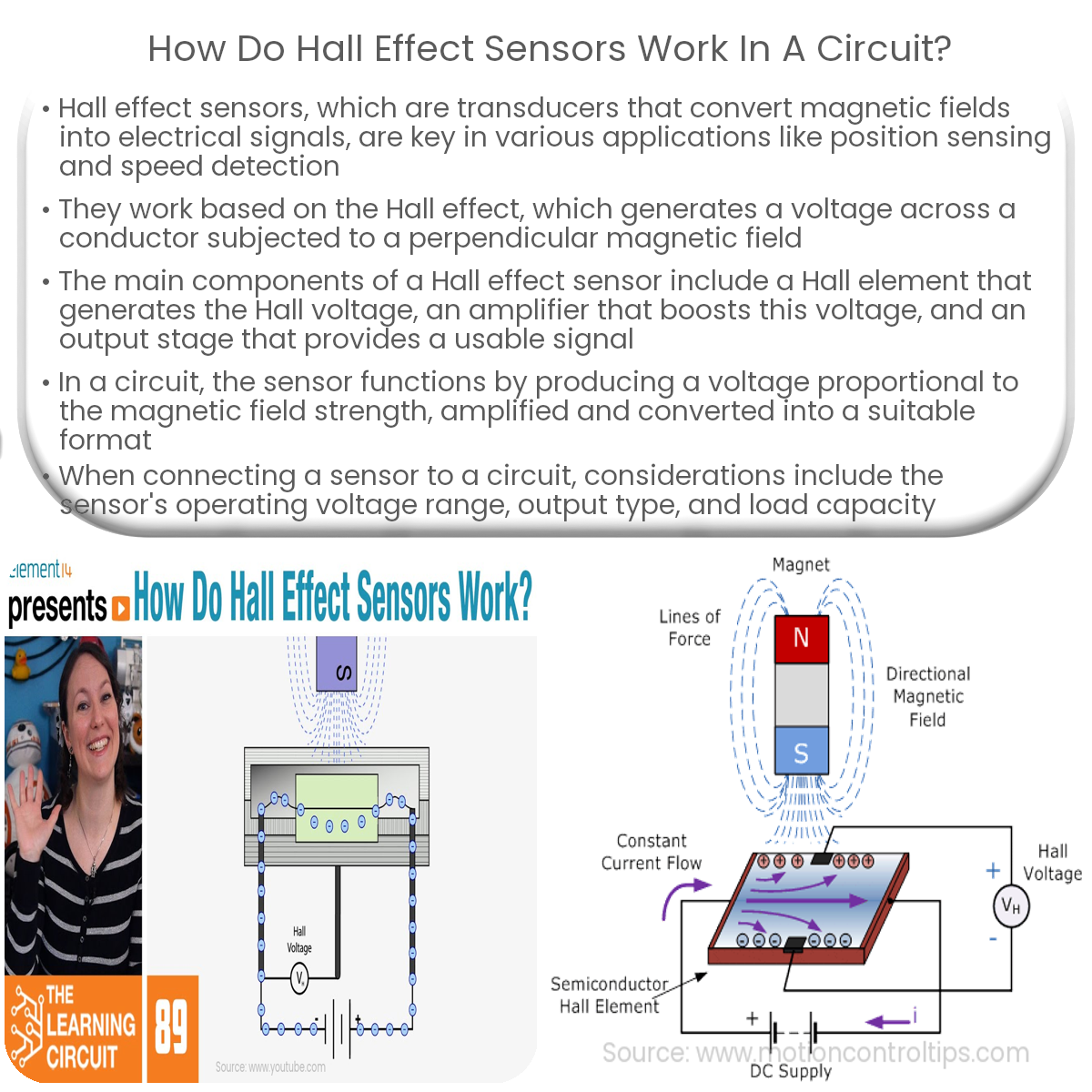
Hall effect sensors detect magnetic fields, convert them into electrical signals, and work in circuits with a Hall element, amplifier, and output stage.
Understanding Hall Effect Sensors
Hall effect sensors are transducers that detect magnetic fields and convert them into electrical signals. They play a crucial role in various applications such as position sensing, current monitoring, and speed detection. In this article, we will discuss how Hall effect sensors work in a circuit.
Basic Principle of Hall Effect Sensors
The Hall effect is a phenomenon where a voltage is generated across a conductor when it is subjected to a magnetic field perpendicular to the direction of current flow. This voltage is called the Hall voltage, and it is proportional to the product of the magnetic field strength, current, and the thickness of the conductor.
Components of a Hall Effect Sensor
A typical Hall effect sensor consists of three main components:
- Hall Element: A thin conductive material that generates the Hall voltage when exposed to a magnetic field.
- Amplifier: An operational amplifier that amplifies the small Hall voltage to a detectable level.
- Output Stage: A circuit that provides a usable output signal, usually in the form of a digital or analog output voltage.
How Hall Effect Sensors Work in a Circuit
When a Hall effect sensor is placed in a magnetic field, the Hall element generates a voltage proportional to the field strength. This voltage is fed into the amplifier, which amplifies the signal and sends it to the output stage. The output stage converts the amplified signal into a format suitable for the specific application, such as a digital or analog voltage.
In many cases, the output stage includes a comparator that compares the amplified Hall voltage to a reference voltage. When the Hall voltage exceeds the reference voltage, the output changes state. This allows the sensor to act as a digital switch, providing a high or low output signal depending on the presence of a magnetic field.
Connecting a Hall Effect Sensor to a Circuit
Connecting a Hall effect sensor to a circuit typically involves three connections: power supply, ground, and output. The power supply and ground connections provide the necessary operating voltage and current for the sensor, while the output connection transmits the sensor’s output signal to the rest of the circuit.
It is essential to consider the specific sensor’s requirements and specifications, such as operating voltage range, output type (digital or analog), and load capacity when designing a circuit with a Hall effect sensor.