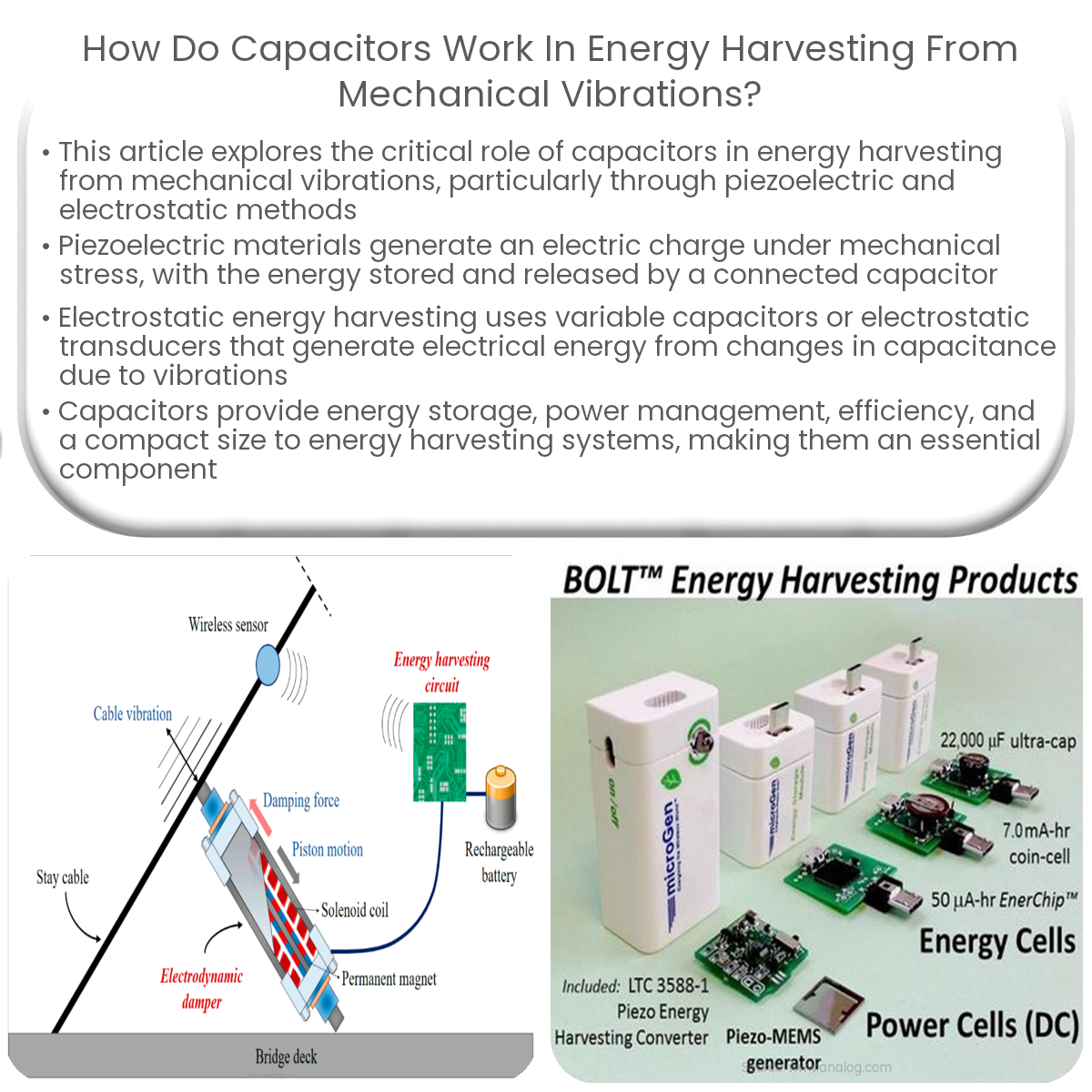
Capacitors store and release electrical energy in energy harvesting systems, enabling efficient power management and energy storage from vibrations.
Capacitors in Energy Harvesting from Mechanical Vibrations
Energy harvesting is the process of capturing and converting ambient energy from the environment into usable electrical energy. One promising source of ambient energy is mechanical vibrations. This article explores how capacitors play a critical role in energy harvesting from mechanical vibrations.
Energy Harvesting: Piezoelectric and Electrostatic Approaches
There are two primary methods for harvesting energy from mechanical vibrations: piezoelectric and electrostatic. Both methods can use capacitors to store and release electrical energy.
Piezoelectric Energy Harvesting
Piezoelectric materials generate an electric charge when subjected to mechanical stress, such as vibrations. In a piezoelectric energy harvester, a capacitor is connected in parallel to the piezoelectric element. When the element is deformed by vibrations, it generates a charge, which is transferred to the capacitor. As the vibrations continue, the capacitor stores the electrical energy and releases it when needed.
Electrostatic Energy Harvesting
Electrostatic energy harvesting uses variable capacitors, also known as electrostatic transducers. These transducers have two conductive plates separated by a dielectric material. One plate is fixed, while the other is free to move in response to vibrations. When the distance between the plates changes due to vibrations, the capacitance of the transducer also changes. This change in capacitance causes an electric charge to be transferred between the plates, generating electrical energy. Capacitors connected to the transducer store the energy and release it when needed.
Advantages of Using Capacitors in Energy Harvesting
Capacitors offer several advantages in energy harvesting systems:
Conclusion
Capacitors play a vital role in energy harvesting systems that capture energy from mechanical vibrations. Through piezoelectric and electrostatic methods, capacitors store and release electrical energy, enabling efficient power management and energy storage. Their ability to function in compact spaces and provide stable power output makes them an essential component in energy harvesting applications.