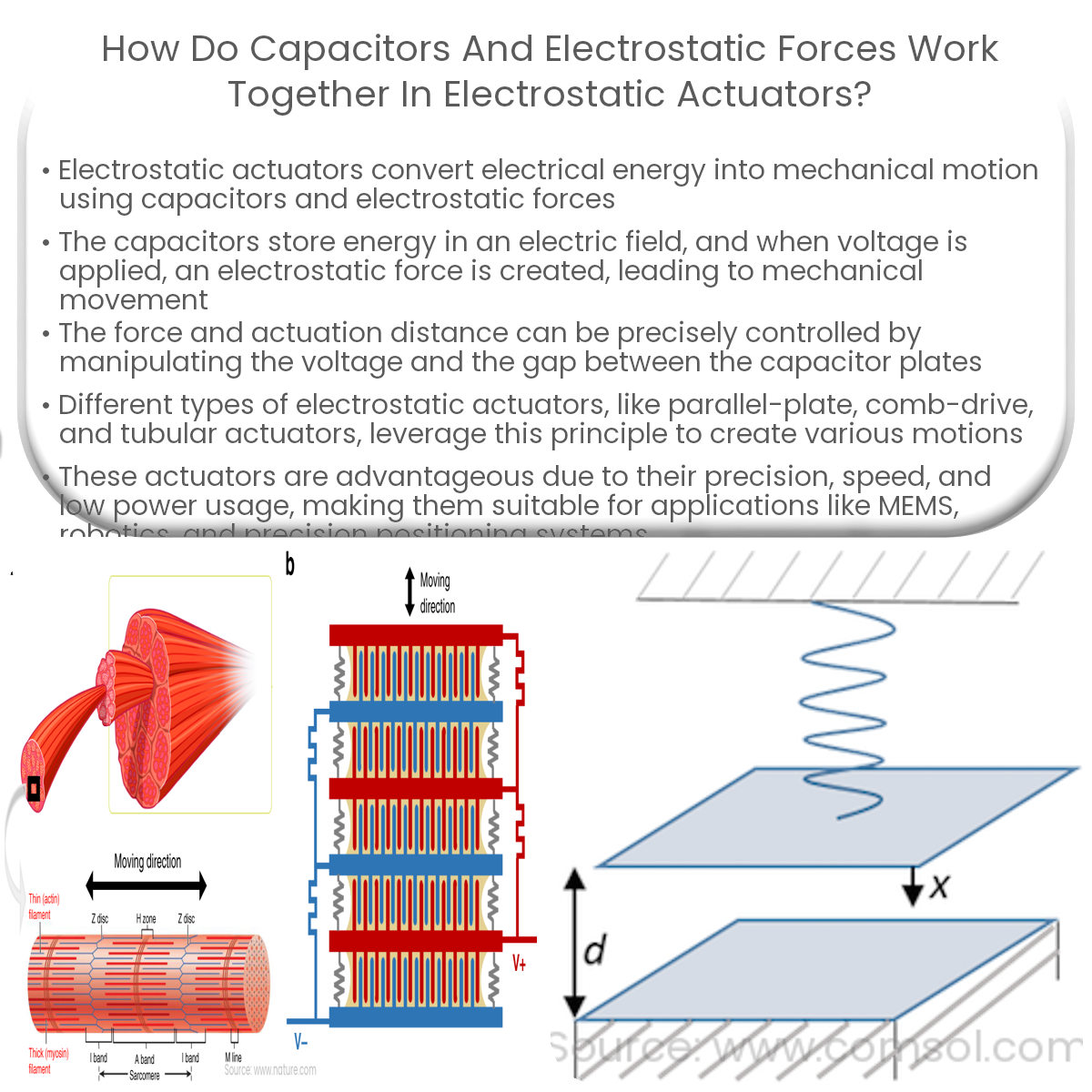
Capacitors store energy as an electric field, and electrostatic forces in actuators create mechanical motion by regulating voltage and actuation distance.
Capacitors and Electrostatic Forces in Electrostatic Actuators
Electrostatic actuators are devices that convert electrical energy into mechanical motion using electrostatic forces. Capacitors, which store energy in the form of an electric field, play a critical role in the functioning of electrostatic actuators. This article explores how capacitors and electrostatic forces work together to enable the operation of electrostatic actuators.
1. Basic Principle
An electrostatic actuator consists of a pair of electrodes separated by a small gap, forming a capacitor. When a voltage is applied across the electrodes, an electric field is generated, resulting in an attractive electrostatic force that causes the electrodes to move toward each other. This mechanical motion can be harnessed to perform work in various applications.
2. Capacitors and Electrostatic Forces
-
Energy Storage: Capacitors store energy in the form of an electric field between their plates. This energy can be released to generate mechanical motion in an electrostatic actuator.
-
Force Generation: The electrostatic force is directly proportional to the square of the electric field, which is determined by the voltage applied across the capacitor. By controlling the voltage, the force generated by the actuator can be precisely regulated.
-
Actuation Distance: The distance between the capacitor plates impacts the strength of the electrostatic force. Smaller gaps result in stronger forces and higher actuator performance.
3. Types of Electrostatic Actuators
-
Parallel-Plate Actuators: These consist of two flat, parallel electrodes. The attractive force generated between the plates causes them to move toward each other, creating mechanical motion.
-
Comb-Drive Actuators: Comb-drive actuators feature interdigitated electrodes that resemble the teeth of a comb. The electrostatic force generated between the comb fingers results in lateral motion.
-
Tubular Actuators: In tubular actuators, a cylindrical electrode is surrounded by an outer electrode. When a voltage is applied, the electrostatic force causes the inner electrode to move axially.
In conclusion, capacitors and electrostatic forces work together to enable the operation of electrostatic actuators by storing electrical energy, generating controllable forces, and influencing actuation distances. These actuators offer numerous advantages, including precise motion control, fast response times, and low power consumption, making them suitable for a wide range of applications, such as microelectromechanical systems (MEMS), robotics, and precision positioning systems.