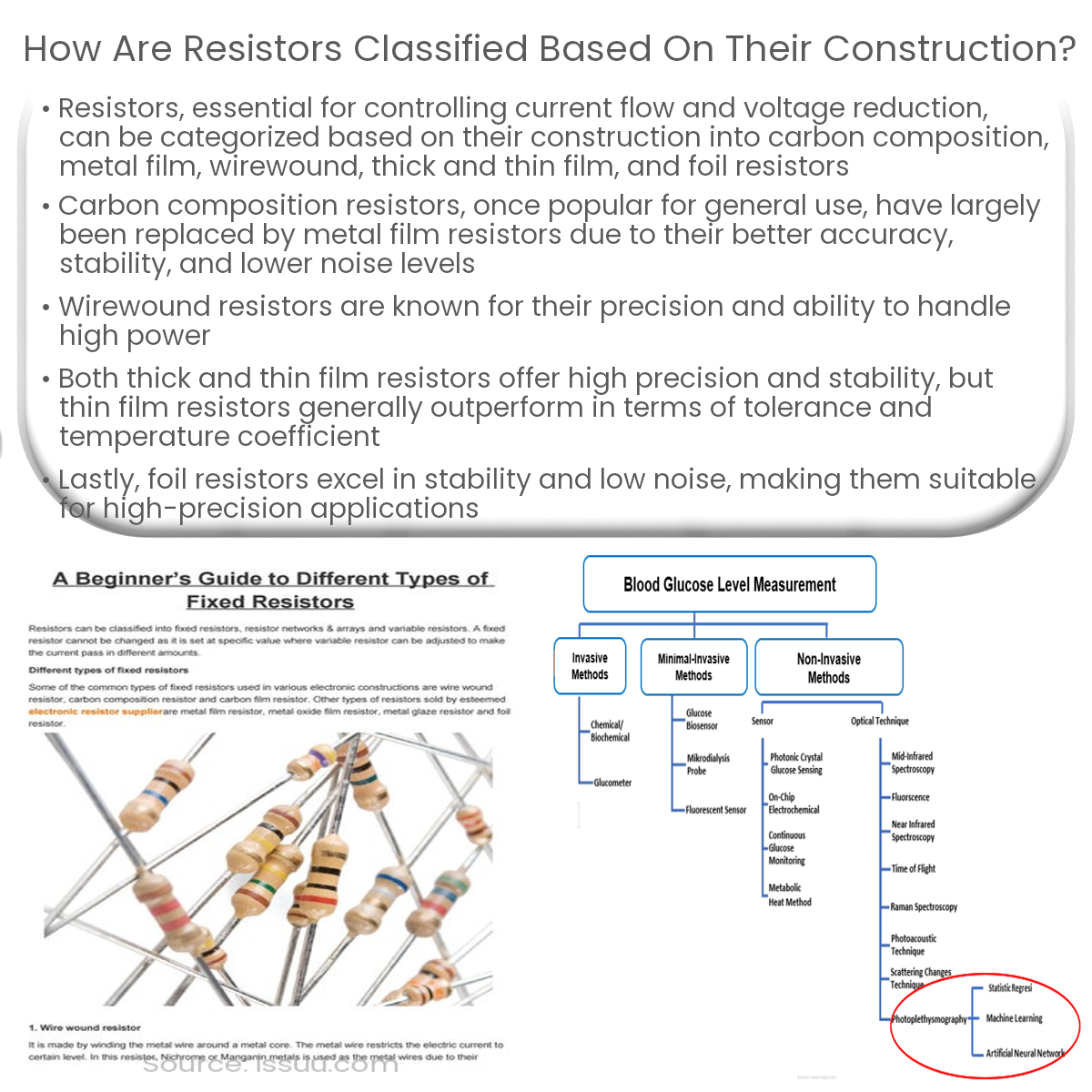
Resistors are classified based on construction as carbon composition, metal film, wirewound, thick and thin film, and foil resistors, each with unique properties.
Resistor Classification Based on Construction
Resistors are passive electronic components that play a crucial role in controlling current flow, voltage reduction, and protecting sensitive elements in a circuit. They can be classified based on their construction, with each type having specific properties and applications. This article discusses the major classifications of resistors based on their construction.
Carbon Composition Resistors
Carbon composition resistors consist of a mixture of carbon particles and an insulating binder, usually made of ceramic. This mixture is molded into a cylindrical shape and coated with a protective layer. The resistor’s value is determined by the proportion of carbon to the insulating material. Carbon composition resistors are inexpensive and have been widely used in general-purpose applications. However, they have been largely replaced by metal film resistors due to their relatively high temperature coefficient and noise levels.
Metal Film Resistors
Metal film resistors are manufactured by depositing a thin layer of metal, such as nickel-chromium or tantalum nitride, onto an insulating substrate. The resistive element is then etched or trimmed to achieve the desired resistance value. Metal film resistors offer better accuracy, stability, and lower noise levels compared to carbon composition resistors, making them suitable for precision applications.
Wirewound Resistors
Wirewound resistors are constructed by winding a metal wire, usually nichrome or tungsten, around an insulating core, such as ceramic or fiberglass. The resistance value depends on the wire’s length, diameter, and resistivity. Wirewound resistors can handle high power and are known for their precision and stability, making them ideal for applications requiring accurate and stable resistance values.
Thick and Thin Film Resistors
Thick and thin film resistors are made by depositing a resistive film on a ceramic substrate. Thick film resistors are created by screen printing the resistive material onto the substrate, while thin film resistors are produced by vapor deposition. Both types offer high precision and stability, with thin film resistors generally providing better performance in terms of tolerance and temperature coefficient.
Foil Resistors
Foil resistors are similar to metal film resistors, but instead of depositing a thin layer of metal, a metal foil is bonded to an insulating substrate. The foil is then etched into a precise pattern to achieve the desired resistance value. Foil resistors are known for their excellent stability, low temperature coefficient, and low noise, making them suitable for high-precision applications.
Conclusion
Resistors are classified based on their construction, with each type having its specific properties and applications. Carbon composition, metal film, wirewound, thick and thin film, and foil resistors are the primary types of resistors used in electronic circuits. Understanding the different classifications and their characteristics is essential for engineers and designers working with electronic devices and circuits.