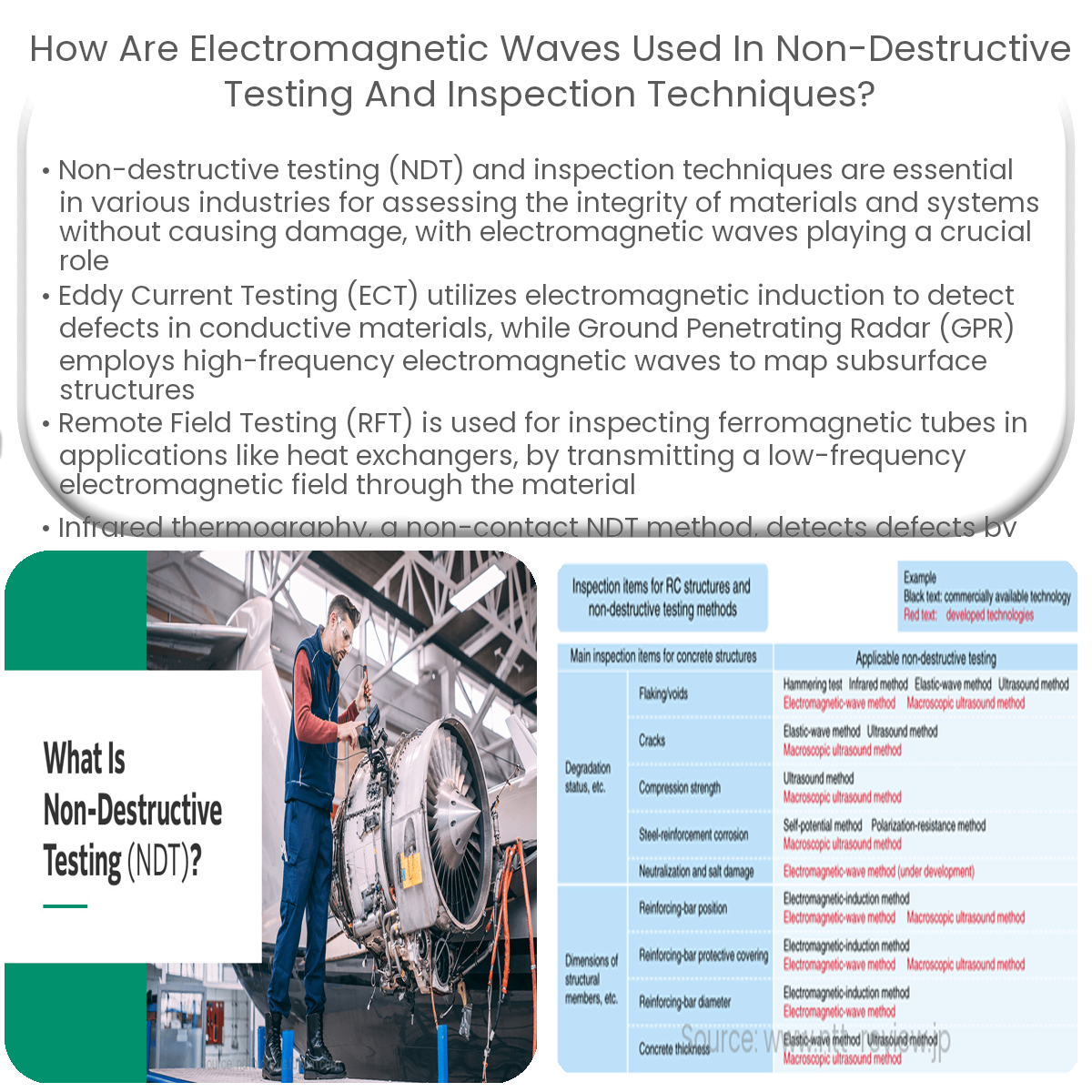
Electromagnetic waves are used in non-destructive testing techniques like Eddy Current Testing, Ground Penetrating Radar, Remote Field Testing, and Thermography to detect defects.
Electromagnetic Waves in Non-Destructive Testing and Inspection Techniques
Non-destructive testing (NDT) and inspection techniques are essential tools in various industries for the evaluation and maintenance of materials, components, and systems without causing any damage. Electromagnetic waves play a crucial role in many of these techniques, offering accurate and efficient means of assessing the integrity of various structures. In this article, we will discuss some common applications of electromagnetic waves in NDT and inspection methods.
Eddy Current Testing (ECT)
Eddy current testing (ECT) is a widely-used NDT method that utilizes electromagnetic induction to detect defects in conductive materials. By applying an alternating current to a coil, a magnetic field is generated, which in turn induces eddy currents in the material being tested. Variations in the flow of these currents can be measured and analyzed to identify cracks, corrosion, or changes in the material’s properties.
Ground Penetrating Radar (GPR)
Ground Penetrating Radar (GPR) is an NDT technique that uses high-frequency electromagnetic waves to detect and map subsurface structures, such as pipes, cables, and voids in concrete. The radar emits electromagnetic pulses, which penetrate the ground and reflect off buried objects, providing valuable information on the location, depth, and size of these structures.
Remote Field Testing (RFT)
Remote field testing (RFT) is an NDT method particularly useful for inspecting ferromagnetic tubes in heat exchangers, boilers, and other applications. RFT involves transmitting a low-frequency electromagnetic field through the material and measuring the response of the magnetic field at a receiver coil. The presence of defects or material variations can be detected by analyzing changes in the amplitude and phase of the received signal.
Thermography
Infrared thermography is a non-contact NDT technique that uses infrared cameras to measure the surface temperature of an object. When an object is subjected to an external energy source, such as heat or ultrasound, the temperature distribution on its surface changes. By analyzing these temperature variations, defects, such as delamination, inclusions, or voids, can be detected.
Conclusion
Electromagnetic waves have proven to be an invaluable tool in non-destructive testing and inspection techniques. The versatility of these methods enables the detection and analysis of defects and structural changes in a wide range of materials and applications, ensuring the integrity and reliability of critical systems across various industries.