
Explore high voltage probes, their types, applications, and safety measures, to better understand their crucial role in various industries.
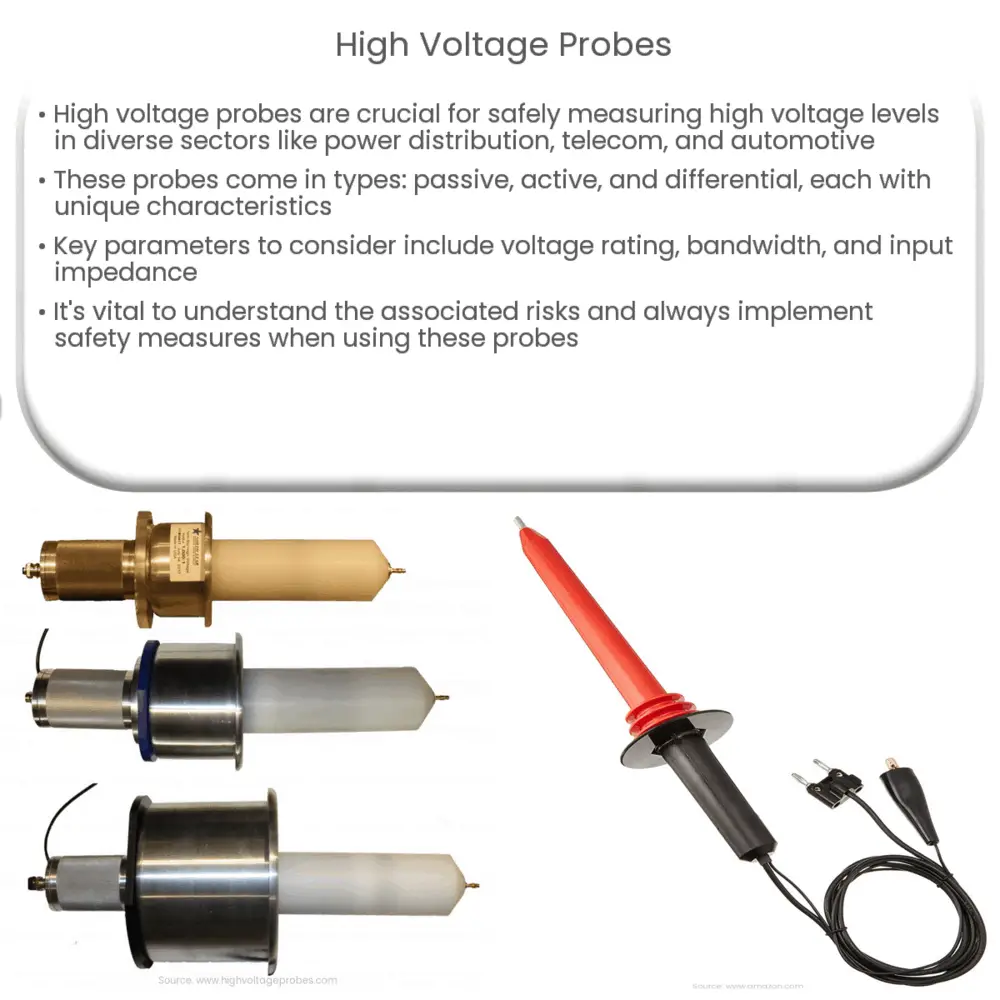
Understanding High Voltage Probes
High voltage probes are specialized instruments designed to safely measure high voltage levels. They are an integral part of any electrical engineer’s toolkit, often used in various applications ranging from power distribution to telecommunications and automotive industries.
The Fundamental Design
A high voltage probe typically consists of a high resistance voltage divider network that scales down the input voltage to a safe, measurable level. This scaled-down voltage can then be read by an oscilloscope or any other voltage measurement device. The key here is to ensure accuracy, safety, and consistency in measurements.
Types of High Voltage Probes
- Passive Probes: These are the most common type of oscilloscope probes. They are simple, reliable, and require no external power source. Their main component is a resistive voltage divider that reduces the amplitude of the signals they measure.
- Active Probes: These probes require a power supply for their operation. They use electronic components to buffer the signal, providing higher bandwidth and impedance, and lesser loading effects compared to passive probes.
- Differential Probes: These probes can measure the voltage difference between two points, which are not grounded, by providing isolation between the probe and oscilloscope.
Key Parameters to Consider
When choosing a high voltage probe, it’s crucial to understand certain parameters that determine their effectiveness:
- Voltage Rating: The maximum input voltage that the probe can safely handle. It is imperative to select a probe that can withstand the voltage levels in your application.
- Bandwidth: The range of frequencies the probe can accurately measure. A higher bandwidth allows for accurate measurement of faster-changing signals.
- Input Impedance: This parameter impacts the loading effect of the probe on the circuit under test. Higher impedance results in lower loading effect and more accurate measurements.
High voltage probes play a critical role in safely and accurately measuring high voltage signals. In the next section, we’ll delve deeper into their applications and safety measures to be taken while using these devices.
Applications of High Voltage Probes
High voltage probes have wide-ranging applications across various industries:
- Power Systems: In the power distribution and transmission sector, these probes are used to monitor and measure the performance of high voltage components and systems.
- Electronics and Telecommunication: Probes help in troubleshooting, verifying signal integrity, and characterizing the performance of digital circuits.
- Automotive: As electric vehicles become more common, high voltage probes are increasingly used to measure and test the high voltage systems within these vehicles.
Safety Measures with High Voltage Probes
Handling high voltages always presents a risk, and therefore appropriate safety measures should be in place:
- Proper Training: It’s important for the user to understand the operation and safety precautions associated with high voltage probes.
- Regular Inspection: Probes should be regularly inspected for damage or wear that could expose the user to high voltage.
- Right Equipment: Always use the right probe for the right application. Never exceed the voltage rating of the probe.
Conclusion
In summary, high voltage probes are essential tools for accurately measuring high voltage signals in various applications. Their design and type play a critical role in determining their functionality and suitability to a specific application. As important as their utilization, is the understanding of the inherent risks associated with high voltages, and the necessity for safety measures when using these probes. They enable engineers to navigate complex electrical systems with safety and precision, making them indispensable in the technological world.