
High-resistance ohmmeters accurately measure high resistance values in insulation, high-voltage equipment, and ESD protection circuits, providing reliable results in various industries.
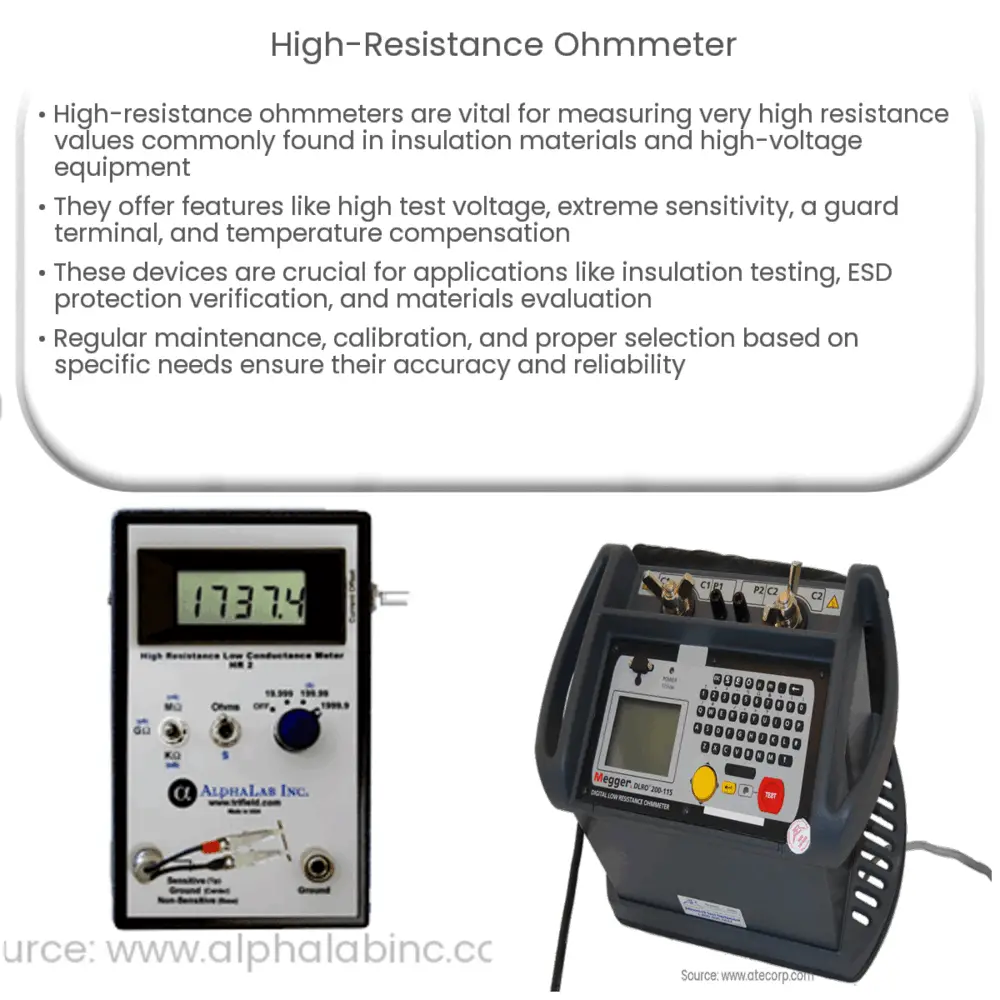
High-Resistance Ohmmeter: An Essential Tool for Electrical Measurements
High-resistance ohmmeters are indispensable tools in the field of electrical testing and measurements. These specialized devices are designed to accurately measure very high resistance values, which are often encountered in insulation materials, high-voltage equipment, and electrostatic discharge (ESD) protection circuits. In this article, we will explore the fundamental principles of high-resistance ohmmeters, their key features, and the various applications in which they prove invaluable.
Understanding Resistance and Ohmmeter Basics
Resistance, denoted by the symbol ‘R’ and measured in ohms (Ω), is a fundamental electrical property that describes the opposition a material presents to the flow of electric current. Ohmmeters are electronic instruments that measure resistance by applying a known voltage across a device under test (DUT) and measuring the resulting current. The resistance value can then be calculated using Ohm’s Law (R = V/I).
High-Resistance Ohmmeters: Key Features and Advantages
Traditional ohmmeters are generally limited in their ability to measure high resistance values, as the current generated by the applied voltage can be too small to accurately detect. High-resistance ohmmeters, on the other hand, are specifically designed to overcome this limitation by employing several key features:
- High Test Voltage: These devices generate a high test voltage, typically in the range of hundreds or thousands of volts, to produce a more easily detectable current even for very high resistance values.
- High Sensitivity: High-resistance ohmmeters are equipped with sensitive current measuring circuits that can detect and measure extremely small currents, often in the range of picoamperes (10-12 A) to nanoamperes (10-9 A).
- Guard Terminal: A guard terminal is provided to minimize the effects of leakage currents and stray capacitance, which can significantly impact the accuracy of high resistance measurements.
- Temperature Compensation: As the resistance of materials can be influenced by temperature, these devices often incorporate temperature compensation to correct for any temperature-induced variations in resistance.
These features enable high-resistance ohmmeters to measure resistance values in the range of megaohms (106 Ω) to teraohms (1012 Ω), far beyond the capabilities of standard ohmmeters.
Applications of High-Resistance Ohmmeters
High-resistance ohmmeters find numerous applications in industries where accurate and reliable high resistance measurements are crucial. Some of these applications include:
- Insulation Testing: Assessing the quality and integrity of insulation materials in electrical equipment, such as transformers, cables, and switchgear, requires high-resistance ohmmeters to accurately measure the insulation resistance.
- ESD Protection Testing: Verifying the performance of electrostatic discharge protection circuits in electronic devices necessitates the measurement of high resistance values, which can be achieved using a high-resistance ohmmeter.
- Materials Testing: High-resistance ohmmeters can be employed to evaluate the resistive properties of various materials, such as ceramics, plastics, and coatings, for applications in the aerospace, automotive, and electronics industries.
- Resistance Range: Ensure that the device can measure the specific resistance values required for your application, whether it is in the megaohm or teraohm range.
- Test Voltage: Consider the test voltage capabilities of the ohmmeter, as higher test voltages may be necessary for accurate measurements of very high resistance values or for specific applications, such as insulation testing.
- Accuracy and Resolution: Look for devices with high accuracy and resolution to ensure that the measured values are reliable and precise.
- Additional Features: Examine any additional features, such as temperature compensation, data logging, and connectivity options, which may be beneficial for your specific application.
- Budget: Lastly, consider your budget and select a device that offers the best balance of features and performance within your price range.
- Proper Storage: Store the device in a clean, dry, and temperature-controlled environment to protect it from dust, moisture, and temperature fluctuations that may affect its performance.
- Clean Contacts: Regularly clean the test leads and device terminals to minimize contact resistance and maintain accurate measurements.
- Battery Care: Replace or recharge batteries as needed and remove them from the device when not in use for extended periods to prevent battery leakage and corrosion.
Choosing the Right High-Resistance Ohmmeter
Selecting the appropriate high-resistance ohmmeter depends on several factors, such as the required resistance range, test voltage, accuracy, and budget constraints. Here are some key considerations when choosing a high-resistance ohmmeter:
Maintenance and Calibration of High-Resistance Ohmmeters
To ensure the continued accuracy and reliability of a high-resistance ohmmeter, regular maintenance and calibration are essential. Some maintenance tips include:
Periodic calibration of the high-resistance ohmmeter is also crucial for maintaining its accuracy. Calibration involves comparing the device’s readings with a known reference standard and adjusting it as necessary to ensure that it conforms to the specified tolerances. It is recommended to calibrate the device at least once a year or as specified by the manufacturer.
Conclusion
High-resistance ohmmeters are invaluable tools in various industries where accurate and reliable high resistance measurements are essential. Understanding the key features, applications, and considerations when selecting and maintaining a high-resistance ohmmeter will help you make informed decisions and ensure the continued accuracy and performance of your device.



