
The high-precision ohmmeter offers exceptional accuracy in resistance measurement, serving diverse industries and applications with advanced features.
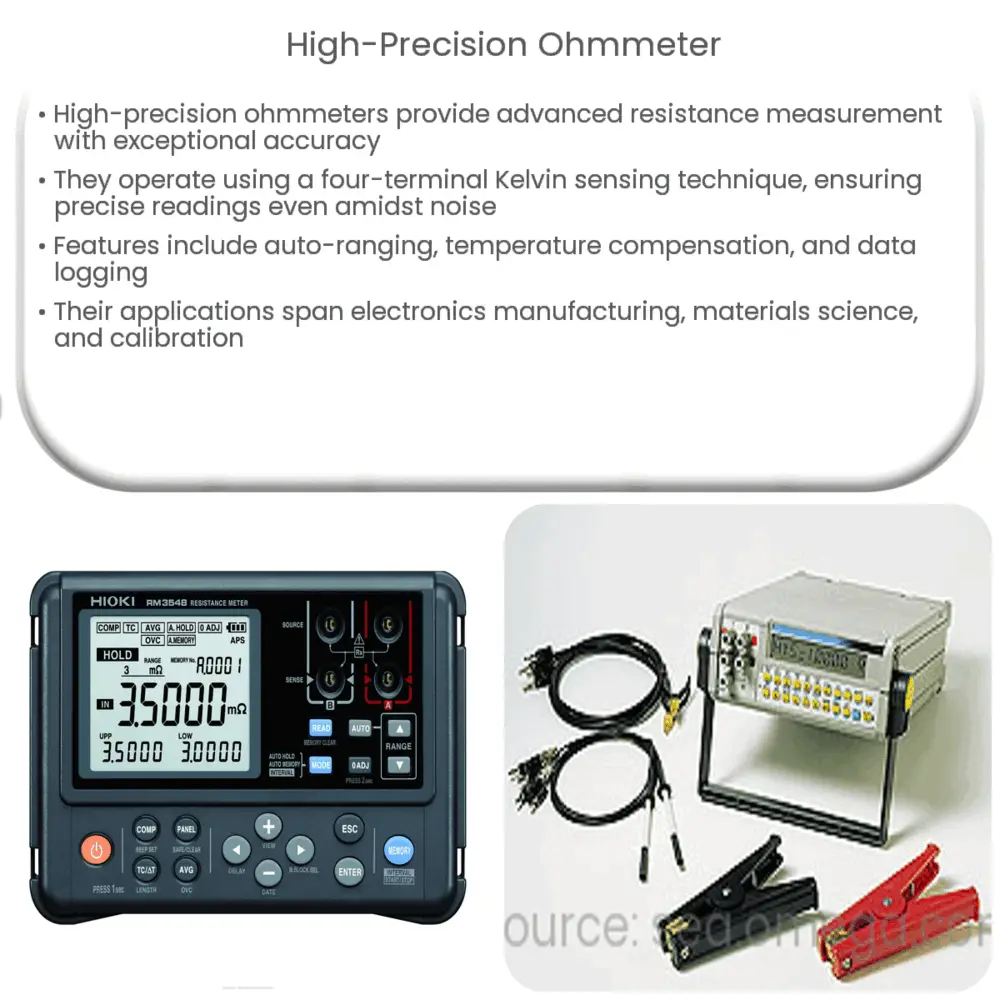
High-Precision Ohmmeter: Revolutionizing Resistance Measurement
Introduction
Accurate measurement of electrical resistance is an essential aspect of electrical and electronic engineering. Resistance is a fundamental property that determines the flow of current in a circuit. As technology advances, the demand for high-precision measurements of resistance has grown. The high-precision ohmmeter has emerged as a reliable and advanced tool for measuring resistance with exceptional accuracy, catering to the needs of various industries and applications.
What is a High-Precision Ohmmeter?
A high-precision ohmmeter is a specialized device that measures electrical resistance with outstanding accuracy and resolution. It is designed to provide precise and stable readings, even in the presence of noise and other factors that may affect measurements. These devices are particularly useful for applications that require high-resolution and accuracy, such as testing sensitive electronic components, evaluating material properties, and assessing the quality of electrical connections.
How Does a High-Precision Ohmmeter Work?
High-precision ohmmeters operate on the principle of the four-terminal, or four-wire, Kelvin sensing technique. This method eliminates the effects of lead resistance, ensuring that the measurement is solely of the resistance of the test sample. The instrument applies a constant current to the sample using a pair of terminals, while the voltage drop across the sample is measured using a separate pair of terminals. The resistance value is then calculated by dividing the measured voltage by the applied current.
High-precision ohmmeters employ sophisticated circuitry and algorithms to minimize errors and improve measurement accuracy. Some of the key features of these devices include:
- Auto-ranging: The instrument automatically selects the appropriate measurement range based on the magnitude of the resistance being measured. This ensures optimal accuracy and resolution for each measurement.
- Low-noise design: High-precision ohmmeters are designed to reduce the effects of noise and interference, enabling accurate measurements even in electrically noisy environments.
- Temperature compensation: The device accounts for temperature variations that can affect resistance measurements, ensuring consistent and accurate results across a wide range of operating conditions.
- Data logging and analysis: Advanced models often include built-in data storage and analysis capabilities, allowing users to capture and analyze measurements over time.
Applications of High-Precision Ohmmeters
High-precision ohmmeters find applications across a diverse range of industries and fields, including:
- Electronics manufacturing: In the production of electronic devices, accurate resistance measurements are crucial for ensuring the performance and reliability of components and circuits. High-precision ohmmeters are used for quality control and testing purposes.
- Materials science: These instruments play a vital role in evaluating the resistive properties of materials, such as the resistivity of semiconductors or the surface resistance of conductive coatings.
- Calibration and metrology: High-precision ohmmeters are used in calibration laboratories and research institutions to establish reference standards and traceable measurements for resistance.
Advantages of High-Precision Ohmmeters
High-precision ohmmeters offer several benefits over traditional multimeters and lower-precision instruments. Some of the key advantages include:
- Improved accuracy and resolution: With their advanced circuitry and calibration, high-precision ohmmeters provide measurement results with greater accuracy and resolution than conventional instruments, ensuring reliable and dependable data.
- Enhanced repeatability: These devices are designed to deliver consistent measurements, even under varying conditions or across multiple test cycles, improving repeatability and reducing the need for repeated tests.
- Reduced measurement errors: High-precision ohmmeters are engineered to minimize the effects of noise, temperature variations, and other factors that can lead to measurement errors, providing more accurate and reliable results.
- Increased productivity: With their advanced features and automation capabilities, high-precision ohmmeters can streamline the testing process, saving time and increasing overall productivity.
Selecting a High-Precision Ohmmeter
When choosing a high-precision ohmmeter, it is essential to consider the specific requirements and constraints of the intended application. Some factors to keep in mind include:
- Accuracy and resolution: Determine the level of accuracy and resolution necessary for the measurements being performed. Higher precision may be required for certain applications, such as calibration or materials research.
- Measurement range: Ensure that the ohmmeter can measure the full range of resistance values required for the application, from low milliohm values to high megaohm or gigaohm values.
- Connectivity and data management: Consider the need for data logging, analysis, and transfer capabilities. Some high-precision ohmmeters feature built-in memory and connectivity options, such as USB or Ethernet, for seamless data management and integration with other systems.
- Portability and durability: For field applications, select an ohmmeter with a rugged design and battery operation to ensure reliable performance under challenging conditions.
- Budget: High-precision ohmmeters are available at various price points, so consider your budget while weighing the features and performance required for your application.
Conclusion
High-precision ohmmeters have revolutionized the field of resistance measurement by offering unparalleled accuracy, resolution, and repeatability. These advanced instruments cater to a wide range of industries and applications, from electronics manufacturing and materials science to calibration and metrology. By carefully considering the specific requirements of their applications, users can select the most suitable high-precision ohmmeter to meet their needs and enhance their testing processes.



