
Explore the High Electron Mobility Transistor (HEMT): its components, working principle, applications, advantages, and drawbacks.
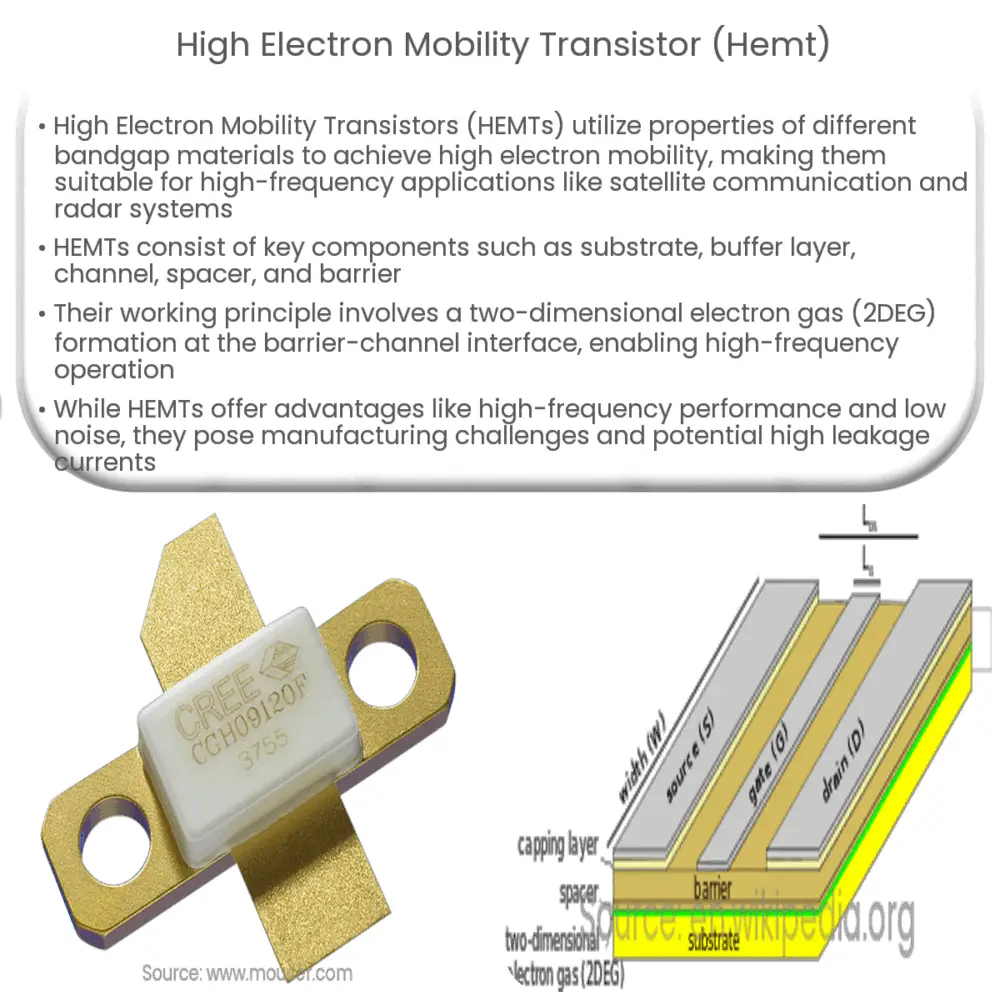
Understanding High Electron Mobility Transistor (HEMT)
A High Electron Mobility Transistor (HEMT) is a unique type of field-effect transistor that leverages the properties of two materials with different bandgaps to attain high electron mobility. Because of this, HEMTs have high frequency and power performance, making them a popular choice in various high-frequency applications such as satellite and terrestrial communication systems, radar systems, and in high-speed computers.
Key Components of a HEMT
- Substrate: This is the base or foundation on which the transistor is built. In a HEMT, the substrate is generally made of a semi-insulating material like gallium arsenide (GaAs) or silicon.
- Buffer Layer: This is an additional layer of the same material as the substrate that is placed on top of the substrate to improve the quality of the subsequent layers.
- Channel: This is the semiconductor layer that allows the movement of charge carriers. In a HEMT, the channel is typically made of a high-mobility semiconductor like indium gallium arsenide (InGaAs).
- Spacer: This is a thin layer placed between the channel and the barrier to reduce scattering and enhance electron mobility.
- Barrier: This is a layer of a wide-bandgap semiconductor such as aluminium gallium arsenide (AlGaAs) that restricts the movement of charge carriers.
Working Principle of HEMTs
The operational mechanism of a HEMT is rooted in the bandgap engineering of the semiconductor materials. When the barrier and channel materials come into contact, a phenomenon known as ‘band bending’ occurs, leading to the formation of a two-dimensional electron gas (2DEG) at the interface. This 2DEG is the main current-carrying channel in the transistor. The conductivity of the channel can be controlled by a voltage applied to a metal gate electrode, which allows modulation of the 2DEG density, effectively turning the transistor ‘on’ or ‘off’.
The fundamental principle behind HEMT’s superior performance is the high mobility of the 2DEG. As the 2DEG is separated from the impurities and defects by the spacer and the barrier, it has significantly fewer scattering interactions, which in turn results in higher mobility and, consequently, high-frequency operation capability.
Applications of HEMTs
Because of their unique properties and superior performance at high frequencies, HEMTs have found their place in numerous applications. Some of these are:
- Communication Systems: HEMTs are commonly used in satellite communication systems for their ability to operate at very high frequencies. They are also used in mobile phone base stations and other terrestrial communication systems.
- Radar Systems: The high-power, high-frequency characteristics of HEMTs make them an excellent choice for radar systems, including weather and air traffic control radars.
- Scientific Instruments: HEMTs are used in radio telescopes and other scientific instruments for their low-noise properties at cryogenic temperatures.
Advantages and Disadvantages of HEMTs
HEMTs offer several advantages, including high electron mobility, high-frequency operation, and low noise, making them ideal for numerous applications. However, like all technologies, they have their limitations. HEMTs are more complicated to manufacture than other types of transistors due to the precise layering of different materials required. They can also suffer from high leakage currents, especially at higher temperatures, which can affect their performance.
Conclusion
In conclusion, High Electron Mobility Transistors (HEMTs) are a revolutionary technology that has reshaped the field of electronics. Their unique operational mechanism enables them to deliver high performance at high frequencies, making them a critical component in various applications ranging from communication systems to radar systems and scientific instruments. However, despite their advantages, HEMTs also have their challenges, including complex manufacturing processes and potential for high leakage currents. Nonetheless, the continued development and refinement of HEMT technology promise to further expand their potential and applicability in the future, paving the way for faster, more efficient electronic systems.



