
Explore the principles, types, applications, benefits, and limitations of heat pipes, an efficient tool for thermal management.
Introduction to Heat Pipes
Heat pipes are highly efficient conduits which have extensive uses in both space and terrestrial applications. Their fundamental operation principle lies in the heat transfer phenomena, providing an incredibly high thermal conductivity, superior to any known metal.
What are Heat Pipes?
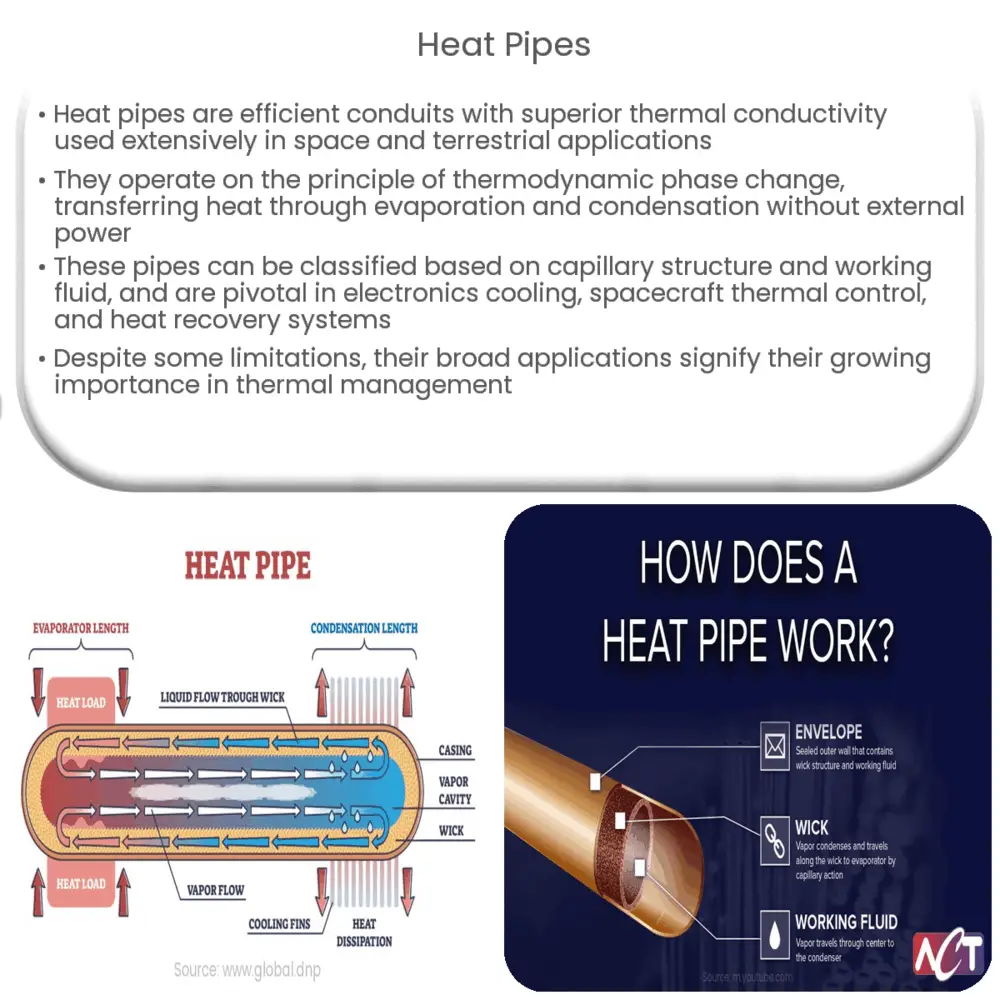
A heat pipe is essentially a device with a sealed hollow tube that is lined with a capillary structure or wick. This tube is then filled with a working fluid, like water or acetone, under its own vapor pressure. The basic components of a heat pipe include a shell, wick structure, and working fluid.
Operating Principle of Heat Pipes
The operation of heat pipes involves the Thermodynamic Phase Change of the working fluid. It is based on the concept of evaporation and condensation. Here’s how it works:
- The heat source heats up one end of the pipe, termed as the evaporator section. The working fluid in this section absorbs the heat and turns into a vapor.
- The vapor then travels to the other end of the pipe (the condenser section), carrying the heat along with it. Here, it loses heat and condenses back into a liquid form.
- The capillary action in the wick then returns the liquid to the evaporator section, and the cycle repeats.
This process facilitates the rapid transfer of heat from the source to the sink without any external power sources.
Types of Heat Pipes
Heat pipes can be classified into various types based on the capillary structure, orientation, and working fluid used. Let’s briefly explore some of the common types:
- Diode Heat Pipes: These are designed to transfer heat in one direction only, preventing backflow of heat.
- Variable Conductance Heat Pipes (VCHP): These have a non-condensable gas to control the effective thermal conductivity, allowing for a varying rate of heat transfer.
- Thermosyphon: This type relies on gravity rather than capillary action to return the liquid to the evaporator.
Applications of Heat Pipes
Heat pipes are employed in a wide range of applications due to their remarkable heat transfer efficiency:
- Electronics Cooling: Miniaturized heat pipes are used in laptops and desktop computers to prevent overheating of the CPU and other high power-dissipating components.
- Spacecraft Thermal Control: In the space industry, heat pipes are used for temperature control in satellites and spacecraft. They facilitate passive thermal control by spreading and radiating heat into space.
- Heat Recovery Systems: Heat pipes are employed in heat recovery ventilation systems to recover waste heat and increase the overall efficiency of the system.
Advantages and Limitations
Heat pipes offer a number of advantages:
- They have extremely high thermal conductivity, leading to efficient heat transfer.
- They operate passively, i.e., they don’t require any external power source.
- Their isothermal nature makes them useful for precision temperature control.
However, they also have a few limitations:
- Their performance is highly dependent on the gravity vector, particularly in the case of thermosyphons.
- Heat pipes have specific temperature ranges based on the working fluid used, which limits their application.
- Manufacturing challenges and costs associated with the wick structure can be significant.
Conclusion
In conclusion, heat pipes are a critical component in various fields due to their high heat transfer efficiency. Despite their limitations, their wide range of applications in industries such as electronics, space, and heat recovery systems underlines their importance. As thermal management continues to be a major concern, especially with the ongoing miniaturization of electronic components, the relevance and demand for heat pipes are likely to increase.



