
Gas chromatography sensors enable precise detection & analysis of volatile compounds in mixtures, used in various industries like environment, pharma & forensics.
Gas Chromatography Sensors: An Introduction
Gas chromatography (GC) is a powerful analytical technique used to separate and analyze volatile compounds present in complex mixtures. The technique has found wide application in various fields, including environmental monitoring, pharmaceuticals, petrochemicals, food and beverages, and forensics. This article will provide an introduction to gas chromatography sensors, which are a critical component of GC systems.
Basics of Gas Chromatography
Gas chromatography works by injecting a sample into a heated inlet, where it vaporizes and is carried by an inert gas (usually helium or hydrogen) through a column packed with a stationary phase. The stationary phase can be either a solid or a liquid, and it selectively interacts with the different components of the sample mixture. As a result, the components of the mixture travel at different rates through the column and eventually elute separately. The time it takes for a compound to elute is known as its retention time.
Types of Detectors in Gas Chromatography
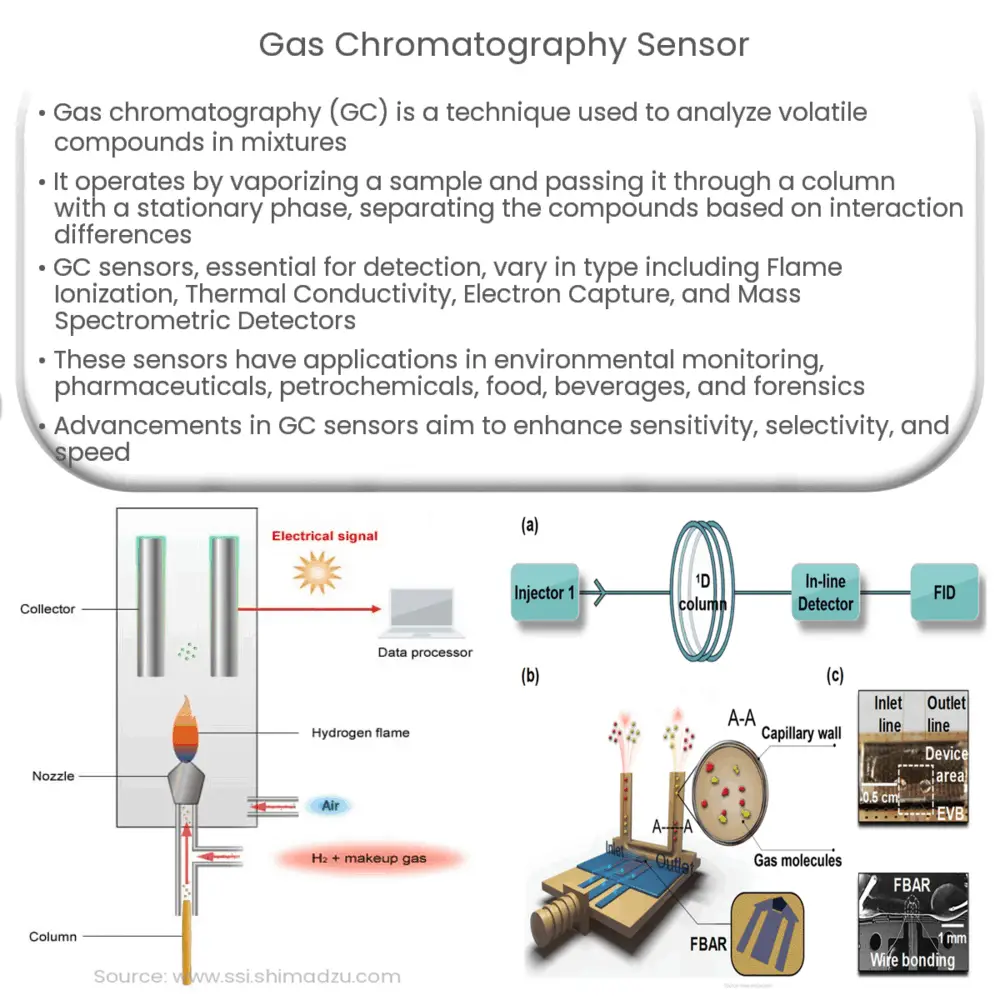
The role of the detector in a GC system is to sense the presence of analytes as they elute from the column and generate a signal proportional to their concentration. There are several types of detectors used in gas chromatography, including:
- Flame Ionization Detector (FID): The FID is a universal detector that is sensitive to most organic compounds. It works by burning the analytes in a hydrogen-air flame, producing ions and electrons that are collected on an electrode to generate a current proportional to the concentration of the analyte.
- Thermal Conductivity Detector (TCD): The TCD measures the change in thermal conductivity of the carrier gas as analytes elute from the column. It is a non-destructive detector and is suitable for analyzing permanent gases and small organic molecules.
- Electron Capture Detector (ECD): The ECD is highly sensitive to compounds containing electronegative elements such as halogens, nitro groups, and carbonyl groups. It operates by measuring the reduction in electron capture resulting from the presence of analytes.
- Mass Spectrometric Detector (MSD): The MSD is a highly sensitive and selective detector that identifies analytes based on their mass-to-charge ratio. It can provide both qualitative and quantitative information about the sample.
Choosing the appropriate detector for a specific application depends on the nature of the analytes, their concentration levels, and the desired sensitivity and selectivity of the analysis.
Applications of Gas Chromatography Sensors
Gas chromatography sensors are employed in a wide range of applications, including:
- Environmental Monitoring: GC sensors are used to detect and quantify pollutants in air, water, and soil samples, ensuring compliance with environmental regulations and assessing the effectiveness of pollution control measures.
- Pharmaceutical Analysis: In the pharmaceutical industry, GC sensors are utilized for quality control, impurity profiling, and stability testing of drugs and drug products.
- Petrochemical Industry: GC sensors play a vital role in the petrochemical industry for the analysis of hydrocarbons, determination of impurities, and process monitoring to ensure optimal performance and product quality.
- Food and Beverage Analysis: In the food and beverage industry, GC sensors are used to detect and quantify contaminants, such as pesticides and additives, as well as to analyze flavor compounds, nutritional components, and trace elements.
- Forensic Science: Gas chromatography is a crucial tool in forensic science for the analysis of drugs, explosives, and other substances in criminal investigations.
Recent Advances in Gas Chromatography Sensors
Technological advancements in the field of gas chromatography have led to the development of new and improved sensors, offering enhanced sensitivity, selectivity, and faster analysis times. Some recent developments include:
- Microfabricated Detectors: Miniaturized detectors based on microfabrication techniques have been developed, offering lower power consumption, reduced size, and faster response times. These detectors are particularly useful in portable and field-deployable GC systems.
- Ion Mobility Spectrometry (IMS): Combining GC with IMS has emerged as a powerful tool for the analysis of complex mixtures. The technique offers improved separation of isomeric and isobaric compounds, as well as enhanced sensitivity and selectivity.
- Chemiluminescence and Fluorescence Detectors: The use of chemiluminescence and fluorescence-based detectors in GC systems allows for highly sensitive and selective detection of specific classes of compounds, such as nitrogen-containing and sulfur-containing molecules.
Challenges and Future Directions
Despite the numerous advancements in gas chromatography sensors, there are still challenges to overcome, such as improving the limit of detection for trace-level analyses, enhancing the separation capabilities of GC columns, and developing robust and reliable sensors for field applications. Future research efforts will likely focus on:
- Integration of Artificial Intelligence (AI): The use of AI and machine learning algorithms can help improve data processing, identification, and quantification of analytes, as well as enable predictive maintenance of GC systems.
- Development of Green and Sustainable GC Techniques: Efforts to reduce the environmental impact of GC analysis include the development of more sustainable stationary phases, the use of eco-friendly solvents, and the minimization of waste generation.
- Advancements in Multidimensional GC: Multidimensional GC techniques, which involve the coupling of two or more columns with different stationary phases, can provide enhanced separation and characterization of complex mixtures, opening up new possibilities for research and practical applications.
In conclusion, gas chromatography sensors are indispensable tools in a wide range of applications and industries. Continuous advancements in sensor technology, combined with innovative approaches in data analysis and system design, will ensure that GC remains a powerful and versatile analytical technique for years to come.