
Explore the world of frequency counters – their types, operation, components, and uses in fields like electronics and telecommunications.
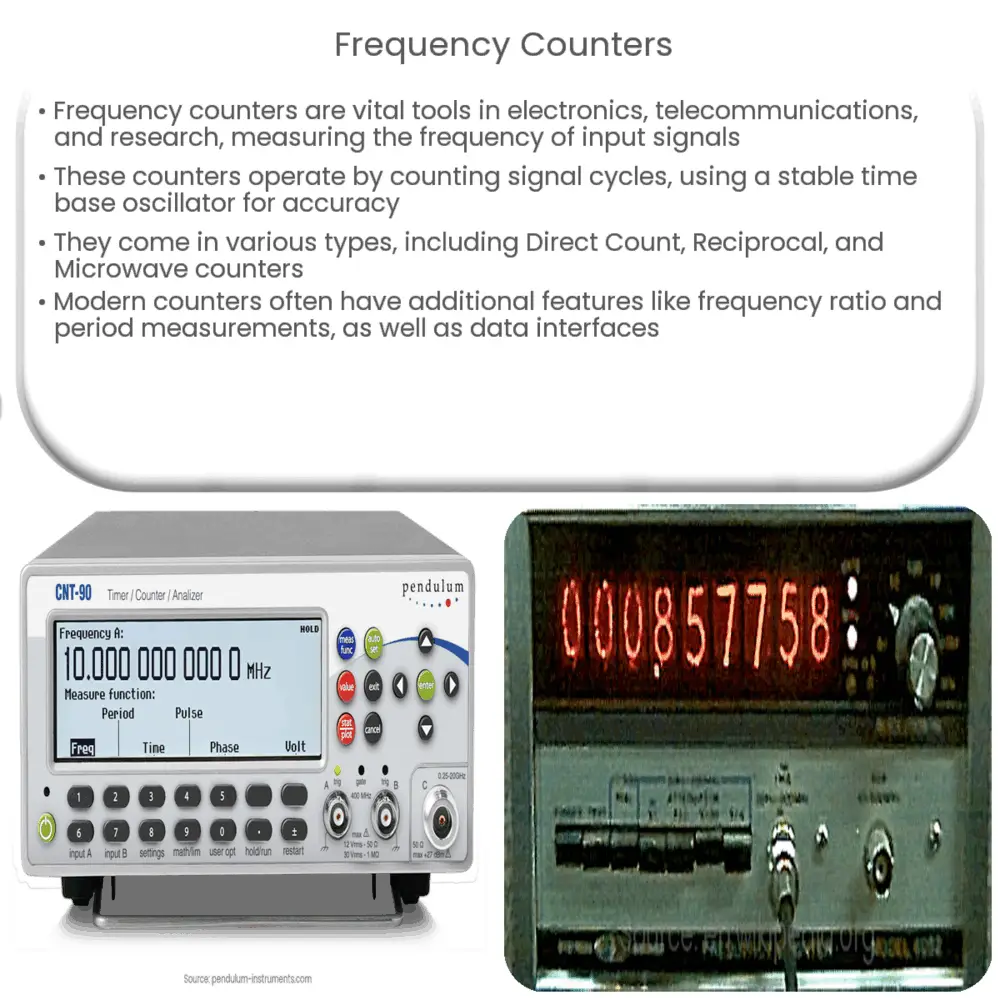
Introduction to Frequency Counters
Frequency counters are essential instruments used in many fields, including electronics, telecommunications, and scientific research. They measure the frequency of an input signal, which is the number of occurrences of a repeating event per unit of time.
The importance of frequency counters is underscored by their wide range of applications. In telecommunications, for instance, they are used for tuning and testing equipment to ensure that signals are transmitted and received at the correct frequency. In electronics manufacturing, they are employed in quality assurance procedures, to verify that components are operating at their designated frequencies.
Operating Principles of Frequency Counters
A frequency counter works by counting the number of cycles of an input signal within a specific time period. It uses a time base oscillator, which provides a stable ‘clock’ signal, and a counter that accumulates the number of input cycles. The time base’s accuracy determines the accuracy of the frequency measurement.
Types of Frequency Counters
Frequency counters can be divided into three main types:
Key Components of Frequency Counters
Frequency counters typically comprise several key components:
- Input Attenuator: This reduces the amplitude of the input signal without distorting its waveform, protecting the counter’s internal circuits from potential damage.
- Amplifier and Schmitt Trigger: The amplifier increases the amplitude of the input signal, and the Schmitt trigger converts it into a square wave with fast, defined transitions, making it suitable for digital counting.
- Prescaler: For high-frequency signals, a prescaler reduces the frequency to a level that can be measured by the counter.
The performance and accuracy of a frequency counter are largely determined by the quality of these components and the time base oscillator.
Understanding the Time Base Oscillator
The time base oscillator is a crucial part of a frequency counter. It is responsible for providing the ‘clock’ signal used as the reference for counting the input signal’s cycles. The accuracy and stability of this time base significantly affect the counter’s performance.
Most frequency counters use quartz crystal oscillators as their time base, thanks to their excellent frequency stability and low cost. For applications requiring extremely high accuracy, other types of oscillators like rubidium or cesium atomic clocks may be used. These atomic clocks provide extreme accuracy but are more expensive and larger in size than their quartz counterparts.
Additional Features of Frequency Counters
Modern frequency counters often incorporate additional features to enhance their functionality and ease of use:
- Frequency Ratio Measurement: Some counters can measure the ratio of two frequencies. This is useful when comparing the frequencies of two signals or calibrating other frequency-generating devices.
- Period Measurement: Besides frequency, some counters can measure the period of the signal, which is the time it takes for one cycle to complete.
- Data Interfaces: Many counters offer USB, Ethernet, or other data interfaces for connecting to a computer. This allows for remote operation, data logging, and integration into automated test systems.
Conclusion
In conclusion, frequency counters are indispensable tools in electronics, telecommunications, and many other fields. They operate by counting the cycles of an input signal and use a time base oscillator as the reference for counting. The accuracy and range of these instruments depend on their design and the quality of their components, particularly the time base oscillator.
The diversity of frequency counters, from simple direct count types to more advanced reciprocal and microwave counters, caters to a broad spectrum of applications and accuracy requirements. Modern counters often include additional features like frequency ratio measurement, period measurement, and data interfaces, further enhancing their versatility and ease of use. Therefore, whether for tuning a radio station, verifying the performance of electronic components, or contributing to scientific research, frequency counters play a pivotal role.