
Fixed-mount infrared thermometers enable non-contact, accurate temperature measurement for diverse applications across multiple industries.
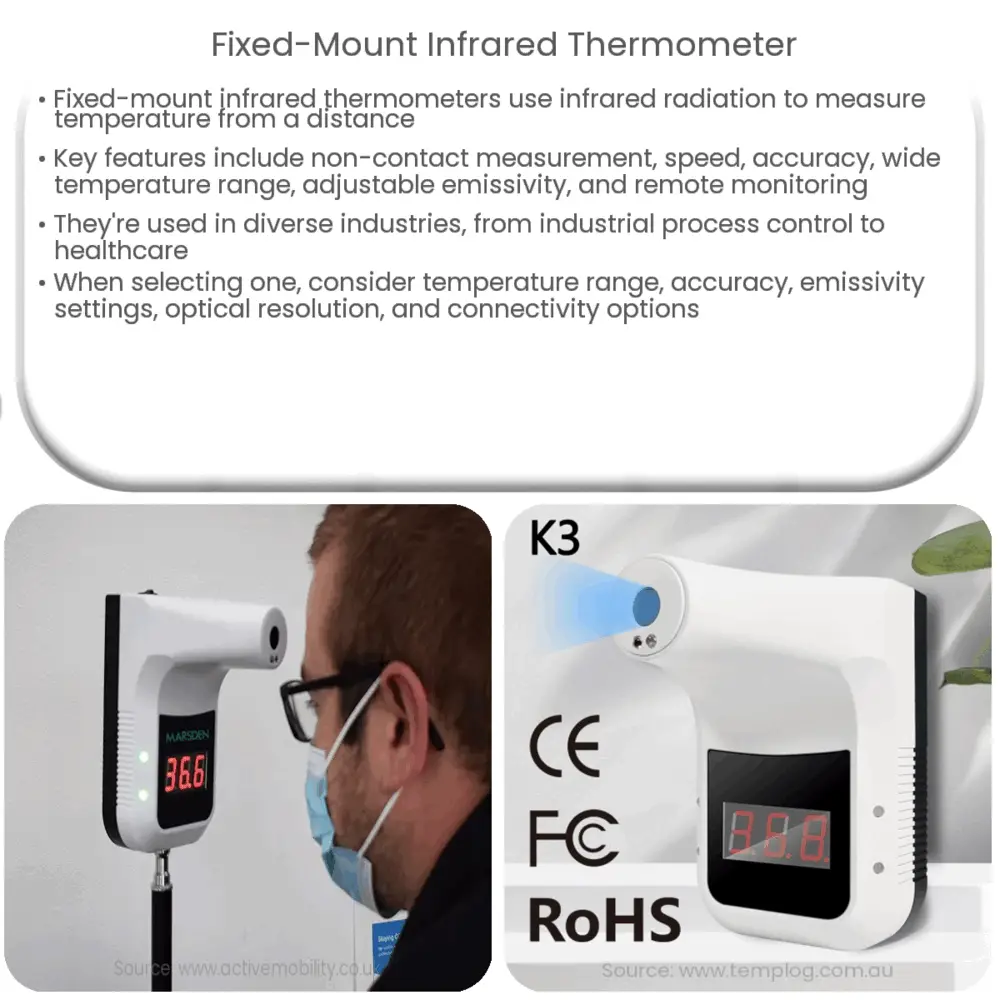
Fixed-Mount Infrared Thermometers: An Overview
Introduction
Fixed-mount infrared thermometers, also known as non-contact or IR thermometers, have become a popular choice for a wide range of applications due to their ability to measure temperature accurately from a distance without physical contact. This article will discuss the basic principles, key features, and various applications of fixed-mount infrared thermometers.
How Do Fixed-Mount Infrared Thermometers Work?
Fixed-mount infrared thermometers work on the principle of infrared radiation, which is emitted by all objects with a temperature above absolute zero (-273.15°C). These devices detect and measure this emitted radiation to determine the temperature of the object without any physical contact, making them a reliable and safe option for temperature measurement.
The primary components of a fixed-mount infrared thermometer are the lens, the infrared detector, and the processing electronics. The lens focuses the infrared radiation onto the detector, which then converts the radiation into an electrical signal. The processing electronics subsequently translate this signal into a temperature reading, which can be displayed or transmitted for further analysis.
Key Features of Fixed-Mount Infrared Thermometers
Fixed-mount infrared thermometers offer several advantages over traditional contact-based thermometers, including:
- Non-contact measurement: As the name suggests, these thermometers measure temperature without making physical contact with the object. This feature reduces the risk of contamination and damage to both the thermometer and the object being measured.
- Speed and accuracy: Fixed-mount infrared thermometers provide fast and accurate temperature readings, with some devices capable of measuring temperature within milliseconds. This quick response time is particularly useful for monitoring dynamic processes and maintaining quality control.
- Wide temperature range: These devices can measure a broad range of temperatures, from cryogenic levels to extremely high temperatures found in industrial settings. The versatility makes them suitable for various applications across industries.
- Adjustable emissivity: Fixed-mount infrared thermometers often come with adjustable emissivity settings, allowing users to account for the unique emissivity values of different materials and obtain accurate temperature readings.
- Remote monitoring: Many fixed-mount infrared thermometers feature remote monitoring capabilities, enabling users to access temperature data and make adjustments from a safe distance. This is particularly useful for monitoring hazardous environments or hard-to-reach locations.
Applications of Fixed-Mount Infrared Thermometers
Due to their versatility and accuracy, fixed-mount infrared thermometers are widely used in various industries and applications, including:
- Industrial process control: These devices are commonly used to monitor and control processes in industries such as steel, glass, and petrochemical production, ensuring optimal performance and quality.
- Food and beverage industry: Fixed-mount infrared thermometers help maintain proper cooking, cooling, and storage temperatures, ensuring food safety and quality throughout the production process.
- Electronics manufacturing: These thermometers aid in monitoring temperature-sensitive components during the production and testing of electronic devices, preventing overheating and ensuring proper functioning.
- Healthcare and medical: Infrared thermometers are used for fever screening, monitoring patient body temperature, and assessing the temperature of medical equipment and supplies.
- Automotive industry: These devices help monitor and control temperatures during various automotive manufacturing processes, such as engine testing, paint curing, and heat treatment of metals.
- Research and development: Fixed-mount infrared thermometers are used in various research settings, including materials science, thermal analysis, and chemical reactions, to gain insights into temperature-dependent phenomena.
Choosing the Right Fixed-Mount Infrared Thermometer
When selecting a fixed-mount infrared thermometer, consider the following factors to ensure optimal performance and suitability for your specific application:
- Temperature range: Choose a device with a temperature range that covers the expected temperatures of the objects or processes you will be monitoring.
- Accuracy and resolution: Consider the required level of accuracy and resolution for your application. Higher accuracy and resolution may be necessary for critical processes and quality control.
- Emissivity settings: Ensure the thermometer has adjustable emissivity settings to account for the unique emissivity values of different materials you will be measuring.
- Optical resolution: The optical resolution, expressed as the distance-to-spot ratio (D:S), determines how large an area the thermometer can measure at a specific distance. Select a device with an appropriate D:S ratio for your application.
- Connectivity and output options: Consider the output options (e.g., analog, digital, or both) and connectivity (e.g., USB, Ethernet, or wireless) for seamless integration with your existing systems and remote monitoring capabilities.
Conclusion
Fixed-mount infrared thermometers offer a non-contact, accurate, and versatile solution for temperature measurement across various industries and applications. By understanding the principles, key features, and applications of these devices, you can make an informed decision when choosing the right fixed-mount infrared thermometer for your needs.



