
Explore the world of Field-Programmable Gate Arrays (FPGAs): their architecture, benefits, applications, and future potential in high-performance computing.
Introduction to Field-Programmable Gate Arrays (FPGAs)
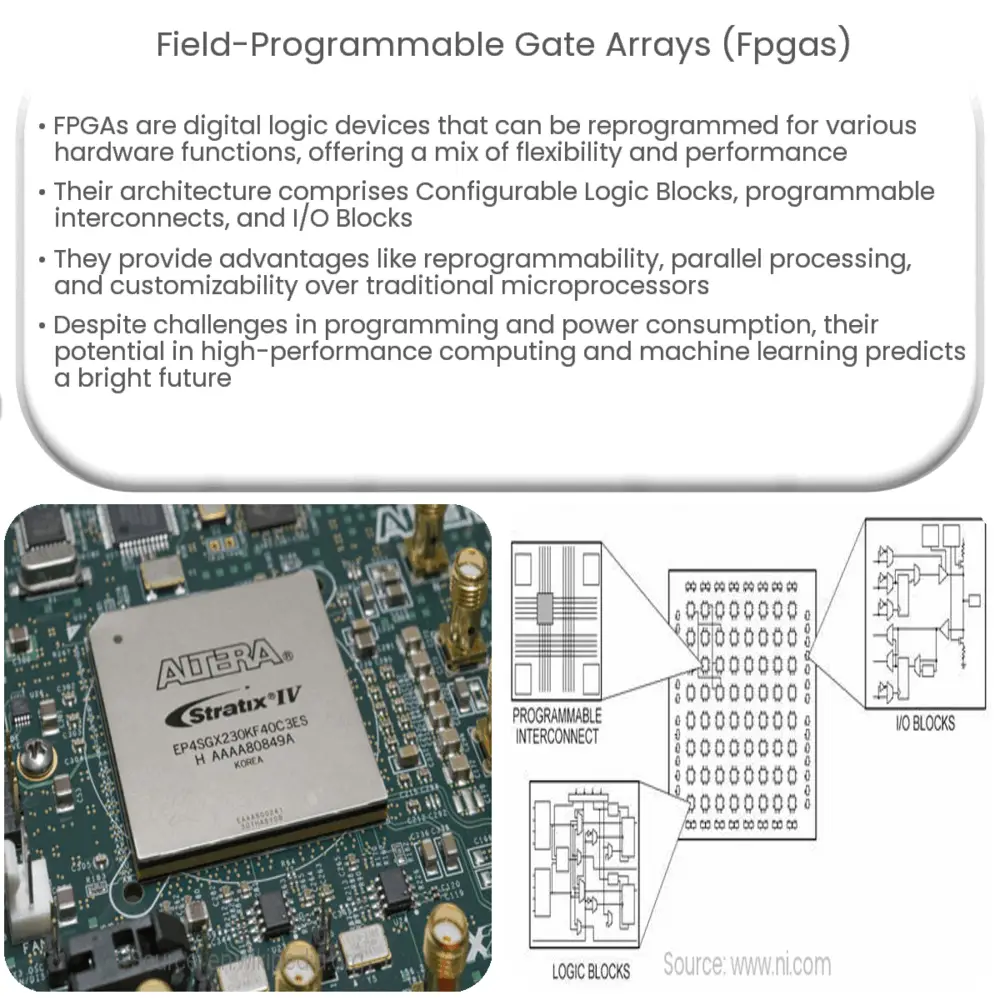
FPGAs, or Field-Programmable Gate Arrays, are a type of digital logic device that can be reprogrammed to implement different hardware functions. They are based on a matrix of configurable logic blocks (CLBs) connected via programmable interconnects, providing a unique blend of flexibility and performance.
Architecture and Functioning
The core functionality of an FPGA is derived from its intricate architecture. The programmable logic blocks, sometimes referred to as Configurable Logic Blocks (CLBs), form the primary building units. These blocks can perform complex combinational functions, or simple logic gates such as AND, OR, and NOT.
- Configurable Logic Blocks (CLBs): These are composed of basic elements known as Look-Up Tables (LUTs), and Flip-Flops. The LUT generates a desired logical output for specific inputs, while flip-flops provide sequential logic.
- Programmable Interconnects: This network of wiring allows the CLBs to be interconnected in many different configurations, thus enabling the design of complex digital circuits.
- I/O Blocks: These handle the communication between the FPGA and the outside world, allowing inputs to be received and outputs to be sent.
Benefits of FPGA
FPGAs offer several advantages over traditional microprocessors and application-specific integrated circuits (ASICs). Here are some notable benefits:
- Reprogrammability: Unlike ASICs, which are hardwired for specific tasks, FPGAs can be reprogrammed to perform a wide range of tasks, even after they have been deployed.
- Parallel Processing: FPGAs are inherently parallel, as each independent task is assigned to a dedicated section of the chip. This allows them to execute multiple operations simultaneously, providing a speed advantage over sequential processors.
- Customizability: With FPGAs, developers can create custom hardware functionality tailored to specific needs, leading to optimized performance and efficiency.
Indeed, FPGA technology has opened up vast possibilities in various industries, including telecommunications, digital signal processing, and hardware acceleration. Despite this, the complexity of programming these devices has traditionally been a stumbling block. The development of high-level synthesis tools is helping to alleviate this issue, bringing FPGAs closer to mainstream use.
Applications of FPGA
FPGAs have found usage in a variety of applications due to their flexible nature and high performance. Here are a few noteworthy areas:
- Digital Signal Processing: FPGAs excel in tasks requiring real-time, high-speed manipulation of digital signals, hence they are frequently used in applications such as radio, audio and video processing.
- Cryptocurrency Mining: Given their high parallelism and energy efficiency, FPGAs are often used in cryptocurrency mining, as they can perform hashing functions at high speeds.
- Software-Defined Radio: With their ability to process signals in real-time, FPGAs are used extensively in software-defined radios.
- Hardware Acceleration: FPGAs are used to accelerate performance in data centers by handling specific functions like data processing and transferring workload from CPUs.
FPGA Programming and Development
Although FPGAs have immense potential, programming them can be quite complex. Traditionally, they have been programmed using hardware description languages (HDLs) like VHDL and Verilog. However, high-level synthesis (HLS) tools have been developed to convert high-level programming languages like C, C++, and Python into HDLs, making FPGA programming more accessible.
Challenges and Future Direction
Despite their advantages, FPGAs also have some limitations. Designing and debugging FPGA circuits can be time-consuming. Power consumption, especially for high-performance FPGAs, can also be significant. However, advancements are continually being made in FPGA design methodologies and technologies to address these challenges.
In the future, the demand for FPGAs is likely to increase due to the growing need for high-performance computing and the rise of applications like machine learning, where FPGAs can provide significant advantages. The FPGA technology is also moving towards more heterogeneous architectures, integrating processors, and FPGA fabric on the same chip to offer more versatile and powerful solutions.
Conclusion
Field-Programmable Gate Arrays (FPGAs) represent a unique fusion of flexibility and performance. They offer reprogrammability, parallel processing, and customizability, making them suitable for a diverse range of applications from digital signal processing to hardware acceleration. Although they pose some challenges, ongoing advancements promise to expand their reach further. With their capacity for high-speed processing and versatility, FPGAs are poised to play a pivotal role in the future of technology and computing.



