
Explore the world of fiber optic connectors, their types, components, importance, and future trends in data transmission technology.
Introduction to Fiber Optic Connectors
Fiber optic connectors play a crucial role in modern-day telecommunications and data communications. They serve as the necessary interface, enabling the seamless transfer of light signals over vast distances.
Defining Fiber Optic Connectors
Fiber optic connectors are specialized devices designed to allow the connection and disconnection of fiber optic cables. They work by accurately aligning the microscopic glass fibers within the cables, enabling effective light signal transmission. This process, when done correctly, results in minimal loss of signal quality or data.
Types of Fiber Optic Connectors
- SC Connector: Developed by NTT, SC (Standard Connector) is a widely used connector type, often found in single-mode systems.
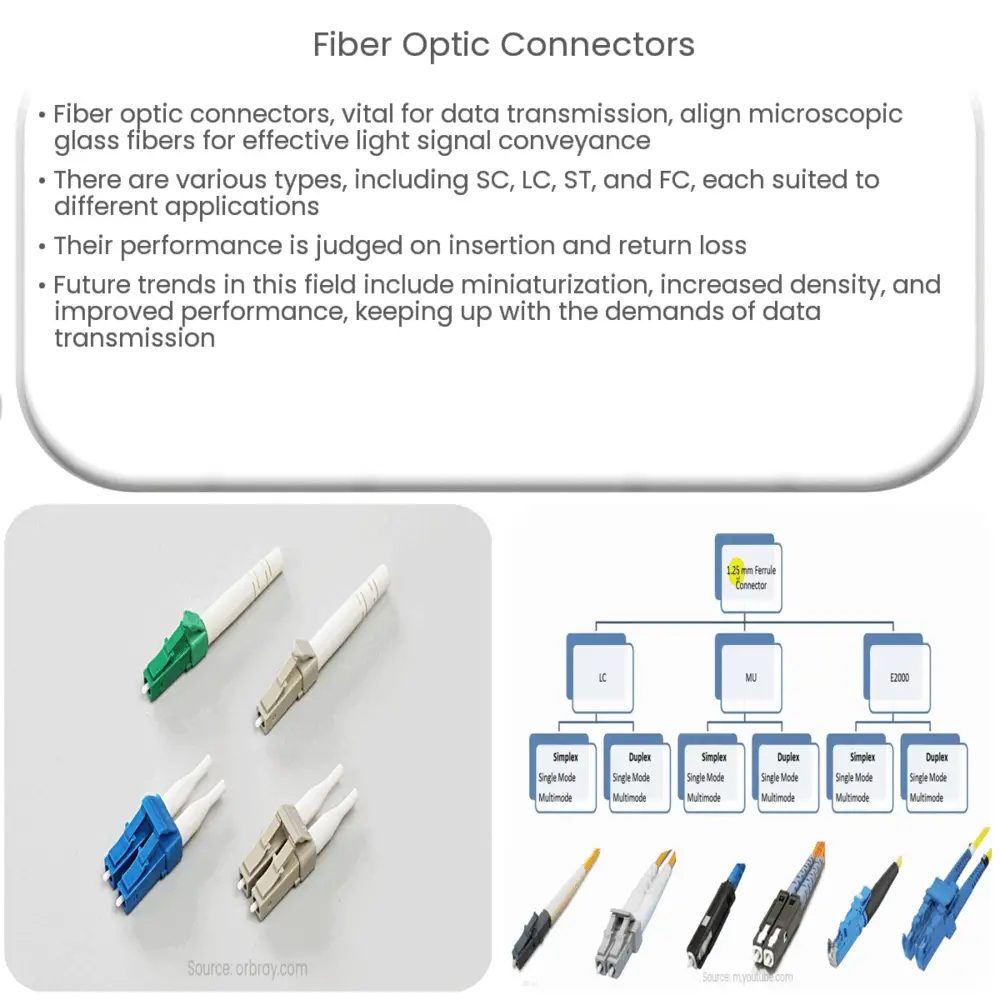
- LC Connector: The Lucent Connector, or LC, is a small form-factor connector using a 1.25 mm ferrule, half the size of the SC, and is a common choice for dense installations.
- ST Connector: The ST (Straight Tip) connector has a long cylindrical ferrule to hold the fiber, and is more commonly used in multimode fiber applications.
- FC Connector: FC (Ferrule Connector) is a round, screw-type connector, frequently used in datacom, telecommunications, and also in measurement equipment.
Key Components of a Fiber Optic Connector
- Ferrule: This is the crucial element that holds the fiber in place and aligns it for effective signal transmission.
- Connector Body: It is the structure that holds the ferrule and is usually made from plastic or metal.
- Cable: This is the physical medium through which the light signals are transmitted. It comprises one or more fibers, each capable of transmitting multiple streams of data.
Importance of Fiber Optic Connectors
With the growing reliance on high-speed, high-capacity networks, fiber optic connectors’ role becomes even more critical. They facilitate quick, efficient, and reliable transmission of data, satisfying the demands of various industries such as telecommunications, healthcare, military, and others. Fiber optic connectors also enable network scalability and flexibility, allowing for easy upgrades and expansions as data transmission needs evolve.
Performance Factors of Fiber Optic Connectors
The performance of fiber optic connectors is primarily evaluated based on insertion loss and return loss. Insertion loss refers to the reduction of signal power resulting from the insertion of a device in a line, while return loss measures the light reflection back to the source. A high-quality connector is designed to minimize both insertion and return loss.
Installation and Maintenance of Fiber Optic Connectors
Correct installation and maintenance of fiber optic connectors are pivotal in ensuring their long-term performance. This includes proper cleaning to remove dust and other contaminants that can interfere with the signal transmission. The connectors must also be inspected regularly to ensure optimal performance and timely detection of any potential issues.
The Future of Fiber Optic Connectors
As data transmission requirements continue to rise, fiber optic technology, including connectors, is expected to evolve to meet these demands. Trends such as miniaturization, increased density, and improved performance are likely to drive the future development of fiber optic connectors.
- Miniaturization: With the increasing need for compact and efficient technology, the miniaturization of fiber optic connectors is a significant trend.
- Increase in Density: As data centers become more complex, there is a growing need for connectors that can support higher data densities.
- Improved Performance: The need for connectors with lower loss and higher speed capabilities is expected to grow.
Conclusion
In conclusion, fiber optic connectors are an integral part of the fiber optic communication system. They play a vital role in transmitting data efficiently over long distances, making them essential in various sectors such as telecommunications, data centers, military, and healthcare. With constant advancements in fiber optic technology, the evolution of these connectors continues, pushing boundaries in terms of miniaturization, density, and overall performance.