
Explore the role of ESD Safe Document Holders in protecting sensitive electronic environments from ElectroStatic Discharge.
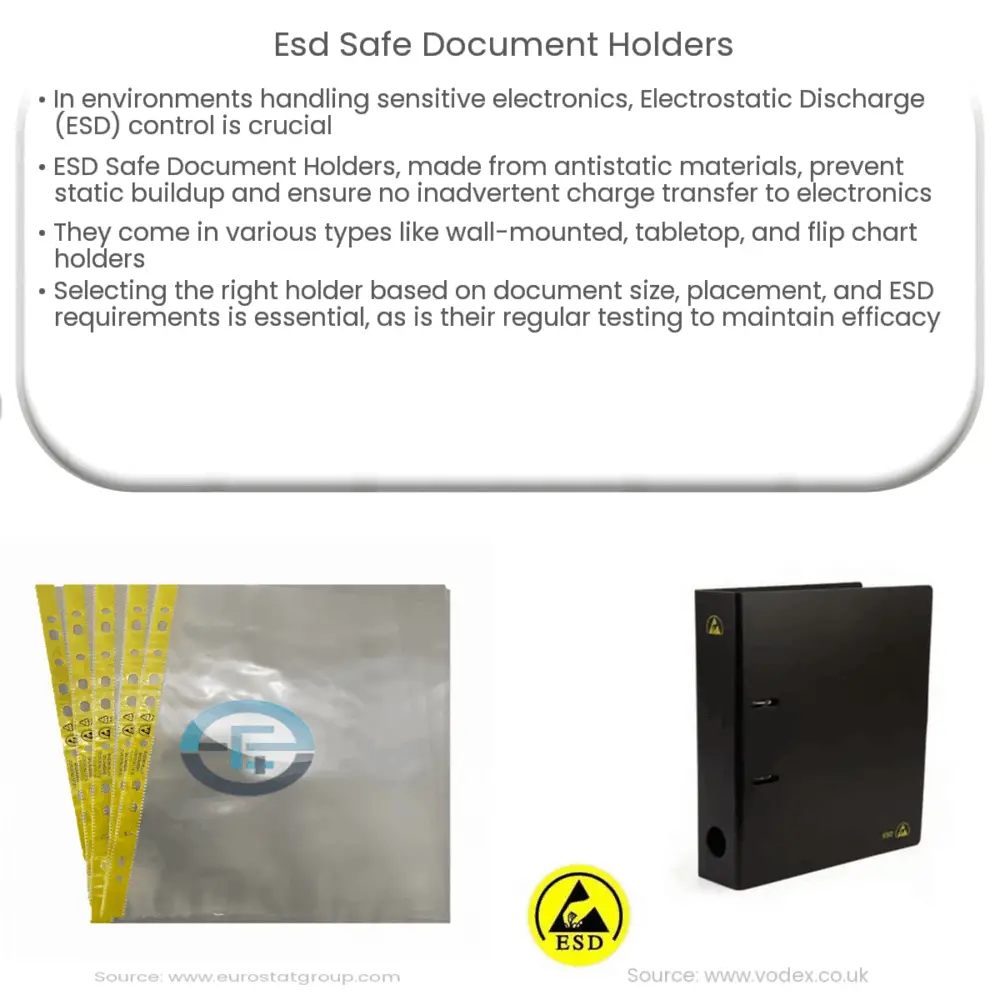
Understanding ESD Safe Document Holders
When working in an environment that deals with sensitive electronic devices, maintaining Electrostatic Discharge (ESD) control becomes crucial. This article will explore one such integral tool in maintaining this control – ESD Safe Document Holders.
ESD, or ElectroStatic Discharge, refers to the sudden flow of electricity between two electrically charged objects. It is caused by contact, electrical short, or dielectric breakdown. This unexpected charge can cause significant damage to sensitive electronic devices.
Why are ESD Safe Document Holders Necessary?
In an electronics manufacturing environment, it’s not only the electronic components that need protection. Any tool or accessory that could potentially carry a charge and cause an ESD event should be controlled. This includes items as simple as document holders, which are often overlooked in the context of ESD safety.
- These document holders can potentially carry an electrical charge which could then be transferred to sensitive electronic devices, causing irreversible damage.
- They are used to store important documents, assembly instructions, or schematic diagrams that are essential for the manufacturing or testing processes in these environments. If these holders carry an electrostatic charge, they could potentially damage the documents they are supposed to protect.
Features of ESD Safe Document Holders
ESD Safe Document Holders are specifically designed to prevent the buildup of static electricity. They are commonly made from antistatic materials which dissipate the electrical charge, ensuring that the holder itself is not a source of ESD.
- Anti-static materials: The most critical feature of an ESD safe document holder is that they are made from materials that prevent the buildup of static electricity. Such materials are known as ‘antistatic’.
- Static Dissipative: Besides being antistatic, these document holders are also static dissipative. This means they have the ability to disperse the electric charge over their surface, reducing the risk of ESD.
Types of ESD Safe Document Holders
ESD safe document holders come in a variety of forms to meet the needs of different environments. Here are a few common types:
- Wall-mounted holders: These are often used for holding documents such as process guides or workflow charts that need to be frequently referenced.
- Tabletop holders: These are designed to sit on a workstation or desk for easy access to documents.
- Flip chart holders: These are used for documents that need to be visible to several people at the same time, such as assembly instructions or training materials.
Choosing the Right ESD Safe Document Holder
When choosing an ESD safe document holder, consider factors such as the size of the documents, where the holder will be placed, and the specific ESD requirements of your workplace. It is important to remember that not all document holders are ESD safe, so be sure to check the product specifications before making a purchase.
Importance of Regular Testing
Regular testing of ESD safe document holders is essential to ensure their effectiveness. This can be done using an ESD meter, which measures the amount of static electricity present on an object. If the holder is not dissipating the charge as expected, it may need to be replaced.
Conclusion
In conclusion, ESD safe document holders play an important role in minimizing the risk of ElectroStatic Discharge in environments dealing with sensitive electronic devices. By utilizing materials that prevent static buildup and disperse charges, these holders safeguard both electronic components and essential documentation from potential ESD damage. As such, investing in ESD safe document holders and regularly testing them should be an integral part of an effective ESD control program.