
Capacitor
A capacitor is a device that can store electric charge and normally consists of two conducting objects (usually plates or sheets) placed near each other but not touching. Basically, capacitors consist of two metal plates separated by an insulator. The insulator is called a dielectric. (e.g., polystyrene, oil, or air). Capacitors are one of the most used and useful electronic components used in any modern electronic and electrical circuit and devices.
Energy stored in Capacitor
Capacitors can be used to store electrical energy. Many of the most important applications of capacitors depend on their ability to store energy. The electric potential energy stored in a charged capacitor is just equal to the amount of work required to charge it—that is, to separate opposite charges and place them on different conductors. When the capacitor is discharged, this stored energy is recovered as work done by electrical forces.
It can be derived that if, at the end of the charging process, the charge on the top plate is +Q, then the total amount of work done in this process is:
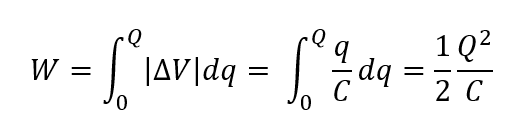
This is also equal to the total work done by the electric field on the charge when the capacitor discharges.