
Explore the world of Electrostatic Bearing Systems – their operating principles, benefits, applications, challenges, and future prospects.
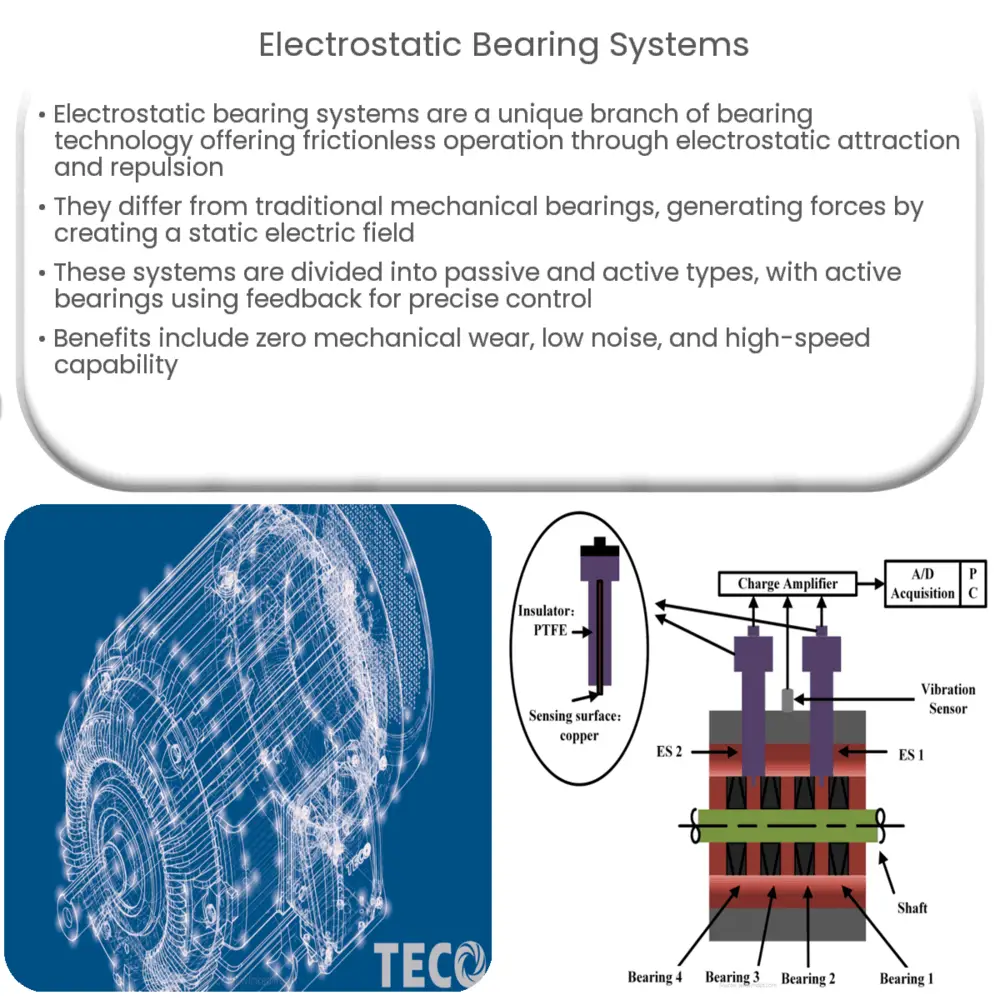
Introduction to Electrostatic Bearing Systems
Electrostatic bearing systems, a relatively unknown branch of bearing technology, offer a unique set of benefits due to their contactless nature. They utilize the principle of electrostatic attraction or repulsion to suspend rotating machinery, allowing for frictionless operation.
Operating Principles of Electrostatic Bearing Systems
Unlike traditional mechanical bearings, electrostatic bearings work on the principle of electrostatics. These bearings generate forces of attraction or repulsion between two elements by creating a static electric field.
- Electrostatic Attraction: When a voltage is applied across two conductors, an attractive force is generated between them due to the uneven distribution of charge.
- Electrostatic Repulsion: On the other hand, when like charges are introduced on the conductive bodies, a repulsive force is created, keeping the bodies apart.
The balance between these attractive and repulsive forces allows the rotor to be suspended within the stator, providing a frictionless operation.
Types of Electrostatic Bearings
Electrostatic bearing systems can be primarily categorized into two types:
- Passive Electrostatic Bearings: These bearings rely solely on the basic electrostatic principles and don’t require an external control system to operate. They are simpler but less stable compared to their active counterparts.
- Active Electrostatic Bearings: These bearings, on the other hand, utilize a feedback control system to monitor and adjust the applied voltage, ensuring precise control and stability.
Benefits of Electrostatic Bearing Systems
Electrostatic bearing systems provide several key advantages, including:
- Zero Mechanical Wear: As there is no physical contact between the rotor and the stator, mechanical wear and tear is virtually eliminated, leading to extended system lifespan.
- Low Noise Operation: Without contact, there is no friction, and as such, no noise generated from the operation of the bearing.
- High Speed Capability: The lack of friction also allows the rotor to achieve much higher rotational speeds compared to mechanical bearing systems.
In the following sections, we’ll delve into the applications of electrostatic bearings, their challenges, and the future prospects in this field.
Applications of Electrostatic Bearings
Electrostatic bearing systems find their applications in a variety of fields that require high-speed operation and precision.
- Spacecraft Reaction Wheels: These devices use electrostatic bearings to achieve precise attitude control in spacecraft.
- Micro-Electro-Mechanical Systems (MEMS): The miniaturization capabilities of electrostatic bearings make them suitable for MEMS applications, such as accelerometers and gyroscopes.
- High-Speed Spindles: In the manufacturing industry, electrostatic bearings are used in high-speed spindles for their high rotational speed capabilities and extended lifespan.
Challenges and Future Prospects
Despite the numerous benefits, electrostatic bearing systems have a few limitations that need to be addressed. One of the primary challenges is the high voltage requirement, making them unsuitable for certain applications. In addition, these systems require sophisticated control mechanisms, adding to their complexity.
However, advancements in power electronics and control systems are expected to address these issues. Researchers are also exploring low voltage electrostatic bearings, which can further broaden their application range.
Conclusion
In summary, electrostatic bearing systems offer a promising alternative to conventional mechanical bearings, with their ability to provide frictionless operation, long lifespan, low noise, and high-speed capabilities. While they currently face some limitations, ongoing advancements in technology are likely to overcome these challenges, making electrostatic bearings a promising solution for future applications. They hold a significant potential for shaping the future of various industries, including aerospace, manufacturing, and MEMS technology. It’s an exciting field that undoubtedly warrants further exploration and investment.



