
Explore the principles of electrostatic attraction devices, their applications from air purifiers to nanotechnology, and future potential.
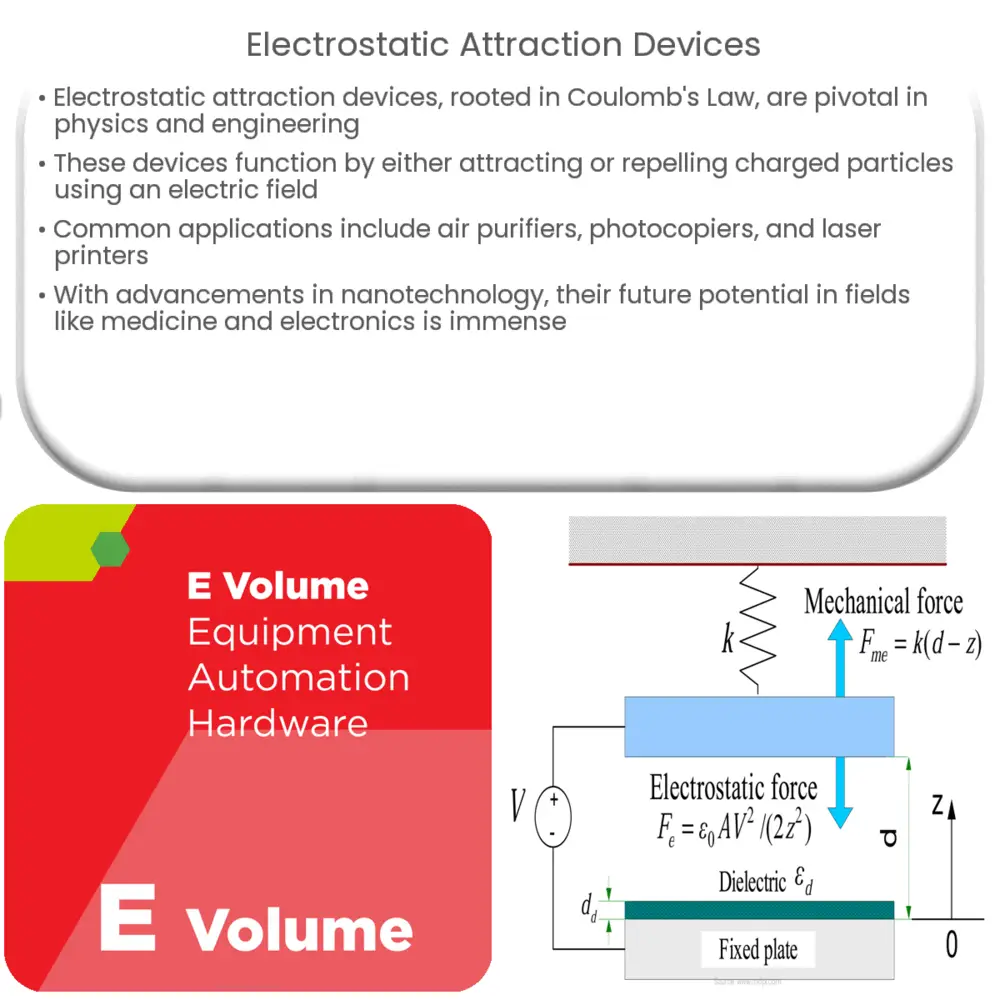
Understanding Electrostatic Attraction Devices
Electrostatic attraction devices are a fascinating area of physics and engineering, used in a variety of applications ranging from industrial to scientific research. To fully comprehend their workings and uses, it’s essential to delve into the principles of electrostatic attraction.
The concept of electrostatic attraction is rooted in the understanding of electrical charges. According to Coulomb’s Law, opposite charges attract, while like charges repel. This principle forms the foundation of all electrostatic attraction devices.
Working Principle of Electrostatic Attraction Devices
An electrostatic attraction device operates on the basis of charge attraction or repulsion. These devices create an electric field by applying a voltage to electrodes. The intensity of this electric field determines the force experienced by a charged object within the field. When another object with an opposite charge is brought close to the field, the two objects attract each other. Conversely, if the object carries a similar charge, it will be repelled.
- Charge Creation: The first step in the operation of an electrostatic device is the creation of an electrical charge. This process, also known as ionization, can be achieved in several ways such as by heat, radiation, or using a sharp pointed needle (corona discharge).
- Charge Attraction or Repulsion: After charge generation, the charged particles are either attracted towards or repelled away from the electrodes. The direction of the force depends on the type of charge on the particle and the electrode.
- Neutralization: Once the particles reach the electrode, they can neutralize their charge, which can be a part of the intended operation in certain applications, like in air purifiers.
Applications of Electrostatic Attraction Devices
Due to their unique ability to control and manipulate charged particles, electrostatic attraction devices are employed in a wide variety of applications.
- Electrostatic Precipitators: One of the most common applications of electrostatic attraction is in electrostatic precipitators used for air purification. These devices utilize the principle of electrostatic attraction to remove particulate matter from air or gas streams.
- Photocopiers and Laser Printers: Electrostatic attraction plays a crucial role in the operation of photocopiers and laser printers. In these devices, an electrostatic image of the original page is created on a charged drum, and then toner particles are attracted to this image.
These applications and principles only scratch the surface of the broad and complex field of electrostatic attraction devices. The next section will dive deeper into the mechanics and implications of these devices in various fields.
Further Applications and Future Outlook
Electrostatic attraction is not just limited to air purification and printing technologies. It has found widespread applications in other areas as well.
- Manufacturing and Material Processing: Electrostatic attraction is also utilized in powder coating processes, where the item to be coated is given a charge, and the coating material is given an opposite charge. The electrostatic attraction ensures an even coating on the surface. This process is used extensively in the automotive and appliance industries.
- Scientific Research: In the realm of scientific research, electrostatic forces are used in particle accelerators to propel charged particles at high velocities. This technology is crucial in numerous areas of physics, including nuclear and particle physics.
In addition to these existing applications, the future of electrostatic attraction devices seems promising. With the ongoing advancements in nanotechnology, it is expected that electrostatic forces could play an even greater role in manipulating and assembling nanoscale structures, opening up a new realm of possibilities in fields such as medicine, electronics, and materials science.
Conclusion
Electrostatic attraction devices leverage the fundamental principle of charged particles being drawn to or repelled from each other. Their applications span across diverse fields, from air purification and laser printers to scientific research and nanotechnology. The continued study and development of these devices hold immense potential, promising a significant impact in our daily lives and scientific progress.
The future of these devices is intertwined with advancements in related fields, including materials science, nanotechnology, and electrical engineering. As our understanding and ability to manipulate electrostatic forces expand, the possibilities for new and improved electrostatic attraction devices are virtually limitless.
Whether we realize it or not, these devices are an integral part of our technological landscape, and their continued evolution will undoubtedly lead to more efficient, precise, and innovative applications.



