
Dual-laser infrared thermometers offer non-contact, accurate temperature measurements across various industries, including automotive, HVAC, and food safety.
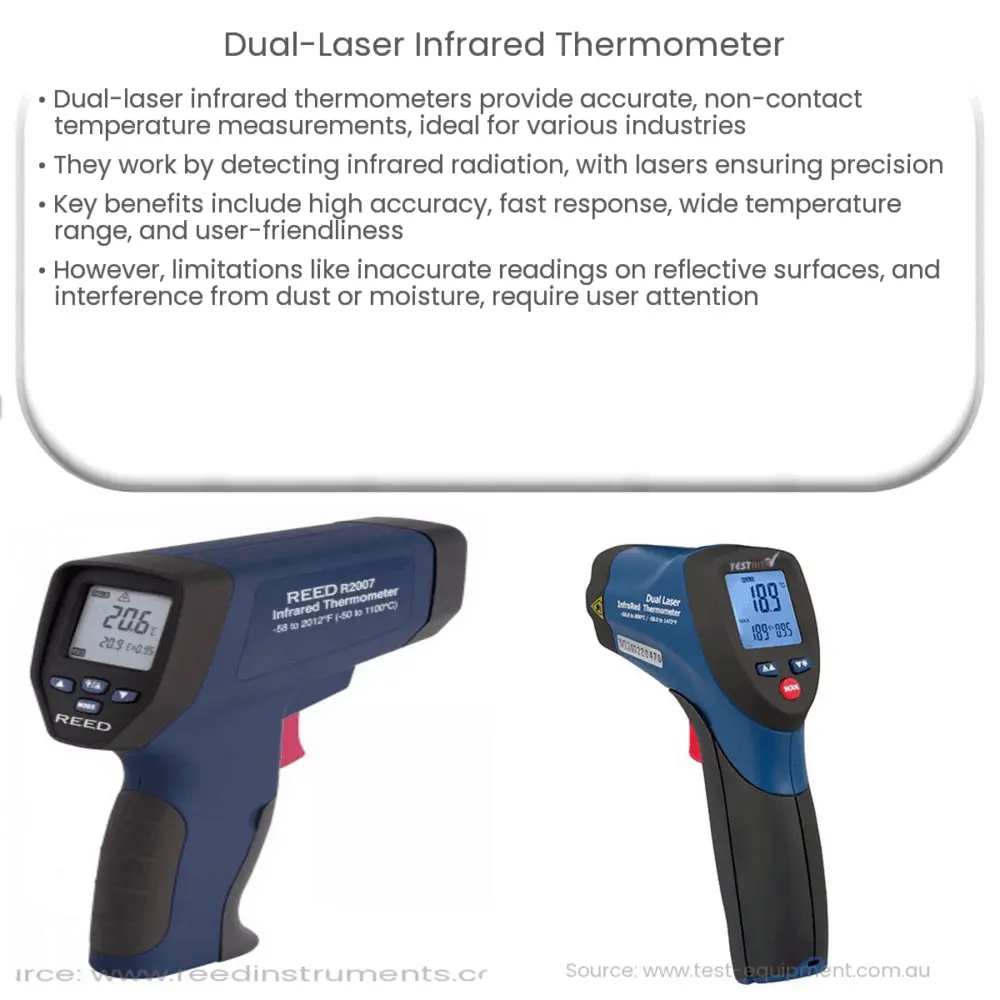
Dual-Laser Infrared Thermometers: A Comprehensive Overview
Introduction
Infrared thermometers have revolutionized the way temperature measurements are taken across various industries. Dual-laser infrared thermometers, in particular, have emerged as a popular choice for many applications due to their increased accuracy and ease of use. This article aims to provide an in-depth understanding of these devices, highlighting their benefits, uses, and how they work.
What are Dual-Laser Infrared Thermometers?
Dual-laser infrared thermometers, also known as non-contact thermometers, are devices that measure temperature by detecting the infrared radiation emitted by an object. They consist of two laser pointers that help to precisely target the measurement area and ensure accurate readings. By not requiring physical contact, these thermometers minimize the risk of contamination and damage to sensitive surfaces, making them ideal for various applications.
How do Dual-Laser Infrared Thermometers Work?
The underlying principle behind dual-laser infrared thermometers is the detection of infrared radiation. All objects emit infrared radiation as a function of their temperature. The device’s infrared sensor captures this radiation and converts it into an electrical signal, which is then processed by the thermometer’s internal electronics to calculate the temperature.
Two lasers are used to define the measurement area, ensuring a high level of accuracy. The distance-to-spot ratio (D:S) is a critical factor in the performance of an infrared thermometer. It refers to the ratio of the distance between the thermometer and the target to the diameter of the measured spot. A higher D:S ratio results in a smaller measurement area and increased accuracy.
Key Features and Benefits of Dual-Laser Infrared Thermometers
Some of the key features and benefits of dual-laser infrared thermometers include:
- Non-contact temperature measurement: The ability to measure temperature without touching the object being measured helps prevent cross-contamination and damage to sensitive surfaces.
- High accuracy: Dual-laser targeting allows for precise temperature readings by clearly defining the measurement area and reducing the influence of environmental factors.
- Fast response times: These devices provide instant temperature readings, making them suitable for quickly assessing temperature changes in various applications.
- Wide temperature range: Dual-laser infrared thermometers can measure a broad range of temperatures, making them versatile tools for multiple industries.
- User-friendly interface: Many models feature easy-to-read displays, adjustable emissivity settings, and data storage capabilities for improved usability and data analysis.
Applications of Dual-Laser Infrared Thermometers
Due to their versatility and accuracy, dual-laser infrared thermometers have found applications in a variety of industries, such as:
- Automotive: Technicians use these devices to diagnose issues related to engine performance, cooling systems, and brakes by measuring temperatures at specific points without damaging components.
- HVAC/R: Heating, ventilation, air conditioning, and refrigeration professionals use dual-laser thermometers to identify temperature anomalies, check system performance, and locate leaks.
- Electronics: Engineers and technicians rely on these devices to identify hotspots and potential failures in electronic circuits and components, helping to improve reliability and prevent damage.
- Food industry: Food safety professionals use infrared thermometers to quickly measure temperatures of food items, ensuring that they are stored, cooked, and served at the proper temperatures.
- Medical: Infrared thermometers have become essential tools for measuring human body temperature in situations where contact thermometers are not practical or carry the risk of cross-contamination.
Limitations of Dual-Laser Infrared Thermometers
While dual-laser infrared thermometers offer many advantages, they also have some limitations:
- Emissivity: The accuracy of infrared thermometers depends on the emissivity of the object being measured. Highly reflective surfaces, like polished metals, can produce inaccurate readings. Many devices allow users to adjust the emissivity settings to account for different materials.
- Environmental factors: Dust, smoke, and moisture can interfere with the infrared radiation reaching the sensor, leading to less accurate readings. It is essential to consider these factors when using the device in certain environments.
- Angle of measurement: The angle between the thermometer and the surface being measured can affect the accuracy of the readings. Ideally, the thermometer should be perpendicular to the surface for the most accurate results.
Conclusion
Dual-laser infrared thermometers have become an indispensable tool in various industries due to their accuracy, ease of use, and non-contact nature. They offer numerous advantages, such as fast response times, a wide temperature range, and user-friendly interfaces. However, users must be aware of the limitations and ensure that they account for factors like emissivity, environmental conditions, and angle of measurement. By understanding how these devices work and their potential applications, professionals can make informed decisions and leverage the benefits of dual-laser infrared thermometers for accurate and efficient temperature measurements.