
Explore the advancements in power electronics with the Distributed Buffer Gate-Turn-Off Thyristor (DB-GTO), its structure, benefits, and applications.
Introduction to Distributed Buffer Thyristor (DB-GTO)
The distributed buffer gate-turn-off thyristor (DB-GTO) is a remarkable advancement in power electronics technology. This device, similar to the conventional Gate Turn-Off (GTO) thyristor, can be turned on and off through its gate terminal. However, the DB-GTO possesses certain unique characteristics that make it stand out.
Working Principle of DB-GTO
The operation of a DB-GTO is akin to a conventional GTO, with the primary difference being the distributed buffer layer. This layer minimizes the limitations of the conventional GTO by reducing the turn-off time and improving the device’s overall performance.
- Turn-on Process: During the turn-on process, a positive current is applied to the gate terminal. This results in the formation of a conduction path between the anode and the cathode, allowing current to flow through the device.
- Turn-off Process: To turn off the device, a negative current pulse is applied to the gate. This removes the conduction path and halts the current flow.
Structure of DB-GTO
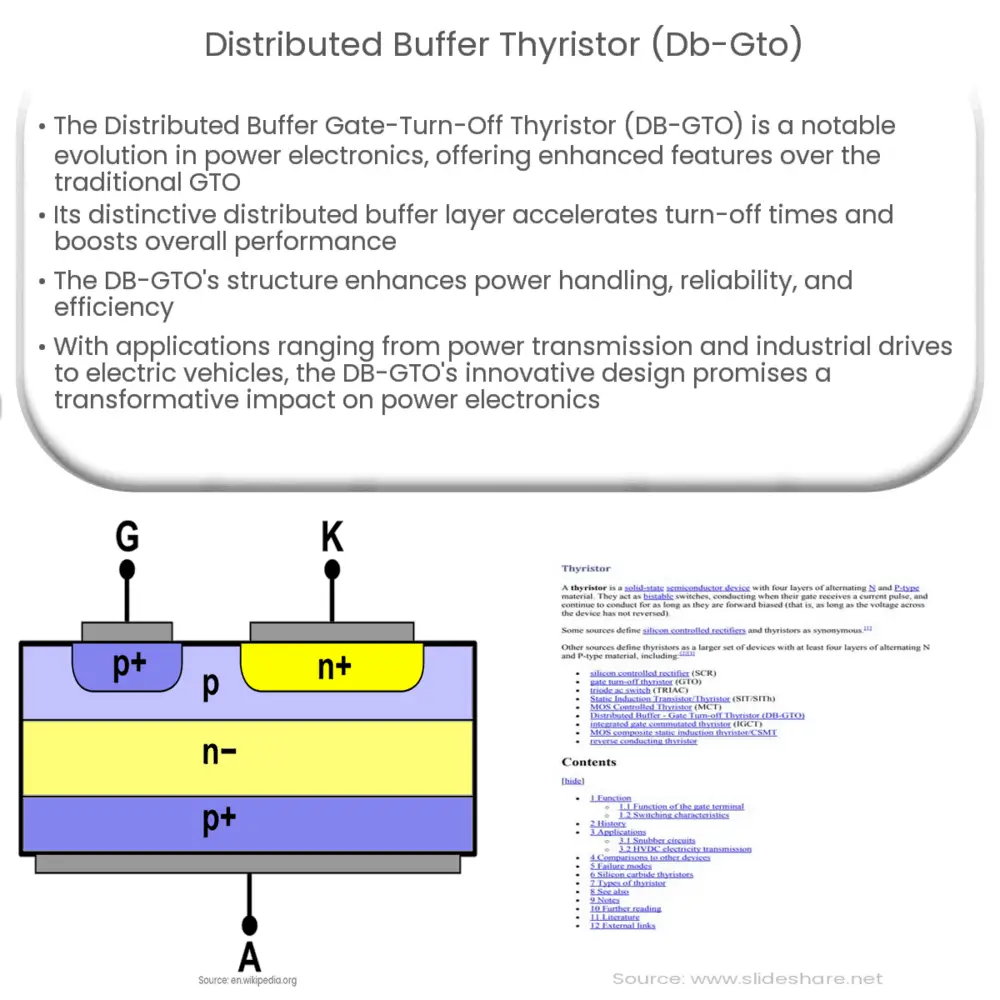
The DB-GTO’s structure is designed to optimize its performance and reduce the limitations of the conventional GTO. It is characterized by an additional buffer layer distributed within the device, hence the name.
- Anode: The anode is the positive terminal of the DB-GTO. It is typically made of a highly doped P+ type material.
- Cathode: The cathode, the negative terminal, is made of an N+ type material.
- Gate: The gate, also composed of a P-type material, controls the operation of the DB-GTO. The application of a positive or negative current to the gate terminal enables the turn-on and turn-off process, respectively.
- Distributed Buffer Layer: This is the unique feature of a DB-GTO. It is an N-type layer, distributed within the thyristor, acting as a buffer during the turn-off process. This layer helps distribute the electric field uniformly across the device, reducing the turn-off time and thereby improving the overall performance.
Advantages of DB-GTO
DB-GTOs offer several significant advantages over traditional GTOs, making them a highly preferred choice in power electronics applications.
- Reduced Turn-Off Time: The distributed buffer layer reduces the turn-off time considerably, which enhances the device’s frequency capabilities and improves overall efficiency.
- Increased Power Handling Capability: The DB-GTO, due to its design, can handle higher power levels than a conventional GTO. This makes it suitable for high-power applications.
- Improved Reliability: DB-GTOs are more reliable, thanks to their improved turn-off characteristics and increased power handling capacity. They also have a lower risk of device failure.
Applications of DB-GTO
The unique characteristics of the DB-GTO make it highly suitable for a wide range of applications. Here are a few notable ones:
- Electric Power Transmission: The high-power handling capability and improved reliability of DB-GTOs make them ideal for use in power transmission systems.
- Industrial Motor Drives: DB-GTOs are commonly used in the control of industrial motor drives due to their fast switching speed and high power handling capability.
- Electric Vehicles: With the rise in electric vehicle technology, DB-GTOs are increasingly being used in the power electronic systems of these vehicles for superior performance.
Conclusion
In summary, the Distributed Buffer Gate-Turn-Off Thyristor (DB-GTO) represents a significant advancement in power electronics technology. With its unique structure, including the distributed buffer layer, and superior performance characteristics, it offers numerous advantages over conventional GTOs. The DB-GTO’s reduced turn-off time, enhanced power handling capability, and improved reliability make it a highly preferred choice for a wide range of high-power applications, from industrial motor drives to electric vehicles. As technology continues to advance, we can expect to see even more innovative uses for this powerful device in the future.



