
Explore Dispersive Signal Touchscreen technology: its working mechanism, unique features, applications, limitations, and future prospects.
Understanding Dispersive Signal Touchscreen Technology
At the heart of the digital revolution lies a simple action: touch. It’s the primary way we interact with devices, thanks to touchscreen technology. Of the numerous types of touchscreens available today, the Dispersive Signal Touchscreen (DST) technology stands out for its unique capabilities and advantages.
The Science Behind Dispersive Signal Touchscreen
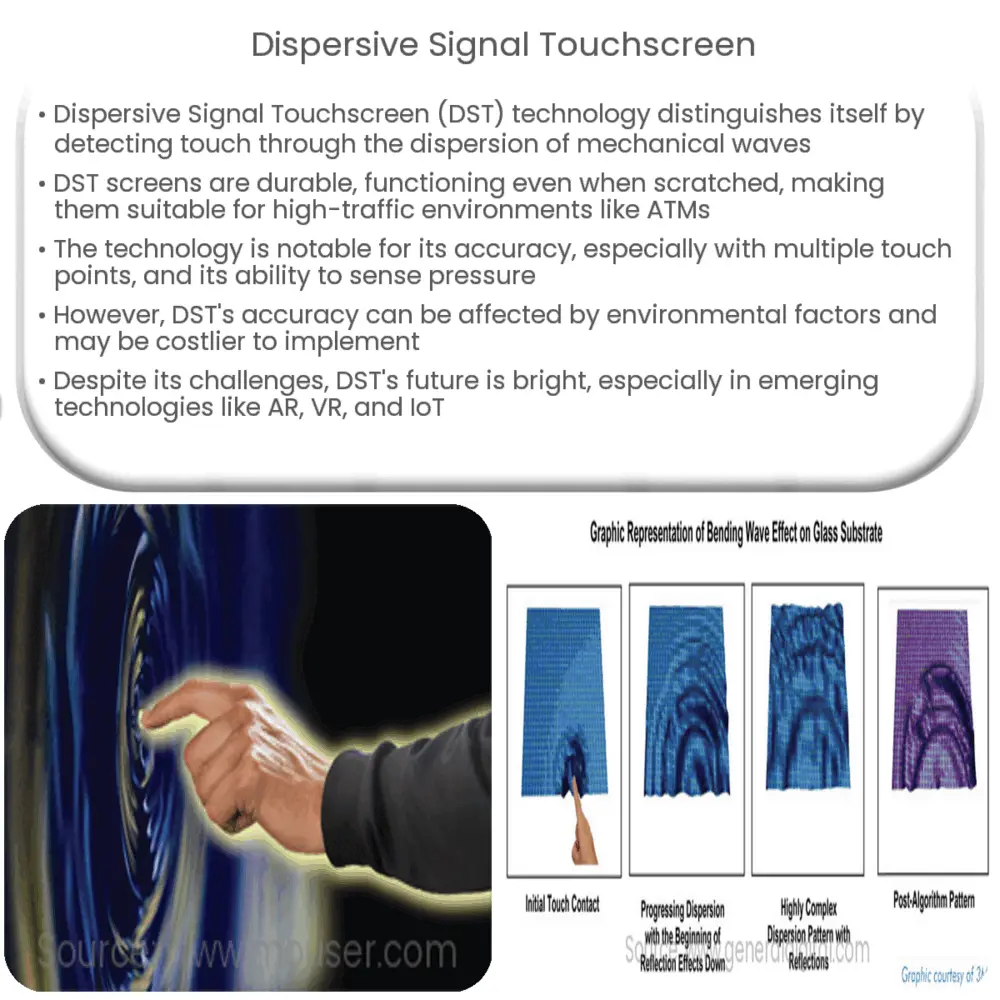
Dispersive Signal Touchscreen technology, as its name implies, involves the dispersion of signals. When a touch is applied to the screen, mechanical waves are generated. These waves propagate across the screen and are detected by sensors located at the corners. The sensors then convert these waves into electrical signals.
Working Mechanism of DST
- Touch Detection: The DST system detects a touch by identifying the changes in vibrational patterns. This technology is based on the principle of wave propagation in solids, specifically the phenomenon of wave dispersion.
- Signal Processing: The sensors convert the mechanical waves into electrical signals which are then fed into a processing unit. The processor interprets these signals, identifying the unique frequency components associated with each type of touch.
- Position Calculation: The processor determines the point of touch by calculating the time delay between the arrival of the wave at different sensors. This process, known as triangulation, allows the system to accurately locate the touch point.
Distinct Features of Dispersive Signal Touchscreen
Dispersive Signal Touchscreen technology offers several distinct features that set it apart from other touchscreen technologies. First, it’s incredibly durable. Since it uses vibrations rather than electrical conductivity or optical recognition, the screen can still function even when scratched or under heavy use. This makes DST technology ideal for public kiosks, ATMs, and other high-traffic environments.
Second, it’s highly accurate. The use of wave dispersion allows for precise touch location determination, even when multiple touch points are present. This can lead to more intuitive and responsive user interfaces.
Lastly, it is capable of detecting pressure. This is a significant advantage over capacitive or resistive touchscreens, which can only register the presence of a touch, not the degree of pressure applied.
Applications of Dispersive Signal Touchscreen
DST technology finds its application in a variety of industries. It’s widely used in public information displays, interactive digital signage, gaming consoles, and industrial control systems. Its ability to withstand heavy use while maintaining high levels of accuracy and responsiveness makes it a preferred choice for these and other demanding applications.
Limitations and Future Prospects
Despite its numerous advantages, Dispersive Signal Touchscreen technology does have some limitations. For instance, the accuracy of DST can be influenced by environmental factors like temperature and humidity, as these can affect the propagation of mechanical waves. Furthermore, the technology can be more costly to implement than other touchscreen technologies due to the complexity of the signal processing involved.
Nevertheless, the future of DST technology looks promising. As the demand for more robust, precise, and versatile touchscreen interfaces continues to grow, the potential for advancements in DST technology is immense. Researchers are working on mitigating its limitations and exploring new applications, which could revolutionize the way we interact with digital devices.
Dispersive Signal Touchscreen in the Context of Emerging Technologies
Dispersive Signal Touchscreen technology has the potential to integrate seamlessly with emerging technologies. In the realm of augmented reality (AR) and virtual reality (VR), for instance, DST could enhance the user experience by providing highly accurate and responsive touch interfaces. Similarly, in the field of Internet of Things (IoT), DST could be employed to create more durable and reliable interfaces for smart devices.
Conclusion
In conclusion, Dispersive Signal Touchscreen technology marks a significant leap forward in the evolution of touchscreen interfaces. Its unique approach to detecting touch via the dispersion of mechanical waves offers several advantages over traditional technologies, including high durability, superior accuracy, and pressure sensitivity. Despite some limitations, the potential for DST is considerable, particularly in its application within emerging technologies. As the digital world continues to expand and evolve, the role of DST technology in shaping our interaction with digital devices is set to become increasingly significant.



