
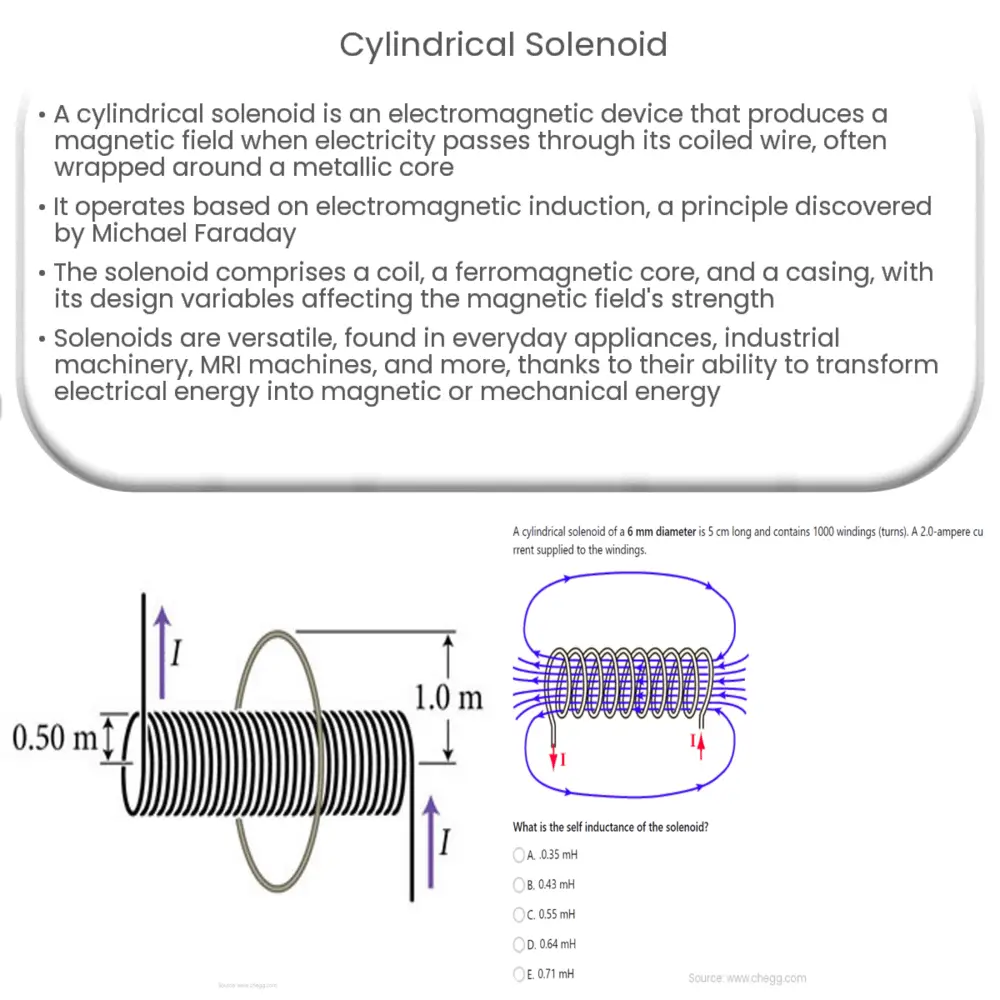
A cylindrical solenoid is a coiled wire that creates a magnetic field when electric current passes through it.
Introduction to Cylindrical Solenoids
A cylindrical solenoid is a type of electromagnetic device that is widely used in a plethora of applications ranging from everyday appliances to complex industrial machinery. Essentially, a solenoid is a long, thin loop of wire, often wrapped around a metallic core, which produces a magnetic field when an electric current is passed through it. The term “cylindrical” comes from its shape, as the wire is usually coiled in a cylindrical configuration.
The fundamental principle behind the operation of a solenoid is electromagnetic induction, a phenomenon discovered by Michael Faraday in the 19th century. When a current is applied to the solenoid, it creates a magnetic field inside the coil. This field can then be used to exert a force on nearby magnetic objects or generate electrical currents in other nearby conductors.
Construction and Design of a Cylindrical Solenoid
A cylindrical solenoid is composed of three main parts: the coil, the core, and the casing. The coil, typically made from a conductive wire such as copper or aluminum, is wound around the core, forming the shape of a cylinder. This coiling increases the density of the magnetic field that the solenoid can produce.
The core is generally made from a ferromagnetic material like iron, nickel, or cobalt. These materials are selected due to their high magnetic permeability, which allows them to concentrate and strengthen the magnetic field produced by the coil. In some solenoids, the core is movable, allowing the device to act as an actuator that can convert the electrical energy into mechanical movement.
The casing of a solenoid is typically made from a non-magnetic material like plastic or aluminum. Its primary function is to provide structural support to the coil and core, and to isolate the magnetic field within the solenoid.
The number of turns in the coil, the material and dimensions of the core, the current applied, and other factors all contribute to the strength and characteristics of the magnetic field produced by a cylindrical solenoid. The design of a solenoid can be tailored to meet the requirements of a specific application, making it an incredibly versatile component in electrical and electromechanical systems.
Working Principle of a Cylindrical Solenoid
The functioning of a cylindrical solenoid revolves around the fundamental concept of electromagnetism. When an electrical current is passed through the coil, it generates a magnetic field due to the movement of electrons. This magnetic field aligns the atomic dipoles of the ferromagnetic core, causing it to become magnetized.
The strength of the magnetic field is proportional to the current through the wire and the number of turns in the coil, and its direction depends on the direction of the current. This relationship is described by Ampère’s law. The magnetic field inside a long solenoid is uniform and directed along the axis of the solenoid, making it resemble a bar magnet.
If the core is movable, the magnetic field will exert a force on it, causing it to move. This motion can be harnessed to perform mechanical work, such as opening or closing a valve, triggering a switch, or moving a mechanical arm.
Applications of Cylindrical Solenoids
The versatility and simplicity of cylindrical solenoids make them invaluable in a wide range of applications. In electronics, they are used as inductors to store energy, filter signals, and transform electrical energy to mechanical energy. They are a critical component in electrically controlled valves and switches, including those found in appliances, automobiles, and industrial equipment.
In scientific research, solenoids are used to create controlled magnetic fields for experiments and measurements. Large solenoids are employed in magnetic resonance imaging (MRI) machines to generate the strong magnetic fields needed for imaging the human body.
In the automotive industry, solenoids are used in starter motors to crank the engine, while in manufacturing, they play a crucial role in automated assembly lines and robotics.
In conclusion, the cylindrical solenoid is an integral component in many areas of modern life. Its ability to efficiently convert electrical energy to a magnetic field, and in some cases to mechanical energy, coupled with its simple design and adaptability, makes it a cornerstone of electromechanical systems. The science behind solenoids continues to be a fascinating area of research, and future advancements promise to further expand their range of applications.



