
Explore the fundamentals of Current Source Inverters (CSI), their types, applications, and pros & cons in power systems and industrial applications.
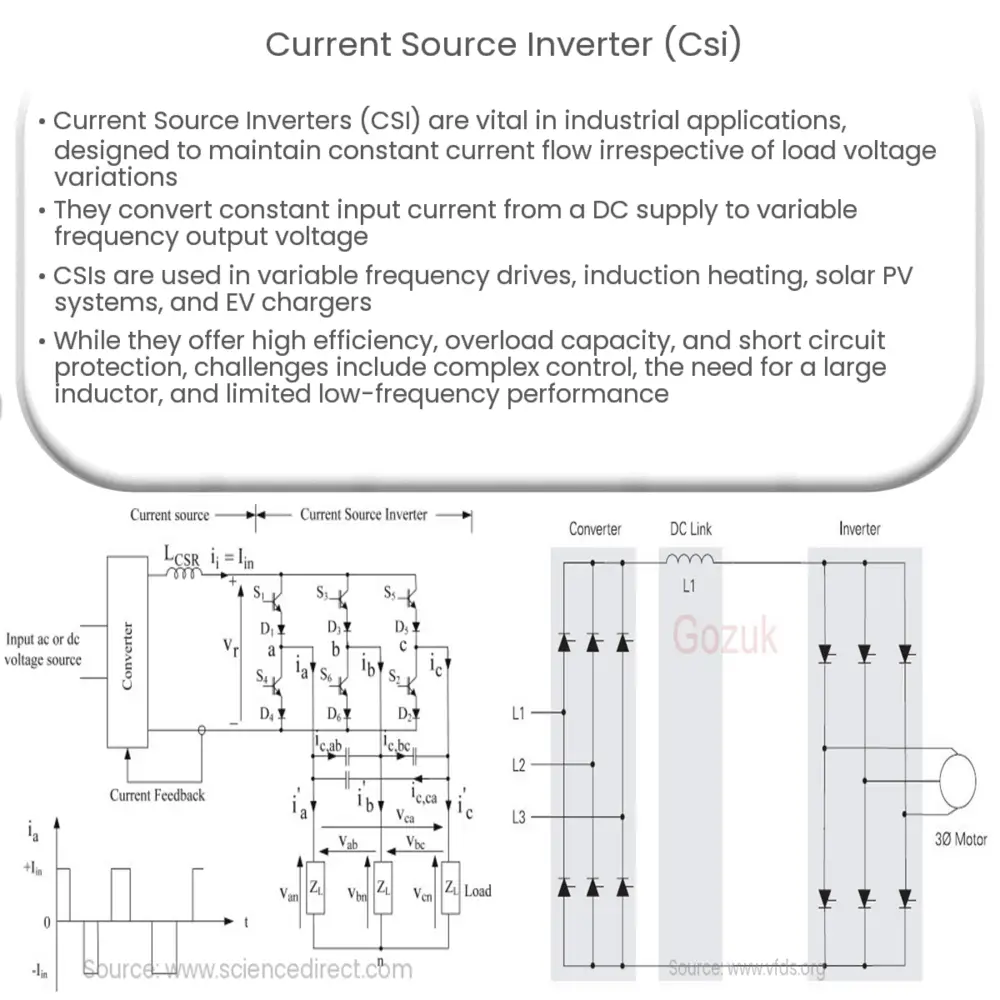
Introduction to Current Source Inverter (CSI)
A Current Source Inverter (CSI) is a type of inverter that is commonly used in industrial applications and power systems. This specific type of inverter is designed with the ability to maintain a constant current flow, regardless of the voltage variations in the load. As such, it serves as a critical component in various power conversion systems.
Principle of Operation
At its core, the CSI operates by converting a constant input current into a variable frequency output voltage. The input current is typically sourced from a DC supply, which is then inverted into an AC current by switching the transistors or other power electronic devices in the inverter circuit.
Structure and Components
- The primary components of a CSI include a DC source, inverter switches, an inductor, and a load.
- The DC source supplies the constant input current to the system.
- The inverter switches are responsible for inverting the DC current into AC current.
- The inductor serves as the current source, maintaining the current flow during the switching process.
- The load is typically an AC motor, but it can also be any electrical device that requires a variable frequency power supply.
Types of Current Source Inverters
There are two primary types of Current Source Inverters:
- Single-phase CSI: This type is often used in small-scale applications and is designed to handle a single phase of AC current.
- Three-phase CSI: More commonly used in industrial applications, this type is designed to handle three phases of AC current. It provides a more stable and efficient power supply, making it suitable for high-power applications.
Applications of CSI
Current Source Inverters are found in various applications, including:
- Variable frequency drives (VFDs)
- Induction heating
- Renewable energy systems like solar photovoltaic (PV) systems
- Electric vehicle (EV) chargers
- Power factor correction in power systems
Advantages and Disadvantages
Like any other technology, CSIs have their advantages and disadvantages. Some of the benefits include their ability to handle overloads and short circuits, their high efficiency, and their ability to maintain a constant current. However, they also have their drawbacks, including their complexity and the need for a large inductor.
Detailed Advantages and Disadvantages
Let’s delve deeper into the pros and cons of Current Source Inverters:
Advantages
- Overload Capacity: One of the key advantages of a CSI is its ability to handle overload conditions. It can provide a high overload capacity without the risk of damage, as the current is always maintained at a constant level.
- Short Circuit Protection: In addition to handling overloads, CSIs also have a high tolerance for short circuits. This is because the current source inverter can limit the current that flows through the circuit, preventing potential damage from a short circuit.
- High Efficiency: CSIs typically have a high efficiency, especially when operating at full load. This is because the current remains constant, and the losses in the power electronic switches are minimized.
Disadvantages
- Complex Control: The control of a CSI can be quite complex, especially compared to a Voltage Source Inverter (VSI). This is because the current waveform needs to be controlled, which requires more sophisticated control algorithms.
- Large Inductor Required: The inductor used in a CSI needs to be large enough to maintain the current at a constant level. This can lead to a larger and heavier inverter, which may not be desirable in some applications.
- Limited Performance at Low Frequencies: A CSI may not perform as well at low frequencies. This is because the inverter’s output voltage decreases as the frequency decreases, which can affect the performance of the load.
Conclusion
In conclusion, Current Source Inverters (CSI) are crucial components in many modern power systems and industrial applications. They offer significant advantages, including high efficiency, overload capacity, and short circuit protection. However, they also have their limitations, such as complex control, large inductor requirement, and limited performance at low frequencies. Despite these drawbacks, the benefits of CSIs often outweigh the disadvantages, making them a preferred choice in applications such as variable frequency drives, induction heating, renewable energy systems, and electric vehicle chargers.
Understanding the characteristics and functionalities of CSIs is essential for engineers and professionals working in the power electronics industry. As technology continues to evolve, it is expected that improvements in the design and control of CSIs will mitigate their current drawbacks and further enhance their efficiency and reliability.



